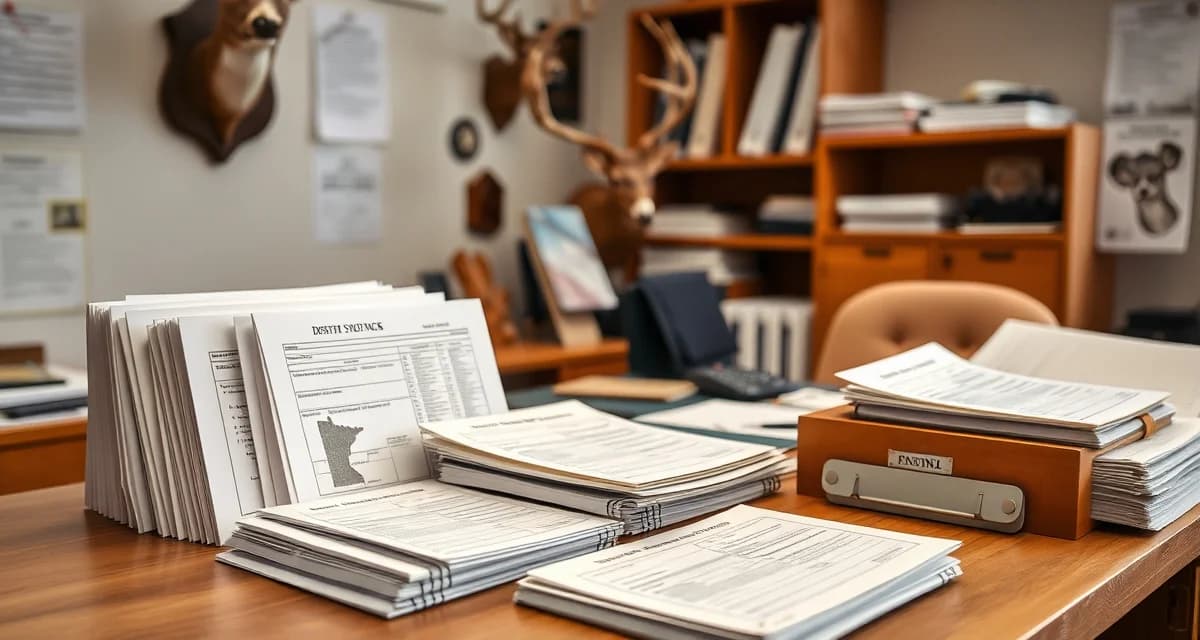
What Records Must Minnesota Taxidermists Keep for Deer?
The short answer: Minnesota commercial taxidermists must maintain a possession log documenting each deer received, including customer name and address, hunting license number, deer license number/tag, harvest zone, sex, and date received. Records must be retained for at least three years and produced for inspection by a DNR conservation officer on request.
TL;DR
- Minnesota DNR requires taxidermists to maintain records for all wildlife received, including customer name, license number, and harvest details.
- Minnesota has documented CWD and harvest county documentation is required for deer.
- Minnesota taxidermist licenses must be current and are issued by the DNR.
- Records must be available for DNR inspection and retained for the required minimum period.
- Minnesota deer seasons span archery, firearms, and muzzleloader with substantial out-of-state hunter participation.
Minnesota Commercial Taxidermist Licensing
Minnesota commercial taxidermists are licensed through the Minnesota Department of Natural Resources (DNR) under Minnesota Statutes Chapter 97A.
License requirement: A Taxidermy License from the Minnesota DNR is required for any person who performs taxidermy commercially, accepting compensation for mounting wildlife specimens belonging to others.
Renewal: Annual.
Application through: Minnesota DNR License Center.
Minnesota Deer Licensing and Tag System
Minnesota uses a deer license system where hunters purchase specific licenses for different deer types and zones.
Minnesota deer license types:
- Regular deer license (antlered or either sex depending on zone)
- Antlerless deer license (doe permits, allocated by zone based on herd management goals)
- Muzzleloader season licenses
- Various specialty season licenses
At intake for Minnesota deer, require:
- Customer full name and mailing address
- Minnesota hunting license number
- Deer license number (the specific license used for this harvest, tag number)
- Zone of harvest (Minnesota manages deer by zone, and this affects season dates and antler restrictions)
- County of harvest
- Date of harvest
- Sex of the animal
- Weapon type (if relevant to the license type)
Minnesota's zone system is important context, different zones have different season dates and antler-point restrictions. Document the zone along with the county.
Minnesota CWD Status
Minnesota has documented CWD in the southeastern portion of the state (primarily the metro-area CWD management zone and surrounding counties) and has expanded surveillance statewide.
For deer from Minnesota CWD management zones:
- Document county and zone of harvest
- Note CWD status
- Confirm compliance with Minnesota's carcass transport rules out of CWD zones
- Check the Minnesota DNR's current CWD zone boundaries before each season, the affected area has expanded significantly in recent years
Minnesota's CWD transport rules restrict certain carcass parts from CWD zones. Taxidermists within CWD zones may receive specimens for processing, but transport restrictions affect what can move out of the zone.
Minnesota Chronic Wasting Disease and Taxidermist-Specific Rules
Minnesota has specific guidance for taxidermists regarding CWD. The Minnesota DNR has issued guidance that taxidermists processing deer from CWD-positive zones must maintain documentation that allows tracing the specimen back to a specific harvest location.
This means your documentation of county and zone for Minnesota deer isn't just general good practice, it's specifically referenced in CWD-related DNR guidance for taxidermists.
Record Retention in Minnesota
Minnesota's minimum record retention for commercial taxidermist records: three years. Best practice: five years.
Maintain records accessible for conservation officer inspection.
Minnesota's Deer Season Context
Minnesota's deer season brings substantial volume to taxidermy shops throughout the state. The gun season concentrated in November creates intake rushes similar to Iowa, Wisconsin, and other Midwest states. Northern Minnesota shops see significant early season archery volume; metro-area shops see heavy gun season business.
For Minnesota shops processing 200+ mounts per year, digital intake and tracking is essentially required to maintain the documentation standards expected for CWD zone accountability.
Related Articles
- What Records Must North Carolina Taxidermists Keep for Deer?
- What Records Must Ohio Taxidermists Keep for Deer?
- What Records Must Pennsylvania Taxidermists Keep for Deer?
- What Records Must Taxidermists Keep for Deer?
FAQ
Minnesota has lot of tribal lands with different hunting rules. How do I document deer harvested under tribal licenses?
Tribal hunting on ceded territories operates under different regulations than state licensing. Documentation for tribal hunts may include a tribal license or ceded territory permit rather than a standard state license. The documentation principle is the same, record who harvested the deer, when, where, and under what authority. If you're unsure about a specific tribal permit's documentation, contact the Minnesota DNR or the relevant tribal natural resources office for guidance.
What about deer harvested in the special early season for license holders in specific wildlife management units?
Minnesota's complex season structure means customers may present a variety of license types at intake. The principle is the same regardless of season: photograph and record the license and the specific deer license/tag that the hunter used for this harvest. If a license type you're unfamiliar with, ask the customer to explain the license type and note it in the job record.
Are electronic records accepted by Minnesota DNR for inspection purposes?
Yes. Minnesota DNR does not require physical paper records, digital records that contain all required information are acceptable. Records accessed via a tablet or computer during an inspection are generally fine. The key is that the records are complete, accurate, and accessible.
What CWD documentation does Minnesota DNR require for deer intake records?
Minnesota requires recording the county of harvest for all deer due to CWD monitoring. Certain southeast Minnesota counties are in documented CWD zones with additional transport restrictions. The Minnesota DNR updates its CWD surveillance area maps before each season, so check current zone information when setting up your intake process.
Do Minnesota taxidermists need to document tribal-land harvests differently?
Deer harvested under tribal treaty rights on ceded territory may have different licensing documentation than state-licensed harvests. If you accept deer from tribal-land harvests, verify the applicable tribal wildlife agency's documentation requirements and retain whatever documentation the hunter provides. Contact the Minnesota DNR for specific guidance.
How do I handle a Minnesota deer intake when the hunter is from Wisconsin or Iowa?
The Minnesota hunting license or tribal permit number is what you need for your Minnesota records, not the hunter's home state license. Collect the Minnesota license number, harvest county, and harvest date.
Try These Free Tools
Put these insights into practice with our free calculators and planners:
Sources
- Minnesota Department of Natural Resources
- National Taxidermists Association (NTA)
- Chronic Wasting Disease Alliance
- US Fish & Wildlife Service
Get Started with MountChief
Minnesota deer season brings high volume and CWD documentation requirements that every taxidermist must handle correctly. MountChief captures all required fields at intake, flags CWD-zone specimens automatically, and keeps records organized for DNR inspection. Try MountChief before deer season to make compliance straightforward.