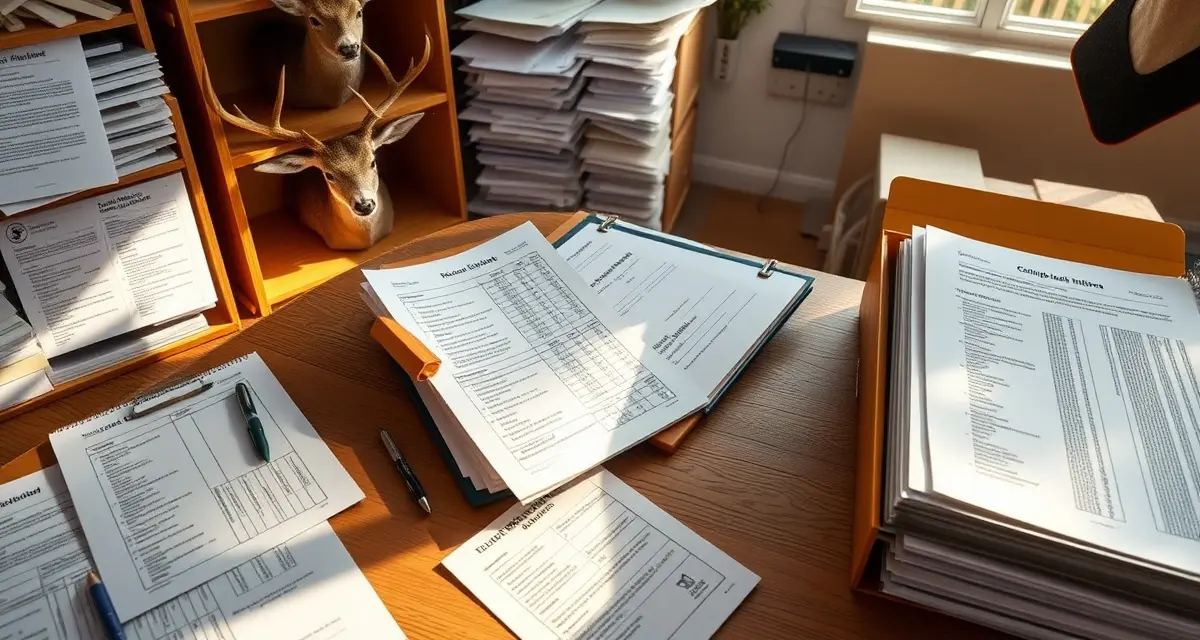
What Records Must Taxidermists Keep for Deer?
State requirements vary, but there's a common baseline that applies almost everywhere. If you're a licensed taxidermist accepting deer mounts, you need to know what to collect at intake and how long to keep it.
Most states require taxidermists to keep deer records for a minimum of two to five years. The specific fields required overlap significantly across states, even if the retention periods differ.
TL;DR
- Every state requires some form of intake record for deer taxidermy, though required fields vary by state.
- At minimum, records must include customer name, license number, harvest date, and species.
- CWD surveillance requirements in 30+ states now make harvest county documentation standard practice nationwide.
- Federal wildlife law applies to deer moved across state lines, adding documentation obligations beyond state requirements.
- Keep records for at least five years regardless of your state's minimum requirement.
- Digital records that are organized and searchable make compliance inspections far less stressful.
Standard Deer Record Requirements
The records most states require for deer specimens include:
- Hunter name and address: the full legal name and mailing address of the person who harvested the animal
- Harvest date: the specific date the deer was taken
- Harvest location: at minimum the state, usually the county, and often the hunting unit or zone
- License number: the hunting license number of the person who harvested the deer
- Tag or permit number: if the deer required a separate tag (as most do), that tag number goes in the record
- Species and sex: whitetail vs. mule deer, buck vs. doe
- Date received: when you accepted the specimen into your shop
Some states also require the taxidermist's license number on each record and the signature of the hunter at intake. A few states require the customer's address to match the license address on file with the wildlife agency.
When Federal Records Are Required
Federal requirements kick in when a deer mount crosses state lines. The Lacey Act prohibits the transport of wildlife taken in violation of state law, and taxidermists who ship finished mounts to customers in other states need records that demonstrate the deer was legally taken.
Practically, this means:
- If you take in a deer from an out-of-state hunter and ship the finished mount to their home state, keep a copy of the hunting license and tag
- If you receive a raw cape or hide that was shipped from another state for mounting, get documentation of legal harvest from the customer
- Keep those records for the full retention period required by your state (or the harvest state if longer)
For interstate shipping documentation and CITES requirements for any exotic or regulated species, wildlife compliance software for taxidermy shops covers the full federal picture.
State-Specific Variations
A few states stand out for stricter requirements:
Texas requires retention of TPWD tag number, harvest county, and harvest date for a minimum of two years. Non-compliance has resulted in $5,000+ fines for TX taxidermists.
Colorado requires license number, species, sex, and harvest unit for all big game including deer and elk, with records kept a minimum of three years.
Pennsylvania and most Mid-Atlantic states align with a two-year minimum with county-level location requirements.
Your state wildlife agency's taxidermist licensing page will have the exact requirements. If you can't find them, call the license and permit division directly.
How Long Must You Keep the Records?
Two years is the most common minimum, but don't assume that's your state's requirement. States with active CWD management programs (Michigan, Wisconsin, Colorado, Iowa, and others) sometimes require longer retention to support disease tracking.
A practical approach: keep all deer records for five years minimum regardless of your state's requirement. Storage is cheap. Re-creating records you should have kept isn't possible.
Digital records are accepted for compliance purposes in nearly every state, provided they're accurate, complete, and accessible for inspection. If you're using management software, make sure the system can export records in a readable format for wildlife agency audits.
What Happens Without Proper Records?
A game warden or wildlife conservation officer can request to inspect your records during a routine compliance check. If records are missing, incomplete, or don't match physical specimens in your shop, penalties range from fines to suspension or revocation of your taxidermy license.
Most violations are discovered during state-initiated inspections rather than federal investigations. Keeping clean records at intake is the only protection.
Frequently Asked Questions
What information must be on a deer taxidermy record?
At minimum: hunter name and address, harvest date, harvest location (state and county), license number, tag or permit number, and species and sex. Most states also require the date you received the specimen and your taxidermist license number on each record. Requirements vary by state, so confirm with your state wildlife agency.
How long must a taxidermist keep deer harvest records?
Most states require a minimum of two years. States with active CWD management or stricter wildlife regulations often require three to five years. As a practical matter, keeping all deer intake records for at least five years is a safe standard that satisfies virtually every state requirement.
What happens if a taxidermist doesn't have proper deer records?
During a compliance inspection, missing or incomplete records can result in fines, citation, or in serious cases, suspension of your taxidermy license. Most violations are discovered during state wildlife agency inspections of licensed taxidermists. Federal penalties apply when the underlying harvest violated state law and the mount was transported across state lines.
What is the minimum information I must collect for a deer intake record?
Most states require at minimum the customer's name, address, hunting license number, species, harvest date, and date received. Many states also require harvest county or management unit. For deer from CWD-affected areas, harvest location documentation is typically mandatory regardless of your state's baseline requirements.
Do deer taxidermy records need to be in a specific format?
Most states allow any organized format, written or digital, as long as required information is present and records are available for inspection. There is no universal required form. The practical standard is that records must be legible, organized by job, and retrievable quickly when an officer asks for them.
How long must I keep deer taxidermy intake records?
State requirements range from one to five years, but keeping records for at least five years is the practical standard. Federal wildlife enforcement investigations related to poaching have no fixed time limit, and documentation that has expired under your state's minimum retention period may still be requested. Digital records cost nothing to store indefinitely.
Related Articles
- What Records Must Minnesota Taxidermists Keep for Deer?
- What Records Must North Carolina Taxidermists Keep for Deer?
- What Records Must Ohio Taxidermists Keep for Deer?
Try These Free Tools
Put these insights into practice with our free calculators and planners:
Sources
- US Fish & Wildlife Service, Office of Law Enforcement
- National Taxidermists Association (NTA)
- Chronic Wasting Disease Alliance
- State wildlife agencies
Get Started with MountChief
Deer intake records are the foundation of your wildlife compliance documentation, and every gap in those records is a liability. MountChief captures all required fields at intake, stores records digitally, and keeps them organized for inspection anytime. Try MountChief before deer season to make compliance part of every intake.