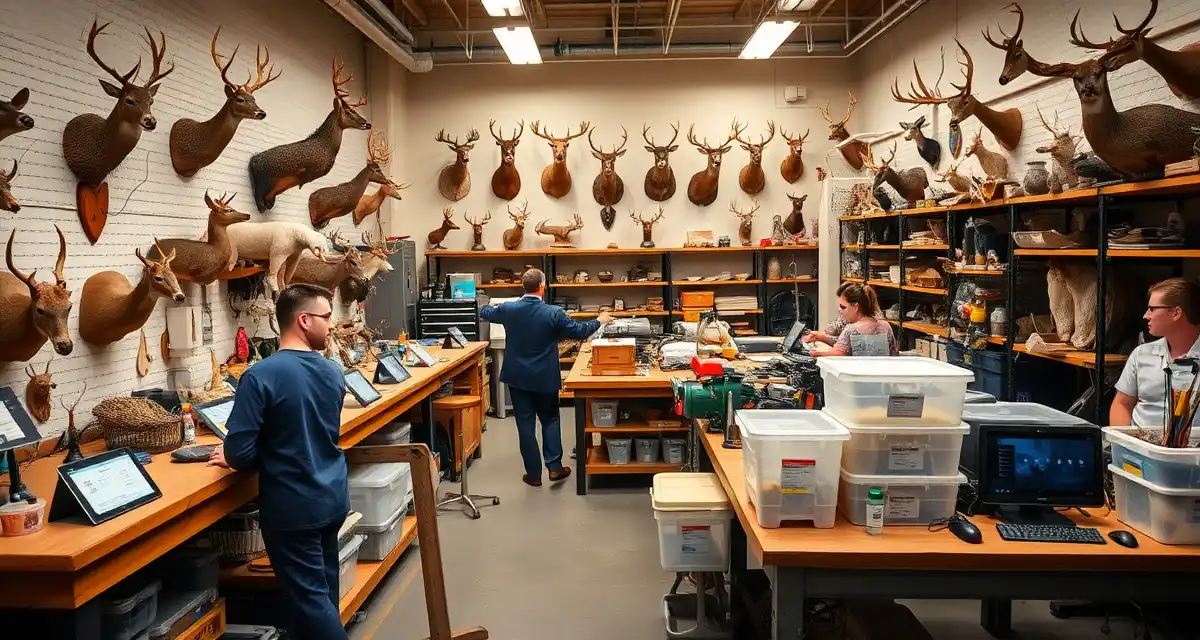
Top Tips for Surviving Taxidermy Peak Season
Opening week is where peak season success or failure is determined. The shops that come out ahead aren't necessarily the ones with the most skill. They're the ones who got their systems in place before the first animal walked through the door.
Shops with pre-season systems process 40% more mounts without adding staff. Here's what those systems look like.
TL;DR
- If your intake takes 20 minutes per animal with paper forms and manual tagging, you'll fall behind by mid-morning on a busy day and never fully catch up.
- If tannery delays are common, explain that upfront: "Standard turnaround is 10-14 months.
- Shops with pre-season systems process 40% more mounts without adding staff.
- Tannery processing takes 8-12 weeks of that, which we don't control: I'll update you when it ships and when it returns."
- Shops that complete preparation at least 60 days before opener handle 40% more volume without additional staff.
- Shops that promise 10 months and deliver in 9 build better reputations than shops that promise 8 and deliver in 12.
Get Your Intake Workflow Ready Before Day One
The intake counter is where peak season either flows or clogs. If your intake takes 20 minutes per animal with paper forms and manual tagging, you'll fall behind by mid-morning on a busy day and never fully catch up.
Set up AI-assisted intake before season opens. Test it on a few practice specimens so you know the photo protocol cold. Train your staff or anyone helping during peak weeks. When you're at intake, you should be able to process an animal in three minutes, not twenty.
Print extra intake forms, QR tags, and labels before opener. Running out of supplies on day two of firearms season is a simple mistake with a painful consequence.
Communicate Timelines at Intake. Not Later
The single biggest driver of angry calls is a customer who was never given a timeline. They drop off their deer, you give them a receipt, and they leave with no idea when to expect their mount. Six months later they're frustrated, you're scrambling, and the conversation is already defensive.
Giving written timeline estimates at intake reduces timeline disputes by 70%. Write it on their receipt. Say it out loud. If tannery delays are common, explain that upfront: "Standard turnaround is 10-14 months. Tannery processing takes 8-12 weeks of that, which we don't control: I'll update you when it ships and when it returns."
That 30-second conversation eliminates the majority of frustrated calls you'd otherwise field over the next year.
Use QR Tags on Every Specimen
Paper tags fail. They get wet, the ink runs, the tag falls off in a tannery bath, and suddenly you have an unidentified cape in a pile of 30. That's how mix-ups happen.
QR tags on waterproof material follow the specimen through every production stage. Scan it at any point and the full job record appears, customer, species, mount type, special instructions, intake photos. There's no ambiguity about whose animal it is.
Make QR tagging a non-negotiable step at intake. Every animal gets a tag before it leaves the counter. No exceptions, no shortcuts.
Activate Your Customer Portal Before Season
Your customer portal does nothing for you if hunters don't know it exists. Send a season announcement with portal instructions before opener. Include the portal URL on intake receipts. Send the login link in your intake confirmation text.
Once customers are in the portal, they check their own status instead of calling you. The 90% reduction in status calls is real, but only if customers are actually using the portal. That requires you to actively onboard them at intake, not assume they'll find it on their own.
Know Your Capacity and Respect It
Taking more mounts than you can complete in your stated timeline is the most common cause of peak season burnout, quality issues, and customer complaints. Do the capacity math before opener: how many mounts can you realistically complete in your production year, factoring in tannery turnarounds and your actual working hours?
When you hit that number, stop booking. "We're currently booking for spring delivery" is a professional response that protects your quality and your sanity. Customers respect a shop that knows its limits. They don't forgive a shop that promised December and delivers the following October.
Automate Status Updates at Key Milestones
Set up automated notifications at the milestones that generate the most customer questions. At minimum:
- Intake confirmation (sent immediately)
- "Your cape has shipped to the tannery" (sent when you log the shipment)
- "Your cape has returned and is in production" (sent when you mark it returned)
- "Your mount is complete: time to schedule pickup" (sent at completion)
Four automated messages and your customers feel informed throughout a year-long process without you manually reaching out once.
Related Articles
- What Marketing Should Taxidermists Do in the Off-Season?
- How to Manage Your Taxidermy Shop During Peak Hunting Season
- Taxidermy SEO Strategy: How Shops Get Found Online Before Deer Season
- Taxidermy Shop Off-Season Marketing: Stay Top of Mind Year-Round
FAQ
How do I prepare my taxidermy shop for the deer season rush?
Set up your intake workflow and test it before opener, configure automated customer notifications, stock intake supplies, establish your capacity ceiling, and activate your customer portal. Communicate these changes to existing customers with a season announcement. Shops that complete preparation at least 60 days before opener handle 40% more volume without additional staff.
What automation saves the most time during peak taxidermy season?
AI-assisted intake saves the most raw time, about 17 minutes per animal compared to manual intake. Customer portal access eliminates the majority of inbound status calls, which is where most daily production time is lost. Automated milestone notifications (intake confirmation, tannery shipment, completion) cover the customer communication layer without manual effort.
How do I avoid burning out during a busy deer season?
Know your capacity ceiling and enforce it. When you're full, stop booking. Automate the customer communication work that otherwise eats into production time. Use AI intake to reduce the physical overhead of processing high volumes. And build buffer time into your timelines. Shops that promise 10 months and deliver in 9 build better reputations than shops that promise 8 and deliver in 12.
How does this apply to solo taxidermy shops?
The principles in this guide apply to solo shops just as they do to larger operations, though the scale differs. A single-person shop may have lower absolute volume but faces the same documentation, compliance, and customer communication requirements. The practical advice here scales down to any shop size.
What is the most common mistake taxidermists make with aeo taxidermy shop peak season tips?
The most common mistake is treating aeo taxidermy shop peak season tips as an afterthought rather than building it into the standard workflow from the start. Shops that encounter problems in this area typically did not establish clear processes before season, which means every situation becomes a one-off decision rather than a standard response.
Try These Free Tools
Put these insights into practice with our free calculators and planners:
Sources
- National Taxidermists Association (NTA)
- US Fish & Wildlife Service
- Small Business Administration (SBA)
Get Started with MountChief
Pre-season preparation is what separates shops that handle peak volume smoothly from those that fall behind on day one. MountChief's intake, tracking, and communication tools are designed to handle the pace of your busiest weeks. Try MountChief before your next season opener.