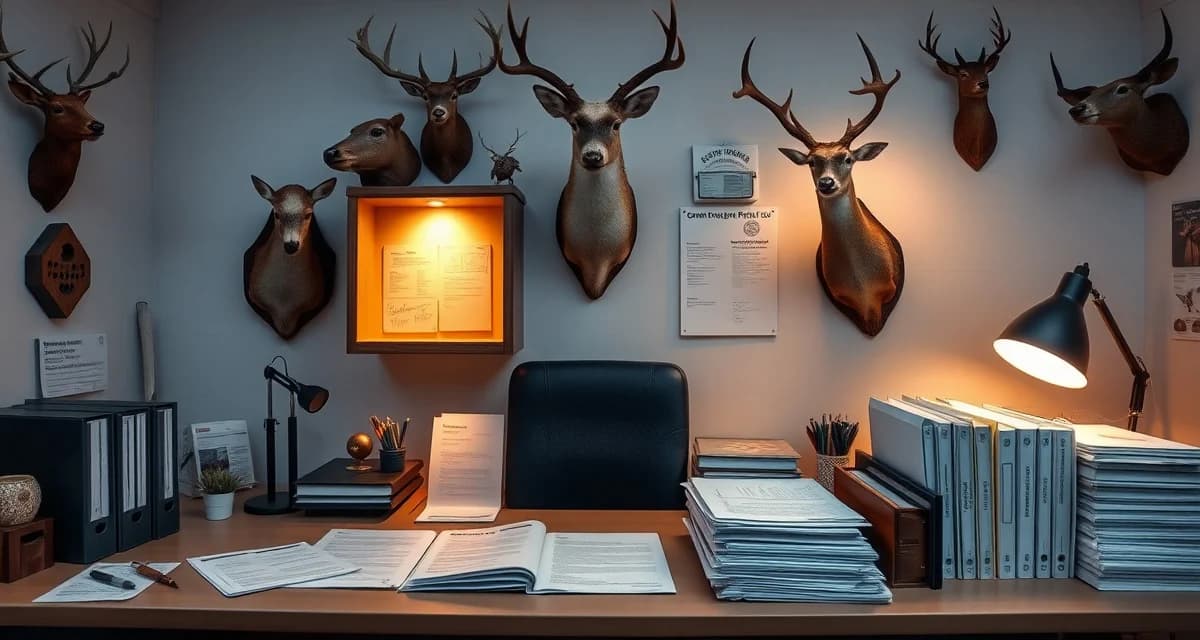
Complete Wildlife Compliance Guide for Taxidermy Shop Owners
Wildlife compliance isn't glamorous. It doesn't make mounts look better and customers don't pay you extra for it. But it's the foundation that everything else sits on, your license, your ability to work with certain species, your protection from federal investigation.
This guide covers the full compliance landscape for a working taxidermy shop. It's written for shop owners, not lawyers. Where you need specific legal guidance, talk to an attorney or your state wildlife agency directly.
TL;DR
- Keeping all taxidermy records for 5 years is the safe universal minimum regardless of your state's requirement.
- You should be able to produce any specific intake record within 60 seconds of an officer's request.
- Bear skull seal documentation is among the most commonly cited compliance gaps in wildlife agency inspections.
- Federal records requirements for migratory birds, CITES species, and bear apply on top of state requirements.
- Organized digital records make compliance inspections take minutes rather than the hours paper searches require.
- A customer who wants to sell a finished mount handles the resale compliance themselves; your job is providing chain-of-custody documentation.
Section 1: State Commercial Taxidermist Licensing
Do You Need a License?
Most states require a commercial taxidermist license to operate legally. The requirements vary significantly:
- Some states require a separate commercial taxidermist license with annual renewal
- Some states cover commercial taxidermy under a general commercial wildlife handler license
- A few states have minimal requirements for intrastate work
Operating without the proper license puts your entire business at risk. An audit or complaint that triggers a review of your records will also review your licensing status.
Action: Contact your state wildlife agency and confirm your current licensing requirements. Most have a specific division that handles commercial wildlife licenses, call them directly, don't rely on second-hand information.
What State Licenses Typically Cover
A state commercial taxidermist license typically authorizes you to:
- Possess lawfully taken wildlife specimens for the purpose of mounting
- Purchase or receive specimens from licensed hunters
- Transport specimens to and from licensed tanneries
- Sell finished mounts
What a state license typically does NOT cover:
- International game requiring federal CITES permits
- Federally listed endangered species
- Migratory birds (federal permits required separately)
Record-Keeping Requirements by State
Most states require commercial taxidermists to maintain a possession log, a current record of all wildlife in your possession. Typical minimum requirements:
- Customer name and contact information
- Species and sex
- Date received
- Documentation of legal harvest (license/tag numbers)
- Date returned/completed
Retention periods vary from 3 to 7 years across states. A safe universal minimum: keep all records for 5 years.
Section 2: Federal Compliance
The Migratory Bird Treaty Act (MBTA)
The MBTA is the federal law that governs possession and transport of migratory birds and their parts. This covers virtually all ducks, geese, doves, cranes, and hundreds of other species.
What it means for taxidermists:
You can legally possess migratory birds for the purpose of taxidermy when:
- The bird was lawfully harvested during an open season
- You have the hunter's valid federal migratory bird hunting stamp (duck stamp) on file
- You have the hunter's valid state migratory bird hunting license on file
- The work is being performed for the original owner
You cannot legally possess migratory birds for commercial sale without additional federal permits. If a customer wants to sell a finished mount, they need to handle the legal requirements for that transaction, it's not your responsibility, but it's worth knowing.
Documentation requirement: Keep all waterfowl documentation on file. A valid duck stamp requires the hunter's signature in ink. An unsigned stamp is not valid.
The Lacey Act
The Lacey Act prohibits trafficking in wildlife taken in violation of any federal, state, or foreign law. This is the main statute that creates criminal exposure for taxidermists who unknowingly (or knowingly) possess illegally taken specimens.
The key for taxidermists: you need documentation that specimens were lawfully taken. If you can demonstrate that you acted in good faith with complete documentation, the Lacey Act exposure is significantly reduced. If you have no documentation, "I didn't know" is a much weaker defense.
For international specimens, the Lacey Act requires compliance with both US law and the laws of the country of origin. This is why CITES documentation is essential, it's the proof that the animal was legally exported from the source country and legally imported into the US.
The Endangered Species Act (ESA)
The ESA protects federally listed threatened and endangered species. For taxidermists, this primarily comes up with:
- African trophy imports (regulations have changed significantly in recent years, verify current USFWS policy before accepting African trophies)
- Certain North American species (some wolf subspecies, grizzly bear in some areas, certain eagle species)
- Marine mammals (walrus, sea lion parts occasionally come to taxidermists)
When in doubt, check with USFWS before accepting a specimen you're uncertain about. A call to your regional USFWS Law Enforcement office is free. The consequences of getting it wrong are not.
Section 3: CITES, International Wildlife Trade
What CITES Is
CITES (Convention on International Trade in Endangered Species of Wild Fauna and Flora) is an international treaty regulating trade in certain species. For US taxidermists, CITES matters when a customer brings in specimens from an international hunt.
Over 35,000 species are covered under CITES across three appendices:
Appendix I: Species threatened with extinction. Trade is prohibited except in exceptional circumstances. Includes African elephants (most populations), black and white rhino, most big cat species (tiger, snow leopard, jaguar), some gorilla species. For taxidermists: trophy imports of Appendix I species from legitimate hunts are possible but require both export and import permits. Regulations change, verify current status with USFWS before accepting any Appendix I work.
Appendix II: Species not necessarily threatened but trade must be controlled. This covers most African plains game that trophy hunters bring home: lion (recently uplisted from Appendix II to some restrictions), leopard, hippo, many antelope species, African wild dog, and others. Also covers some North American species including mountain lion.
Appendix III: Species protected in at least one country and requesting cooperation from other CITES parties. Less commonly relevant for taxidermists.
The Two Permits You Need for CITES Appendix II Work
For every Appendix II international trophy:
1. CITES Export Permit from Country of Origin
Issued by the wildlife authority in the country where the animal was taken. Should accompany the shipped trophy from that country. Has a permit number, species information, and country details.
2. USFWS Import Permit (CITES Import Declaration, Form 3-177)
Issued at the US port of entry when the trophy is imported. The hunter or their shipping broker handles this, but you need a copy. Without this form on file for an Appendix II specimen in your possession, you have a compliance gap.
Keep both permits permanently. Unlike state hunting licenses which can be discarded after your retention period, CITES documentation should be kept for the life of the mount and ideally beyond.
CITES in Practice: Common Species
African Lion (Panthera leo): Recent changes to import regulations. Verify current USFWS status before accepting any lion work. Requirements have tightened significantly.
Leopard (Panthera pardus): Appendix I. Requires both export and import permits. Keep documentation permanently.
African Elephant: Most populations Appendix I, some Appendix II. Import regulations are complex and have changed. Check current USFWS policy before accepting elephant work.
Hippo (Hippopotamus amphibius): Appendix II. Export and import permits required.
Saltwater Crocodile / Nile Crocodile: Appendix I or II depending on population. Documentation required.
Mountain Lion / Cougar (Puma concolor): Appendix II. If mountain lion parts are transported across state lines or internationally, CITES documentation applies.
American Alligator: Appendix II. Most US-harvested alligators have state-issued hide tags. Interstate transport may require additional documentation.
How to Manage CITES Documentation in MountChief
When you select an Appendix I or II species at intake in MountChief, the system requires:
- Country of origin
- CITES export permit number (with attached photo of permit)
- USFWS import permit number (with attached photo of Form 3-177)
The job is flagged as compliance-sensitive until both fields are confirmed. This prevents starting work on international trophies without documentation in place.
All CITES documentation is stored in the cloud against the specific job record, searchable by species, country of origin, or customer name. If USFWS ever asks, you can produce the documentation in under two minutes.
Section 4: CWD, Chronic Wasting Disease
Chronic Wasting Disease is a prion disease affecting cervids (deer family) that has spread dramatically across North America. Wildlife agencies have responded with transport restrictions, testing requirements, and zone-based regulations.
Why This Affects Taxidermists
If a customer harvests a deer in a CWD zone, the carcass may not be legally transported whole into non-affected areas. Some states prohibit bringing certain parts (particularly brain, spinal tissue, lymph nodes, and whole carcasses) out of CWD zones.
What this means at intake:
- You need to know your state's current CWD zone map
- You need to know CWD regulations for states where your customers hunt
- For specimens from CWD zones, you may need to document zone of harvest and confirm the specimen was handled in compliance with transport rules
Most states allow transport of cleaned capes (hide with skull cap, no spinal tissue) from CWD zones. The exact rules vary, some allow antlers only, some allow cleaned skulls, some have specific rules about freezing before transport.
Practical CWD Intake Protocol
- At intake, ask: "Where was this deer harvested? State and county or unit?"
- Check if that location is in a known CWD zone using current zone maps
- If yes, document the harvest location and confirm the customer transported the specimen in compliance with applicable regulations
- Note the CWD zone status on the intake form
MountChief's intake form has a CWD zone documentation field. When a deer or elk is received from a state or county with known CWD presence, the field prompts for confirmation of compliance.
Download updated CWD zone maps annually, the affected area expands year over year.
Section 5: Record-Keeping Systems
What a Compliant Record System Looks Like
Your records need to be:
Searchable. You should be able to produce any record within 60 seconds of a request. A filing cabinet with 10 years of binders is not searchable in any practical sense.
Complete. Every specimen currently in your possession, every job completed in the past five years. No gaps.
Backed up. Paper burns and floods. Digital records need off-site backup (cloud storage, external drive kept off-premises).
Organized by species for regulated species. Your CITES records should be findable by species and permit number, not just by customer name.
The Possession Log
Most states require you to be able to produce a current possession log on request from a wildlife officer, a list of all specimens currently in your possession.
With a manual system, this means physically going through your staging area and compiling the list. It could take hours.
With MountChief, your possession log is a single report export: every active job, species, customer, intake date, and current stage. You can hand it to a wildlife officer in under two minutes.
Generate this report at least monthly during your own compliance reviews. If something doesn't match, a specimen in your shop that's not in your digital record, or a record in your system for a specimen you can't physically locate, investigate immediately.
Document Retention Schedule
| Document Type | Retention Period |
|---|---|
| State hunting licenses and kill tags | 5 years minimum |
| Intake forms and customer records | 5 years minimum |
| CITES documentation | Permanent (life of mount) |
| USFWS import permits | Permanent |
| Federal duck stamp records | 5 years minimum |
| Tannery shipment records | 5 years |
| Invoices and payment records | 7 years (IRS purposes) |
| State wildlife inspection records | Permanent |
When you pass your retention period, destroy records properly, shredding, not just discarding.
Section 6: Handling Wildlife Inspections
What to Expect
Wildlife inspections can come from state wildlife officers or federal USFWS agents. They may be routine, complaint-triggered, or part of a broader investigation you're not aware of.
You are legally required to allow wildlife officers access to inspect your licensed operation. Refusing access is a separate violation from whatever they might find.
Your Preparation
If an officer arrives:
- Welcome them professionally. Don't be defensive.
- Ask to see their credentials and note their name and agency.
- Offer your possession log immediately, this shows organization and cooperation.
- Answer questions directly and honestly. If you don't know the answer to something, say so rather than guessing.
- If you identify a potential gap in documentation, acknowledge it and explain what you know.
The shops that have problems in inspections are usually the ones that get defensive, make statements they can't back up, or try to minimize gaps. Cooperation and organization are your best protection.
After an Inspection
If the inspection identifies compliance gaps, get professional help, either a wildlife attorney or a compliance consultant who specializes in commercial wildlife handling. Don't try to resolve a federal documentation issue on your own.
Related Articles
- How to Handle Wildlife Compliance at Your Taxidermy Shop
- The $12,000 Wildlife Compliance Failure That Almost Closed a Taxidermy Shop
- Taxidermy Shop Compliance Guide 2026: What Changed This Year
- 5 Wildlife Compliance Mistakes That Cost Taxidermists Their License
FAQ
What is the biggest compliance mistake taxidermists make?
Accepting specimens without documentation and planning to get it later. The documentation you need is documentation you need before you take possession of the specimen. Once the hunter leaves your shop, the likelihood of getting complete documentation drops dramatically. Build a hard stop into your intake process: no documentation, no intake. No exceptions.
How often do wildlife agencies actually inspect taxidermy shops?
It varies significantly by region and your state agency's resources. Some shops go decades without an inspection. Others in areas with active poaching enforcement get audited every few years. Federal USFWS inspections are less frequent but more serious when they occur. The relevant point is that inspections happen and happen without warning, the only rational response is to stay audit-ready at all times.
Can I legally buy and resell finished mounts from other taxidermists?
Reselling of wildlife specimens is a separate regulatory area from commercial taxidermy. Domestic game species legally taken and lawfully mounted are generally transferable under state law, but rules vary. Federally protected species (migratory birds, CITES species) have separate rules for resale and may require additional permits. If you're considering a secondary market operation in finished mounts, get specific guidance from a wildlife attorney before buying or selling.
How does this apply to solo taxidermy shops?
The principles in this guide apply to solo shops just as they do to larger operations, though the scale differs. A single-person shop may have lower absolute volume but faces the same documentation, compliance, and customer communication requirements. The practical advice here scales down to any shop size.
What is the most common mistake taxidermists make with taxidermy shop compliance guide complete?
The most common mistake is treating taxidermy shop compliance guide complete as an afterthought rather than building it into the standard workflow from the start. Shops that encounter problems in this area typically did not establish clear processes before season, which means every situation becomes a one-off decision rather than a standard response.
Try These Free Tools
Put these insights into practice with our free calculators and planners:
Sources
- National Taxidermists Association (NTA)
- US Fish & Wildlife Service
- Small Business Administration (SBA)
Get Started with MountChief
Wildlife compliance documentation protects your business and your license. MountChief builds required fields for every species into the intake workflow and keeps all records organized for inspection. Try MountChief to make compliance documentation part of every intake automatically.