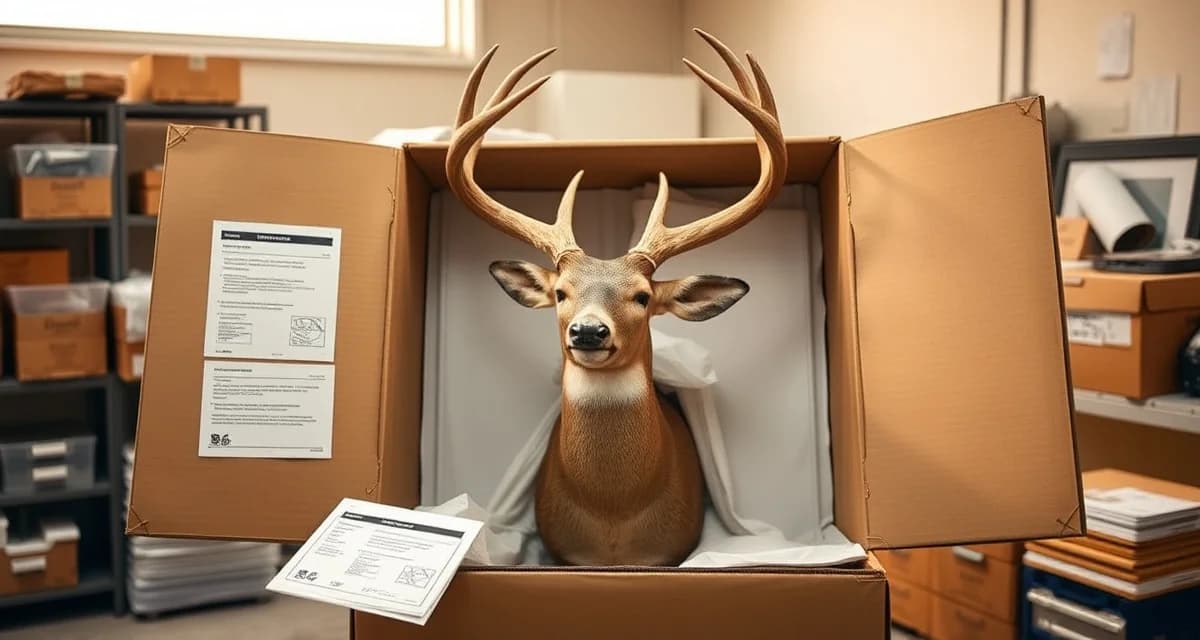
How Do You Ship a Taxidermy Specimen Across State Lines?
Interstate transport of wildlife specimens is federally regulated under the Lacey Act. The rules differ depending on the species, the state of origin, and whether you're shipping a raw specimen or a finished mount. Getting this wrong carries serious consequences: Lacey Act violations for improper specimen transport carry federal criminal penalties.
Many hunters don't realize their out-of-state deer cape requires documentation to ship back home. This is especially common for hunters who travel to other states for deer, elk, or waterfowl hunts and want to ship their cape or specimen to a taxidermist at home.
TL;DR
- Taxidermy specimens must be properly preserved before shipping: frozen, salted, or professionally prepared.
- Raw unpreserved specimens cannot legally be shipped by common carriers.
- Migratory birds require federal salvage or taxidermist permits before they can be shipped.
- Package frozen specimens in insulated containers with dry ice or gel packs for transit.
- Documentation of legal acquisition should travel with the shipment.
- Carriers have specific rules about biological materials; check before shipping.
Deer and Elk Capes: Interstate Transport Rules
For most deer (whitetail, mule deer, blacktail) and elk, interstate transport of legally taken specimens is permitted under federal law provided:
- The hunter has a valid hunting license from the state of harvest
- The specimen is tagged with the required state documentation (carcass tag or game tag)
- The animal was legally taken under that state's regulations
In practice, this means a hunter who tagged a deer in Wisconsin and wants to take the cape back to Illinois for mounting needs to keep the Wisconsin carcass tag attached to the specimen during transport.
CWD zone exception: Many states now restrict movement of whole carcasses and certain parts from CWD-positive areas. Even if federal rules allow interstate transport, state regulations may restrict specific parts. A hunter harvesting from a CWD zone may only legally transport the cape (with spinal column removed), skull plate, boned-out meat, and antlers. Always check the regulations for the state where the animal was harvested.
Migratory Birds: Federal Permit Requirements
Ducks, geese, doves, and other migratory birds are regulated under the Migratory Bird Treaty Act, a federal law. Interstate transport of legally harvested migratory birds requires:
- Valid federal migratory bird hunting license (duck stamp for waterfowl)
- HIP certification (Harvest Information Program)
- The species must be a legally huntable species during a legal season
A finished duck mount shipped across state lines needs documentation that the bird was legally harvested. Your taxidermist should be able to provide documentation of the harvest information captured at intake. The taxidermy customer portal can help shops document and store this information with the job record.
Shipping migratory bird species through a common carrier (UPS, FedEx) across state lines requires that the shipment is labeled appropriately and accompanied by harvest documentation. Carriers may refuse packages without proper documentation.
Shipping a Finished Mount to an Out-of-State Customer
When a taxidermist ships a completed mount back to a customer in another state, the shipping documentation should include:
- A letter or invoice identifying the specimen as a legally mounted specimen that was taken legally
- The customer's name, the species, and the state of harvest
- For migratory birds specifically, the original license and permit information
Common carriers like UPS and FedEx do ship finished taxidermy. Pack mounts extremely carefully. Use rigid outer boxes with foam insulation around antlers and protruding elements. Insure the package for the mount's full value.
Migratory birds require more careful documentation at the shipping stage. Work with your customer to confirm they have copies of their original license documentation before shipping.
Wildlife Compliance Documentation
The wildlife compliance software for taxidermy can help shops generate and store the documentation needed for interstate shipping. Having a digital record of the harvest state, license number, and species for every job makes the shipping documentation process straightforward rather than a last-minute scramble.
Frequently Asked Questions
What documents are needed to ship a deer cape across state lines?
The state carcass tag from the state of harvest should remain attached during transport. The hunter should carry or provide a copy of the hunting license. For CWD-affected areas, only legal parts (cape with spinal column removed, skull plate, antlers, boned meat) may cross state lines, and additional state restrictions may apply. Check the harvest state's specific regulations, as CWD transport rules have become significantly more restrictive in affected zones.
Can I ship a mounted duck across state lines?
Yes, but documentation matters. A finished mounted duck should be shipped with documentation showing it was legally harvested, including the hunter's federal duck stamp information and HIP certification. The taxidermist who mounted the bird should have captured this information at intake. Common carriers accept finished mounted birds when properly packed and documented. Contact the carrier's wildlife shipping guidelines before shipping unusual or particularly large mounted specimens.
How do taxidermists ship finished mounts to out-of-state customers?
Most taxidermists use UPS or FedEx for standard-sized mounts. The mount needs heavy-duty custom packaging with foam protection around antlers, horns, and protruding elements. For a deer shoulder mount, a custom crate is often the safest approach for long-distance shipping. Insurance should be purchased for the full replacement value of the mount. The taxidermist should include a letter of provenance with the shipment identifying the species, hunter, harvest state, and mount completion date.
Can I ship a frozen deer cape through a common carrier like FedEx or UPS?
Yes, frozen biological specimens can be shipped through FedEx and UPS if properly packaged. The specimen must be frozen solid, packed in an insulated container with sufficient coolant for the expected transit time, and properly labeled as biological material. Check the carrier's current requirements for frozen biological materials, as policies are updated periodically.
What documentation should I include when shipping a specimen to a taxidermist?
Include a copy of your hunting license or harvest tag documentation, your name and contact information, species and harvest date, destination taxidermist information, and any state-specific documentation required for the species. For migratory birds, a copy of the relevant permit or authorization should be included.
Are there species I cannot ship at all?
Yes. Certain federally protected species cannot be shipped without specific federal permits. Eagles and most raptors, most migratory birds in non-exempt contexts, and CITES Appendix I species have restrictions that effectively prohibit shipping without proper permits. Consult US Fish & Wildlife Service before shipping any regulated species.
Related Articles
Try These Free Tools
Put these insights into practice with our free calculators and planners:
Sources
- US Fish & Wildlife Service, Office of Law Enforcement
- FedEx Shipping Regulations (biological materials)
- UPS Shipping Regulations (biological materials)
- National Taxidermists Association (NTA)
Get Started with MountChief
Proper specimen handling before the mount ever reaches your shop affects the quality of the finished product. MountChief lets you send customers preparation and shipping guidelines at intake so your specimens arrive in the best possible condition. Try MountChief to make customer preparation part of your intake process.