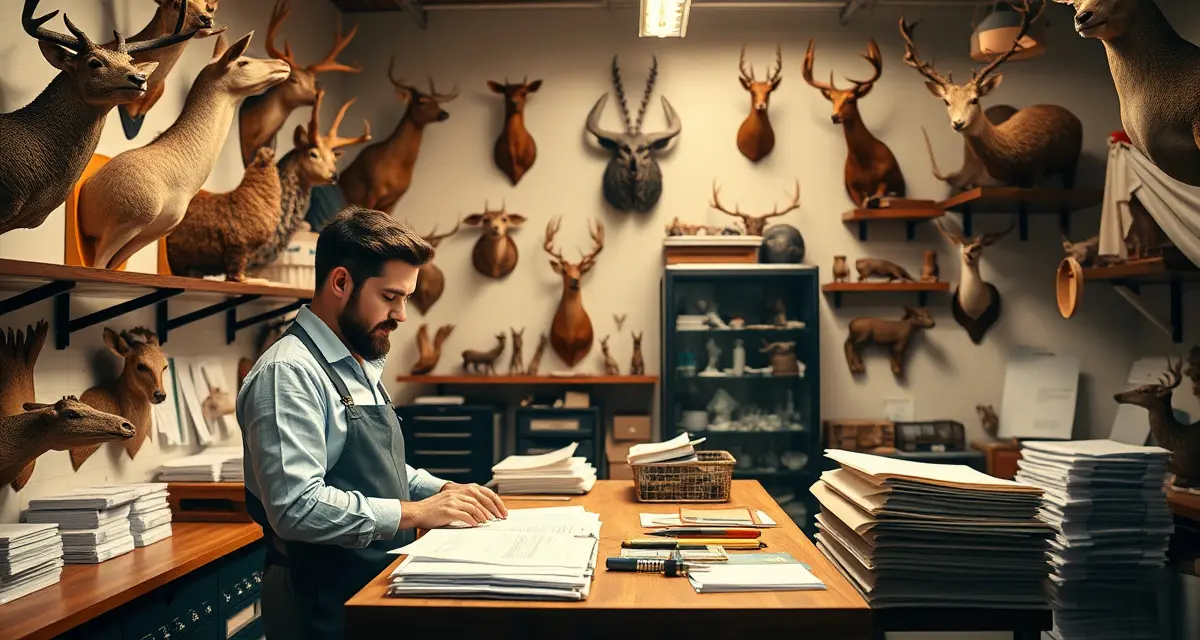
How to Start a Taxidermy Business: Requirements and Setup
New taxidermy shops fail at a 40% rate in year one. The skill is rarely the problem. What sinks new shops is the administrative weight they weren't prepared for: licensing, record-keeping, compliance, cash flow management, and customer communication. Getting the right setup from day one prevents the growing pains that close shops before they have a chance to build a reputation.
Here's the complete rundown of what you need to open a taxidermy shop legally, and how to set yourself up to survive year one.
TL;DR
- Starting a taxidermy business requires a state taxidermist license in most states before you can accept specimens.
- A business plan covering your target volume, pricing, and operating costs is essential before opening.
- Equipment costs for a basic startup range from $3,000-$10,000 depending on species focus.
- Your first year of marketing will rely heavily on word-of-mouth from friends and local hunters.
- Joining the National Taxidermists Association provides resources, networking, and credibility from day one.
- Insurance, including bailee coverage for customer specimens, is a baseline requirement.
Step 1: State Taxidermy License
Almost every state requires a taxidermy license before you can accept specimens for pay. Requirements vary, but typically include:
- Submitting an application to the state wildlife agency
- Paying a licensing fee (usually $25 to $150)
- In some states, passing a written exam covering wildlife regulations
- Proof of a business location (home-based shops are allowed in most states)
- Background check in some states
Your state wildlife agency's website will have the taxidermy licensing section. Look for "taxidermist license" or "taxidermy permit" under their licensing or permits section. Don't skip this step. Operating without a license is a misdemeanor or worse in most states, and it's one of the first things a game warden asks about during an inspection.
Step 2: Federal Permits for Migratory Birds
If you plan to accept any migratory birds, including ducks, geese, wild turkeys, doves, and most other native birds, you need a Federal Taxidermist Permit from the U.S. Fish and Wildlife Service (USFWS). This is separate from your state license and is required before you accept a single bird.
The permit application goes through the USFWS Migratory Bird Permit Office for your region. Processing takes four to eight weeks. The permit requires you to maintain records of every migratory bird you accept, including species, date received, customer information, and band number if the bird was banded.
Operating without a federal permit for migratory birds is a federal criminal offense, not a civil fine. Don't start accepting birds until you have it in hand.
For CITES-listed species (African trophies, certain reptiles, bear, bobcat), additional permits or documentation requirements apply. Wildlife compliance software for taxidermy shops covers the full federal framework.
Step 3: Business Formation and Insurance
You'll need a basic business structure, at minimum a DBA (doing business as) registration with your county or state, and ideally an LLC for liability protection. An LLC separates your personal assets from your business liabilities, which matters when you're holding thousands of dollars worth of other people's trophies.
Insurance is not optional. You need:
- General liability - covers third-party bodily injury and property damage at your shop
- Bailee's insurance - covers customer specimens while in your care, custody, or control. This is the most important coverage for taxidermists. Standard general liability does NOT cover customer property.
- Professional liability - covers claims that your work was deficient
Bailee's coverage is where most new shops underinsure. The average specimen liability claim runs $800 to $2,500. If a customer's record-class buck gets destroyed in a shop fire and you don't have adequate bailee's coverage, you're personally responsible for replacement.
Step 4: Your Business Location and Setup
Home-based taxidermy shops are legal in most states and many municipalities, but check local zoning regulations. Some residential zones prohibit commercial taxidermy work or restrict chemical storage and disposal.
For chemical disposal, you'll need to follow your state's EPA guidelines for formaldehyde and other taxidermy chemicals. Many states have specific disposal requirements for these materials.
At minimum, your workspace needs:
- A clean, climate-controlled area for intake and finishing work
- A separate area or chest freezer for specimen storage
- Adequate ventilation for chemical work
- A secure area where customer specimens won't be disturbed
Step 5: Pricing and Financial Setup
Underpricing is the number one reason taxidermy shops fail in year three. Most new taxidermists price based on what they've seen charged locally, without accounting for all actual costs.
Before you set your rates, calculate:
- Material costs per mount type (forms, eyes, adhesives, finishing materials)
- Tannery fees (varies by species and service level)
- Your effective labor rate (what do you need to pay yourself per hour to make the business viable?)
- Overhead allocation (insurance, utilities, software, supplies)
- A percentage for re-dos and mistakes (budget 3 to 5% of revenue for this)
The taxidermy pricing calculator walks through the math for each mount type.
Step 6: Management Software
Get software before you open, not after. This is the advice most new shops ignore and later regret. Paper systems feel adequate when you have five jobs. At 50 jobs, they break. At 150 jobs, they collapse.
Starting with software from day one means your records are clean, your compliance documentation is in order from the first intake, and your customers get a professional experience from day one. MountChief is designed to be operational in under an hour and requires no IT background.
Frequently Asked Questions
What licenses do I need to open a taxidermy shop?
At minimum, a state taxidermist license from your state wildlife agency. If you plan to accept migratory birds (ducks, geese, turkeys), you also need a Federal Taxidermist Permit from USFWS before accepting any birds. Additional CITES permits or documentation requirements apply for certain exotic and African species. Business licenses and DBA registration from your county or municipality are also required to operate legally as a business.
How much does it cost to start a taxidermy business?
Startup costs vary widely. Licensing fees are typically $25 to $200 total across state and federal permits. Insurance runs $800 to $2,500 per year for a small shop. Basic equipment (freezer, forms, tools, chemicals) for a startup can run $3,000 to $8,000. Add in LLC formation ($100 to $500 depending on state) and initial software. A modest startup with used equipment can be operational for $5,000 to $10,000. A well-equipped purpose-built shop will run higher.
What software should a new taxidermy shop use?
Start with software designed for taxidermy specifically, not a generic small business tool. You need intake records that capture state-required compliance fields automatically, job tracking that prevents specimen mix-ups, and a system that can grow with your volume. MountChief is designed for this from the ground up and is operational in under an hour. Starting with a spreadsheet is a common mistake that becomes painful to migrate away from at volume.
How much does it cost to start a taxidermy business?
A basic startup focusing on deer and common game species requires roughly $3,000-$10,000 in initial equipment including a fleshing machine, reference forms, tools, and finishing supplies. Add licensing fees, insurance, and basic shop setup costs. Most taxidermists start part-time out of a home shop before scaling to a commercial location, which keeps initial overhead low.
How do I build a customer base in my first year?
Tell everyone you know that you are open for business before season. Ask satisfied customers to refer friends. Attend local hunting club meetings and sporting events. Build a basic website with photos of your work. In your first year, word-of-mouth from a few well-executed mounts will generate more business than any advertising.
What licenses and permits do I need to open a taxidermy business?
At minimum, you need your state taxidermist license and a general business license. Depending on your state and species focus, you may also need a federal migratory bird salvage permit, a CITES permit if you plan to work with international species, and possibly a state-specific permit for regulated species like bear. Check your state wildlife agency's requirements before accepting your first job.
Related Articles
- When Does Taxidermy Season Start for Shops?
- Should a Taxidermist Have a Separate Business Bank Account?
Try These Free Tools
Put these insights into practice with our free calculators and planners:
Sources
- National Taxidermists Association (NTA)
- US Fish & Wildlife Service, Migratory Bird Program
- Small Business Administration (SBA)
- State wildlife agencies
Get Started with MountChief
Starting a taxidermy business means building good habits from the first job, and that includes organized records and professional customer communication. MountChief gives new taxidermists the same intake, tracking, and portal tools that established shops use, at a price that makes sense from day one. Try MountChief when you open your doors.