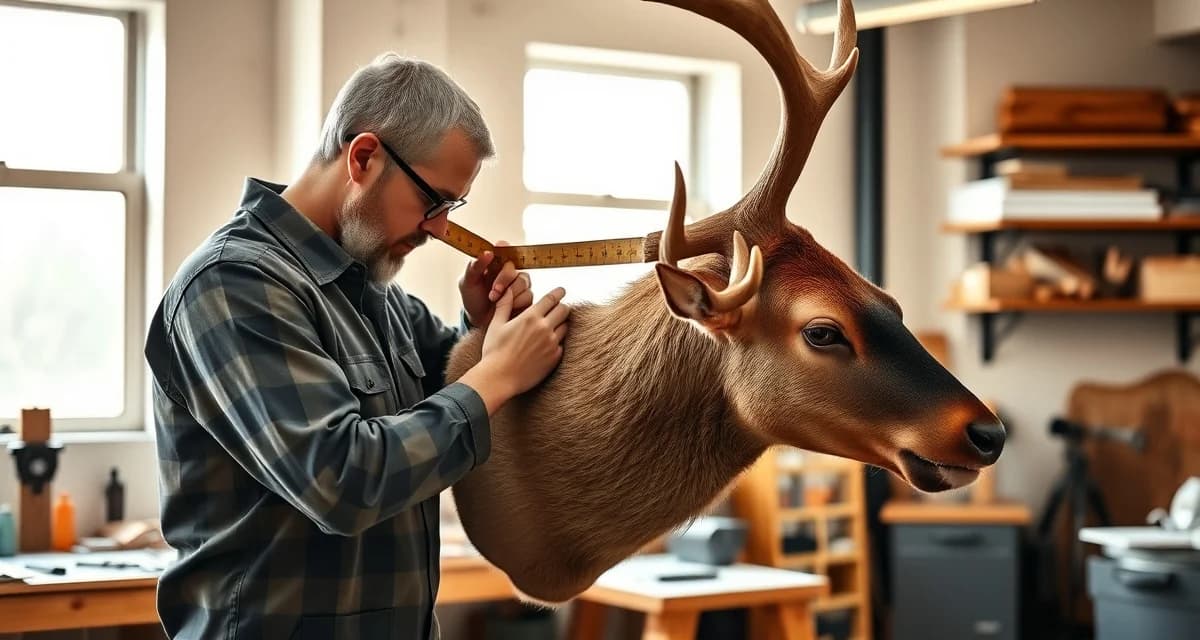
How to Price Elk Taxidermy: Cover Your Costs and Stay Competitive
Elk taxidermy is not deer taxidermy with extra steps. The inputs are different enough that you genuinely cannot price elk by looking at what you charge for a whitetail and scaling up. Get this wrong and you'll finish a $1,000 elk shoulder mount that cost you $650 to produce when you factor in tannery, form, materials, and time. That margin disappears fast.
The average elk shoulder mount runs $800-$1,200, but that range hides a lot of variation. A 6x6 bull with a massive cape that needs custom tannery work and a large-format form is a different cost structure than a modest spike bull. Pricing needs to reflect that.
TL;DR
- If your cost of production is $1,100, you need to be at $1,430-$1,540 to hit that target.
- Budget 20-30% more production hours for elk than a comparable deer job.
- realistic estimate for an elk shoulder mount is 8-14 hours from thawing through final grooming.
- At $30-$50/hour realistic labor value, that's $240-$700 in labor cost.
- Get this wrong and you'll finish a $1,000 elk shoulder mount that cost you $650 to produce when you factor in tannery, form, materials, and time.
- average elk shoulder mount runs $800-$1,200, but that range hides a lot of variation.
Why Elk Costs More Than Deer
This is the foundational thing to understand before you set a single price. Elk costs more to produce at every stage.
Tannery costs run 2-3x what you pay for deer. Elk hides are thick, heavy, and large. Most tanneries charge more per pound for elk than deer, and elk hides weigh significantly more. Your tannery bill for an elk cape can run $180-$320, compared to $65-$100 for a deer cape. If you're pricing elk without this in mind, you're giving away money.
Elk forms cost 2-3x what deer forms cost. A standard whitetail shoulder mount form runs $65-$120. An elk shoulder mount form averages $180-$320, and if the hunter had an oversized bull with an exceptionally large neck, you may be into custom form territory that adds another $50-$150. Suppliers like McKenzie, WASCO, and Research Mannikins all have elk-specific form lines, but the per-unit cost is substantially higher.
Production time is longer. A larger head means more time on detail work: ear buts, lip work, eye setting, and blending the cape over a bigger form. Budget 20-30% more production hours for elk than a comparable deer job.
Storage footprint is larger. An elk cape in the freezer takes up more space than three deer capes. If you're in a market where space is a real cost, that matters.
The Full Cost Breakdown for an Elk Shoulder Mount
Here's how to build your cost structure from the ground up:
Direct Material Costs
- Form: $180-$320 (standard), $250-$450 (custom for oversized bulls)
- Eyes: $15-$35 (elk eyes are larger and cost more than deer)
- Ear liners: $12-$25
- Glues, epoxies, filler, finishing chemicals: $25-$45
- Ear butt material, lip tape, hide paste: $15-$25
Total materials, typical elk: $247-$450
Tannery Costs
- Commercial tannery per elk cape: $180-$320
- Shipping to and from tannery: $35-$65 (elk capes are heavy)
Total tannery, typical elk: $215-$385
Labor
Your hourly rate multiplied by your production time. A realistic estimate for an elk shoulder mount is 8-14 hours from thawing through final grooming. At $30-$50/hour realistic labor value, that's $240-$700 in labor cost.
Most shops don't think explicitly about their own labor cost as a cost of goods. If you don't account for it, you end up "paying yourself less" on complex jobs without realizing it.
Overhead Contribution
Every job needs to cover a portion of your shop's fixed costs: utilities, insurance, software, supplies that aren't job-specific. A simple way to calculate this: take your monthly overhead and divide by your average monthly job count. Assign that amount as an overhead contribution per job. For most shops this runs $30-$80 per job.
Minimum Price Before Profit
Add those up for a typical elk job:
- Materials: $300-$400 average
- Tannery: $280-$350 average
- Labor: $400-$600 average
- Overhead: $50-$80 average
Total cost of production: $1,030-$1,430
That should make the $800-$1,200 average price range look uncomfortable. It should. Many shops are underpricing elk when they do a real cost analysis.
Setting Your Elk Price
Work backward from a target margin rather than forward from what you think the market will bear.
A healthy taxidermy margin on production work is 30-40% above cost of goods. If your cost of production is $1,100, you need to be at $1,430-$1,540 to hit that target. If your cost is $1,300, you're looking at $1,690-$1,820.
That might be above what you're currently charging. Look at why your costs are high before assuming the market won't support your price. Is your tannery billing competitively? Are you buying forms in volume? Is your production time in line with what other experienced taxidermists estimate for elk? You can use MountChief's pricing calculator to run these numbers without doing the math by hand every time.
Variable Pricing for Elk
Not all elk jobs are the same price. A base price for a standard shoulder mount is a reasonable starting point, but some situations warrant upcharges:
- Bull with antlers included at intake: Antlers need to be cleaned, whitened, or treated. If you're doing that work, charge for it. Add $50-$150 depending on condition.
- Oversized bull requiring custom form: Custom form cost gets passed through to the customer plus a setup fee.
- Extended tannery hold due to cape condition issues: If the cape needs extra processing because it came in partially spoiled or poorly skinned, that's an upcharge.
- Rush processing: If a hunter needs an elk done for a specific deadline, rush tannery charges plus your own time premium get added to the base price.
What to Tell Customers About Elk Pricing
Some hunters get sticker shock at elk pricing if they've only had deer mounted before. The conversation is straightforward: elk hides cost more to tan, the forms cost more, the production takes longer, and the finished piece is substantially larger than anything on their wall now.
Tell them the cost breakdown if they ask. Most people are perfectly reasonable when they understand what goes into the work. And a hunter who waited five years to draw an elk tag isn't going to let $200 be the reason they don't mount a trophy of a lifetime.
Set the expectation at intake and collect a deposit that covers your materials at minimum. Document the intake properly so your production record reflects the specific animal's characteristics, which protects you if the form or tannery bill runs higher than your estimate.
Frequently Asked Questions
How do I calculate the cost to produce an elk shoulder mount?
Start with your direct material costs: form ($180-$320), eyes, ear liners, glues, and finishing supplies. Add your tannery bill including shipping, which typically runs $215-$385 for a commercial-tanned elk cape. Add your labor hours at a defined rate, and add an overhead contribution that covers your fixed costs proportionally. Your minimum price needs to cover all of these before profit. For most shops doing honest cost accounting, the cost of production for a standard elk shoulder mount runs $1,000-$1,400.
What is the average price for an elk shoulder mount in 2026?
The market average runs $800-$1,200 nationally, with higher rates in western mountain states where elk hunting is most common and customer expectations are calibrated to the work's complexity. However, this average reflects what shops charge, not necessarily what it costs to produce the work. Many shops are underpricing elk because they haven't done a full cost analysis that includes tannery costs, form costs, and their own labor time.
How do I price elk taxidermy competitively without losing money?
Build your price from cost up, not from market average down. Know your tannery bill, your form cost, your material spend, and your actual production hours. Set a target margin of 30-40% above cost of goods and price accordingly. If your cost-based price is higher than local competitors, investigate whether your input costs are out of line before dropping your price to match them. Selling elk mounts below cost of production to stay competitive is a path to financial loss even at high volume.
How does this apply to solo taxidermy shops?
The principles in this guide apply to solo shops just as they do to larger operations, though the scale differs. A single-person shop may have lower absolute volume but faces the same documentation, compliance, and customer communication requirements. The practical advice here scales down to any shop size.
What is the most common mistake taxidermists make with how to price elk taxidermy?
The most common mistake is treating how to price elk taxidermy as an afterthought rather than building it into the standard workflow from the start. Shops that encounter problems in this area typically did not establish clear processes before season, which means every situation becomes a one-off decision rather than a standard response.
Related Articles
- What Records Must Colorado Taxidermists Keep for Elk?
- What Records Must Wyoming Taxidermists Keep for Elk?
- How Do Taxidermists Set Their Prices?
Try These Free Tools
Put these insights into practice with our free calculators and planners:
Sources
- National Taxidermists Association (NTA)
- US Fish & Wildlife Service
- Rocky Mountain Elk Foundation
- Breakthrough Magazine
- State wildlife agencies
Get Started with MountChief
Elk hunters invest significantly in their trophies and expect professional handling from intake through finished mount. MountChief's AI intake, tannery tracking, and customer portal give every elk customer the visibility and communication they expect during a 10-16 month process. Try MountChief before elk season opens.