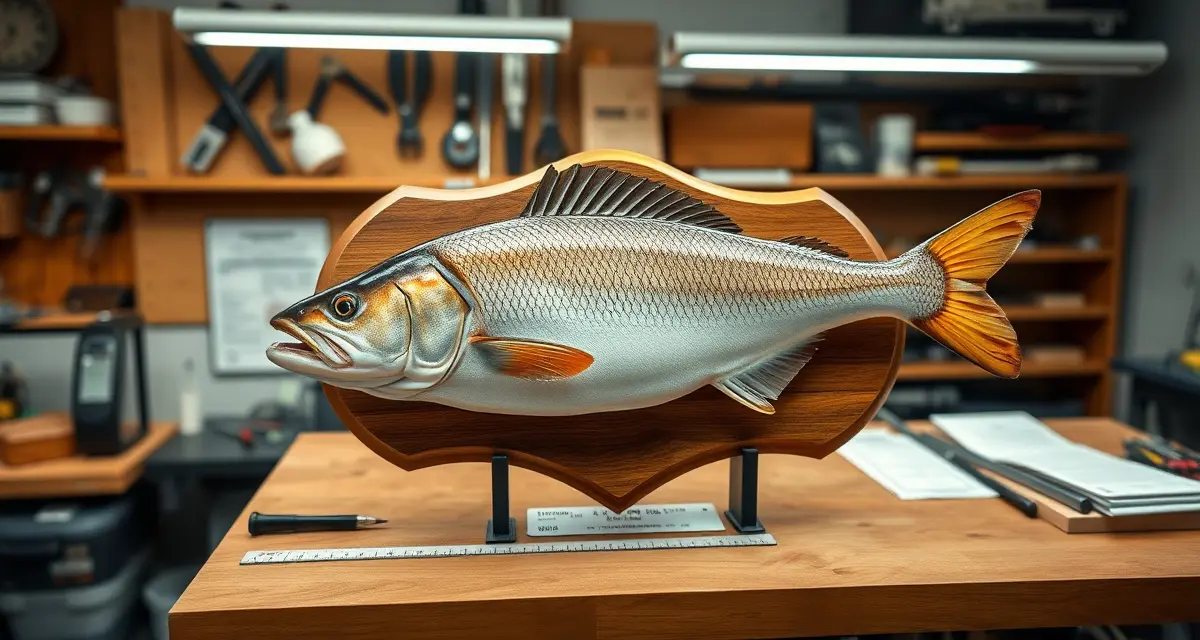
How to Price Fish Taxidermy: Replicas vs Skin Mounts
The per-inch pricing model is the standard in fish taxidermy for good reason. It's transparent, easy for customers to understand, and scales with the actual size and cost of the work. A 24-inch bass runs $288-$432 at $12-$18 per inch. That number makes sense to a customer because it connects directly to the fish they caught.
But "per inch" is just the customer-facing number. Behind it, you need to know what it actually costs to produce a fish mount at each length so your rate isn't just competitive, it's sustainable.
Fish replica pricing by inch is the most transparent method for customer quotes, but the cost structure behind it is more complex than it looks.
TL;DR
- Saltwater fish should be priced with a 15-20% premium over equivalent freshwater skin mounts.
- Pick your most common fish length, say 20 inches, and build the full cost of production for both a replica and a skin mount.
- Start with a representative fish. Pick your most common fish length, say 20 inches, and build the full cost of production for both a replica and a skin mount.
- Behind it, you need to know what it actually costs to produce a fish mount at each length so your rate isn't just competitive, it's sustainable.
- Not all fish of the same length cost the same to mount. Some species require more detail work, different paint processes, or more complex anatomy.
- But "per inch" is just the customer-facing number. Behind it, you need to know what it actually costs to produce a fish mount at each length so your rate isn't just competitive, it's sustainable.
Replica vs. Skin Mount: The Pricing Difference
These two mount types have similar customer-facing price ranges but very different cost structures. Understanding both keeps you from pricing them the same way when the inputs aren't the same.
Fish Replicas
A replica starts with measurements from the fish itself. You send length and girth to a casting supplier who produces a blank form. You then paint and finish that blank to match reference photos from the catch. The fish itself isn't mounted. In many cases the angler releases the fish after photos.
Cost structure for replicas:
- Blank form from supplier: $30-$80+ depending on length and species
- Paint and finishing supplies: $15-$40
- Labor (painting, finishing, eye setting): 4-8 hours depending on complexity
- Overhead allocation
Replicas have no tannery cost, no preservation chemistry cost, and no risk of hide failure. They also require excellent reference photography at the time of catch, which some anglers don't have.
Skin Mounts
A skin mount uses the actual fish skin. The skin is preserved, stretched over a form, and painted. Skin mounts have a more "authentic" appeal to some hunters, but the process has more failure points.
Cost structure for skin mounts:
- Fish form: $25-$65 depending on length and species
- Tanning or preservation chemistry: $15-$35
- Finishing supplies: $15-$30
- Labor (skinning, mounting, finishing): 5-10 hours
- Overhead allocation
- Saltwater species surcharge (if applicable, add 15-20%)
Saltwater fish require special preservation chemistry. A redfish, snook, or tarpon skin has different properties than a largemouth bass. The preservation process costs more and takes longer. Saltwater fish should be priced with a 15-20% premium over equivalent freshwater skin mounts. If you're not doing this, you're losing margin on every saltwater job.
Setting Your Per-Inch Rate
The right per-inch rate for your shop depends on your actual cost structure, not on what the shop in the next county charges.
Start with a representative fish. Pick your most common fish length, say 20 inches, and build the full cost of production for both a replica and a skin mount.
Example: 20-inch largemouth bass replica
- Blank from supplier: $45
- Paint supplies: $20
- Labor at 5 hours x $35/hour: $175
- Overhead: $40
- Total cost: $280
- At $14/inch (20 inches): $280 revenue, break-even
- At $16/inch: $320 revenue, $40 margin
- At $18/inch: $360 revenue, $80 margin
That tells you that $14/inch barely covers your costs, $16/inch gives you a thin margin, and $18/inch gives you a healthier margin on this example fish. Your numbers will differ based on your supplier costs and labor rate, but this approach gives you a price grounded in your actual production costs.
The taxidermy pricing calculator can help you model different per-inch rates against your specific cost inputs without doing this by hand for every length.
Pricing by Length Tier
Many fish taxidermists use tiered pricing rather than a single flat per-inch rate. The reasoning: larger fish take proportionally more time and materials, so a flat per-inch rate undercharges on big fish.
A common structure:
| Length | Per-Inch Rate |
|--------|--------------|
| Under 20" | $13-$15 |
| 20-30" | $15-$17 |
| 31-40" | $17-$19 |
| Over 40" | $19-$22+ |
This tiers the rate upward as the fish gets larger, which more accurately reflects the increased material and labor cost on trophy-sized fish.
Species-Specific Pricing Adjustments
Not all fish of the same length cost the same to mount. Some species require more detail work, different paint processes, or more complex anatomy.
- Walleye and perch: Detailed scale and color work. Add $10-$20 over bass-equivalent rate.
- Trout: Fine scale detail, complex color gradients. Often commands a premium rate.
- Pike and musky: Large, long fish with complex anatomy. Use upper tier per-inch rate.
- Saltwater species (redfish, snook, mahi): Preservation premium plus paint complexity. 15-20% above freshwater equivalent.
- Flathead and channel catfish: Skin mounts are tricky. Charge at least at your upper rate.
How to Explain Replica Pricing to Customers
This comes up constantly. Customers see a $280 quote for a 20-inch replica and ask why it costs so much when there's no fish involved.
The explanation is simple: most of your cost is in the skilled labor. The artist's work, specifically painting a realistic rendition of their fish from reference photos, is what they're paying for. The blank form is just the canvas. A well-painted replica will look better and last longer than a skin mount on the same fish.
Also worth noting: the angler can release the fish. There's real value in that for catch-and-release fishermen. They don't have to keep a fish they'd rather let go. The fish mount tracking system lets you attach their catch photos to the job record at intake, which becomes the production reference for the entire painting process.
Minimum Charges
For very small fish, per-inch rates break down. A 10-inch crappie at $14/inch is $140, which may not cover your labor and materials. Set a minimum charge for small fish, typically $125-$150, below which the per-inch rate doesn't apply.
Deposit Structure for Fish Work
Fish jobs often take 4-12 months. Collect a meaningful deposit at intake. 40-50% is standard. For replicas where you'll be ordering a blank from a supplier immediately, make sure your deposit at least covers the blank and shipping so you're not carrying that cost until pickup.
Frequently Asked Questions
How do I price a fish mount by the inch?
Calculate your cost of production for a representative fish at your most common size (a 20-inch bass works for freshwater shops). Include the form or blank cost, paint and finishing supplies, your labor time at a defined hourly rate, and an overhead contribution. Divide total cost by the fish length in inches to find your break-even per-inch rate. Add your target margin percentage on top. For most shops, this lands between $14-$18/inch for standard freshwater fish.
What is the difference in cost to produce a replica vs a skin mount?
Replicas eliminate tannery and preservation costs but add the cost of a casting blank from a supplier and require skilled painting work that's the primary labor cost. Skin mounts require preservation chemistry and tannery or in-shop processing but the form cost is lower than a casting blank. Both methods have similar labor intensity overall. Replicas carry less risk of hide failure, which is a hidden cost advantage over skin mounts.
How do I explain replica pricing to customers?
Focus the conversation on value: the artist is creating a painting-quality rendition of their specific fish from reference photos, the replica will look better and last longer than a skin mount, and the angler can release the fish rather than sacrificing it. Most customers who ask about price are really asking whether the work is worth it. Showing examples of your painting quality and emphasizing catch-and-release capability answers both questions more effectively than explaining your cost structure.
How does this apply to solo taxidermy shops?
The principles in this guide apply to solo shops just as they do to larger operations, though the scale differs. A single-person shop may have lower absolute volume but faces the same documentation, compliance, and customer communication requirements. The practical advice here scales down to any shop size.
What is the most common mistake taxidermists make with how to price fish taxidermy?
The most common mistake is treating how to price fish taxidermy as an afterthought rather than building it into the standard workflow from the start. Shops that encounter problems in this area typically did not establish clear processes before season, which means every situation becomes a one-off decision rather than a standard response.
Related Articles
- How to Price Turkey Taxidermy: Fans, Bodies, and Tail Mounts
- What Can a Taxidermist Do with Abandoned Mounts?
Try These Free Tools
Put these insights into practice with our free calculators and planners:
Sources
- National Taxidermists Association (NTA)
- US Fish & Wildlife Service
- Bass Anglers Sportsman Society (B.A.S.S.)
- Small Business Administration (SBA)
Get Started with MountChief
Fish and waterfowl jobs require the same organized intake and tracking as big-game work. MountChief handles every species type with the same efficient intake system, customer portal, and production tracking. Try MountChief to manage all your species types in one organized platform.