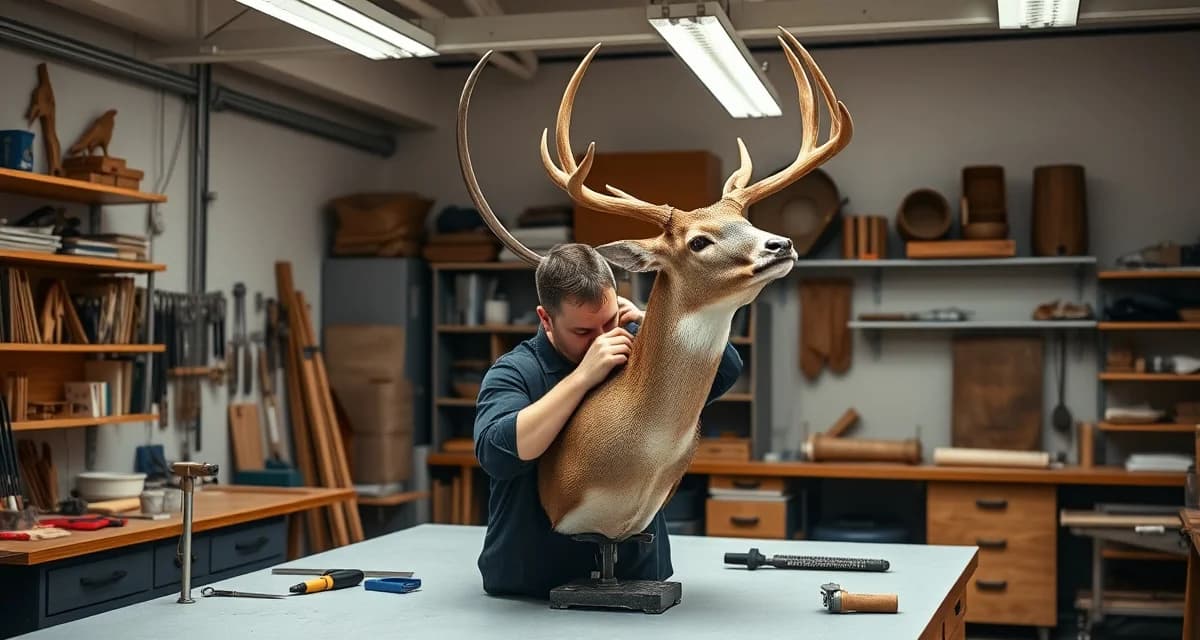
Solo Taxidermist Deer Season: 150 Mounts Alone with MountChief
There's a point in every growing solo taxidermy operation where the math doesn't work anymore. You can take more deer. There's demand. But you're already working 10-hour days through November and December, and the idea of adding more volume without adding help feels like a path to burnout.
This Missouri taxidermist hit that moment at 100 deer per season. He knew the demand was there for 150. He also knew that with his existing paper and spreadsheet system, 150 solo was going to break something. Either his records, his sanity, or both.
What he did instead of hiring was implement a system. The result: 150 deer, 6 weeks, solo, without dropping quality and without the intake chaos that usually comes with pushing volume.
TL;DR
- But you're already working 10-hour days through November and December, and the idea of adding more volume without adding help feels like a path to burnout.
- result: 150 deer, 6 weeks, solo, without dropping quality and without the intake chaos that usually comes with pushing volume.
- But 150 deer at 8 minutes each is 20 hours of intake time during the 6-week peak season.
- At 150 deer, that 4-minute difference is 10 hours of time returned to production.
- For a solo operator, 10 extra production hours during peak season is meaningful.
- The result: during his 150-deer season, he received an average of 2 status calls per week.
The Solo Taxidermist's Problem
Running a one-person operation has obvious advantages. No payroll, full control over quality, no personnel management. It also has obvious limits. There are only so many hours in a day, and every hour spent doing intake and answering status calls is an hour not spent on production.
At 100 deer per season, this taxidermist's time distribution was roughly:
- Production work: 60% of working hours
- Intake: 15%
- Customer communication (phone calls, texts): 15%
- Administrative and billing: 10%
That 15% spent on customer communication was the pain point. During peak deer season, it translated to 8 to 12 status calls per day, each requiring him to stop what he was doing, find the paper record for that customer's deer, give an update, and return to work.
At 150 deer, that communication load would scale up proportionally, unless something changed.
What Had to Change
The taxidermist's goal was straightforward: take 150 deer, keep quality at the same level he'd built his reputation on, and keep his sanity intact. That meant two things had to get faster or go away:
- Intake, which needed to get faster without sacrificing documentation quality
- Status calls, which needed to largely go away through customer self-service
He implemented MountChief before the season. The focus was AI intake speed and the customer portal.
The AI Intake Process
With paper, his deer intake ran 8 to 10 minutes per deer when it was going smoothly. Not bad for a solo operator. But 150 deer at 8 minutes each is 20 hours of intake time during the 6-week peak season. Time that comes directly out of production.
The AI intake process brought that down to 4 to 5 minutes per deer. The guided workflow captures condition photos, harvest information, mount specifications, and customer contact details more quickly than filling out a paper form. Required fields prevent gaps that would require follow-up calls.
At 150 deer, that 4-minute difference is 10 hours of time returned to production. For a solo operator, 10 extra production hours during peak season is meaningful.
He also found that the AI intake process created better records. The condition photos attached to every intake record replaced written condition notes that were sometimes vague. Photos are objective. They either show slippage or they don't.
The Customer Portal Impact
The customer portal was the bigger change. He sent every customer a portal link at intake. The portal shows the status of their mount in plain language. "cape at tannery," "in production," "ready for pickup."
The result: during his 150-deer season, he received an average of 2 status calls per week. Two. In a previous season at lower volume, he was fielding 40 to 50 per week during peak months.
That difference (from 50 calls per week to 2) is transformational for a solo operator. Every call requires him to stop, look up the record, answer the question, and restart his workflow. That context-switching overhead is real and expensive.
With 2 calls per week, he maintained production flow throughout the season. No constant interruptions. No lost minutes every time the phone rang with a question the portal could answer.
Maintaining Quality at 150 Mounts
The concern going into the season wasn't just capacity, it was quality. His reputation was built on the quality of his work. If chasing 150 deer led to rushing production and lower quality output, the volume gain wasn't worth it.
The structured intake process helped here too. With complete condition documentation at intake, there was no ambiguity about a cape's incoming state. Problems that showed up at production (a minor area of slippage, a small patch of freezer burn) were already documented. He could address them with the customer proactively rather than explaining a problem at pickup.
He finished the season at 150 deer. His quality dispute rate (complaints about finished work) was the same as his previous 100-deer seasons.
The 150-deer season validated his model. One person, properly supported by the right systems, can run a higher-volume operation than most solo taxidermists think is possible.
The Numbers on a Solo Operation
At the end of the season, the taxidermist shared his assessment:
- 150 deer completed solo in 6 weeks of peak intake
- 4 to 5 minutes per intake (down from 8 to 10)
- 2 status calls per week (down from 40 to 50)
- Zero mix-ups across 150 simultaneous jobs
- Quality complaints: none
The software investment paid for itself in the first week of the season based on time savings alone. But the more important return was operational. The ability to grow the business without adding overhead.
Frequently Asked Questions
How did this solo taxidermist handle 150 deer alone?
He used MountChief's AI intake to reduce intake time from 8 to 10 minutes per deer to 4 to 5 minutes, and the customer portal to reduce status calls from 40 to 50 per week to 2 per week. Those two changes returned enough time and mental bandwidth to run a 150-deer season solo without sacrificing quality or burning out.
What was the intake workflow for a solo shop during peak season?
Every deer went through a structured AI intake process capturing condition photos, harvest information, mount specifications, and customer contact details. Each cape received a QR tag at intake. The entire process took 4 to 5 minutes per deer, including the customer receiving their portal link. Required fields in the intake system prevented gaps that would have required follow-up time later.
How did the customer portal change this taxidermist's daily routine?
Before the portal, status calls averaged 40 to 50 per week during peak season, each one requiring him to stop production work, find the paper record, give an update, and restart. With the portal, customers checked their own status and called only with specific questions. Call volume dropped to 2 per week. That single change restored a continuous production workflow that wasn't possible when the phone was interrupting every hour.
How does this apply to solo taxidermy shops?
The principles in this guide apply to solo shops just as they do to larger operations, though the scale differs. A single-person shop may have lower absolute volume but faces the same documentation, compliance, and customer communication requirements. The practical advice here scales down to any shop size.
What is the most common mistake taxidermists make with solo shop deer season case study?
The most common mistake is treating solo shop deer season case study as an afterthought rather than building it into the standard workflow from the start. Shops that encounter problems in this area typically did not establish clear processes before season, which means every situation becomes a one-off decision rather than a standard response.
Related Articles
- Pennsylvania Deer Season: How a Shop Survived 200 Mounts in Two Weeks
- Colorado Elk Shop: How AI Intake Handled 60 High-Value Mounts
- How Compliance Tracking Saved a Texas Taxidermist from a Federal Investigation
- Case Study: How Deposit Automation Eliminated Abandoned Mounts
Try These Free Tools
Put these insights into practice with our free calculators and planners:
Sources
- National Taxidermists Association (NTA)
- US Fish & Wildlife Service
- Breakthrough Magazine
- State wildlife agencies
Get Started with MountChief
Deer season is the most demanding time of year for any taxidermist, and the shops that handle it best are the ones that prepared before opening day. MountChief gives you fast AI intake, automatic customer portal activation, and tannery tracking so your busiest weeks are also your most organized. Try MountChief before your next deer season opener.