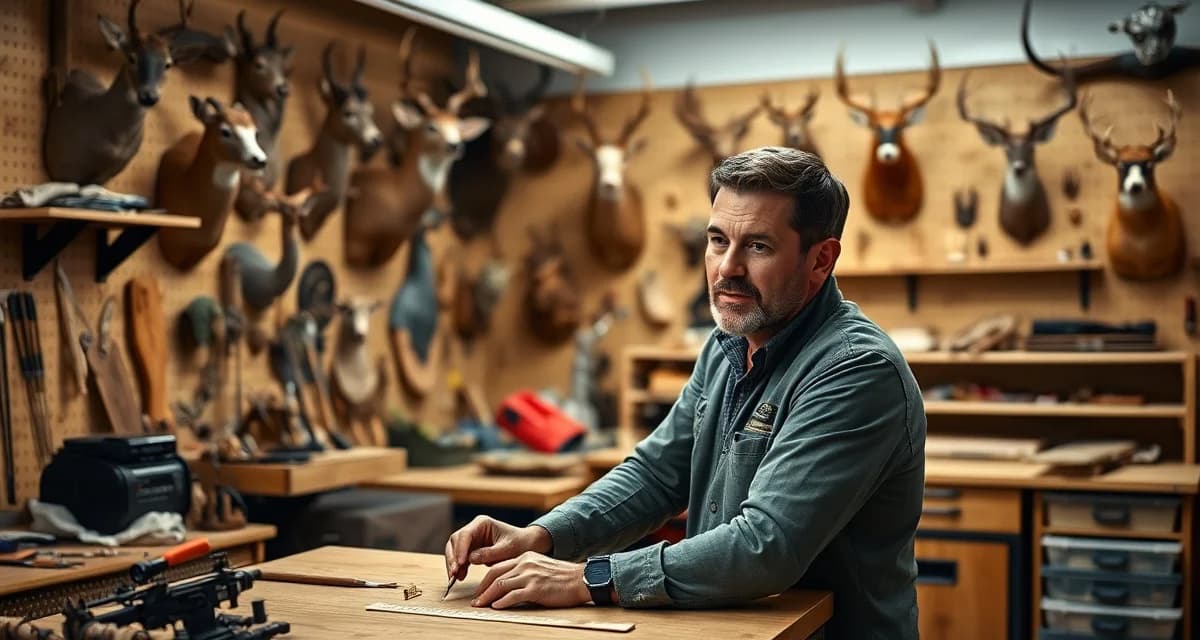
How a Solo Taxidermist Eliminated 10 Daily Status Calls with MountChief
Running a one-person taxidermy shop means every hour matters. There's no one else to answer the phone, handle intake, do the books, and still get the actual mount work done. Time lost to interruptions doesn't get made up later, it just disappears.
For years, Aaron M. ran his whitetail and turkey operation out of a converted barn in rural Indiana, processing around 180 mounts per year. Good business, solid reputation, work he was genuinely proud of. But he was drowning in status calls.
"During November, I'd get ten, twelve calls a day. Every single one was somebody asking where their mount was. I'd stop what I was doing, go find their folder, look at my notes, try to figure out where it was in the queue. Then I'd tell them 'it's coming along, probably another eight months or so.' Then hang up and try to find where I was."
That was two hours per day, minimum. In a 180-mount shop where Aaron was doing every hour of production himself, two hours was the difference between a profitable season and an exhausting one.
TL;DR
- Aaron was fielding 10-12 status calls per day during peak season, costing him two hours of production time daily.
- Over a 90-day peak season, two hours per day adds up to 180 hours of lost production.
- After loading 160 active jobs into MountChief in about four hours, status calls dropped roughly 75 percent within one month.
- Automated tannery notifications eliminated most calls because customers simply had no information before.
- Intake time per animal dropped from 15 minutes with paper to under 4 minutes with AI photo intake.
- At 20-30 intakes over a peak weekend, saving 10 minutes each adds up to 3-5 hours per weekend recovered.
What His System Looked Like Before
Like most shops his size, Aaron ran on a combination of paper intake forms, a physical binder sorted by season, and handwritten tags on every specimen. The system worked well enough to run the business, he'd been doing it for 11 years, but it wasn't designed for customer communication.
When someone called, the information they wanted was somewhere in the binder, or in a note he'd made somewhere, or in his memory of where in the process things were. None of it was at his fingertips.
"The worst calls were when I actually didn't know. A cape goes to the tannery, comes back, sits in staging for a few weeks, by the time the customer calls, I've got to piece it together. I'm telling them 'should be out of tannery soon' and I'm really not sure if it's been six weeks or ten."
He tried a spreadsheet. It helped a little with tracking, but it didn't solve the call problem because the spreadsheet was on his laptop in the office and the calls came when he was in the shop.
The Decision to Try Software
Aaron found MountChief through a Google search after a particularly brutal November Saturday, four hours of production lost to intake and status calls.
"I wasn't looking to spend money on software. I'm one guy, I thought I didn't need it. But I did the math, two hours a day, times the 90-day peak season, that's 180 hours. If I could get that time back, at my shop rate, that's real money."
He signed up for the free trial and spent about three hours the first week setting up job stages and loading his current queue.
The Setup
Loading the existing queue was the most time-consuming part. Aaron photographed each binder folder and used MountChief's AI to extract the intake information, species, customer name, intake date, then manually confirmed the current stage for each.
"It took me about four hours total to get 160 active jobs loaded. That sounds like a lot but it's less than I was losing every week to status calls."
Once the active queue was in the system, he set up five stages to match his actual workflow:
- Received
- Skinned and Salted
- At Tannery
- Back from Tannery / Staging
- In Production
- Ready for Pickup
He configured automated SMS notifications for stages 3, 4, and 6, the tannery transitions and pickup notification. Those were the most-called-about stages.
Then he texted the tracking link to every customer with an active job in the system. That took about two hours on a Sunday afternoon, copying the link from each job and texting it manually to that customer.
What Happened Next
The effect wasn't immediate, it took two weeks for customers to start using the portal, and a few needed a second reminder. But by the end of the first month:
"The calls didn't stop completely, but they dropped maybe 75 percent. Instead of ten calls a day, I was getting two or three. And those calls were mostly people who needed to reschedule pickup or ask about adding a detail to their mount. Actual useful conversations."
The automated tannery notifications were the biggest single change. Most of Aaron's status calls came from customers who had no idea where in the process their cape was. When the system automatically texted them "Your cape has been shipped to our tannery" and then "Your cape is back from the tannery," those calls stopped.
"People weren't calling to be difficult. They were calling because they had no information. Give them information and they stop calling. It's obvious in hindsight but I hadn't figured out how to give it to them without stopping what I was doing."
The Numbers at the End of One Season
At the end of that first deer season with MountChief, Aaron tracked his results:
- Status calls per day during peak season: down from 10-12 to 2-3
- Time recovered daily: approximately 90 minutes
- Over the 90-day peak season: roughly 135 hours of production time recovered
- Intake time per animal: down from 15 minutes with paper to under 4 minutes with AI photo intake
- Specimen mix-up incidents: zero (he'd had two the previous season that required corrections)
"The math on the intake time alone pays for the software. At peak, I'm doing 20-30 intakes over a weekend. If I'm saving 10 minutes each, that's 3-5 hours per weekend. MountChief is $79 a month. That's a good deal."
The mix-up prevention was a bonus Aaron hadn't fully anticipated. With QR tags on every specimen and stage tracking in the system, he always knew exactly where each piece was. The previous season's mix-ups, where two similar-looking capes ended up getting their ear liners swapped, requiring rework on both, couldn't happen with the QR system because every specimen's history was scannable.
What He'd Change
Aaron was direct about the onboarding: "Getting the existing queue loaded is a bit of a project. I'd recommend doing it in the offseason, not the week before deer season. I jumped in during November and it was stressful. If you can load your active queue in September before the rush, you'll be in good shape."
He also noted that customer adoption took some nudging. "Older hunters especially didn't immediately go to the portal. They'd call, I'd remind them about the link, they'd use it. After the second call, almost everyone was using it. The younger guys used it immediately."
How long does it take to load an existing job queue into MountChief?
Aaron loaded 160 active jobs in about four hours by photographing each binder folder and using MountChief's AI to extract the intake information. The time investment is less than a single week of status calls at the rate most busy shops field. Doing this in the offseason rather than mid-season makes the setup significantly less stressful.
Can older customers who are not comfortable with technology use the portal?
Most do, with a little initial prompting. Aaron found that older hunters typically needed one reminder after their first call to start using the portal, but used it consistently after that. Younger hunters adopted it immediately. The browser-based link with no app download required keeps the barrier low for all age groups.
What if a shop does not want to automate everything?
Even partial automation helps significantly. Setting up just the tannery shipment and return notifications, without automating every stage, eliminates the most-called-about status questions. Starting with those two stages alone reduced Aaron's calls before he set up the full portal workflow.
Related Articles
- How to Reduce Status Calls at Your Taxidermy Shop
- How Do QR Code Tags Work for Taxidermy Shop Management?
- Should I Have a Home Studio or Commercial Taxidermy Shop?
- Should a Taxidermist Have a Separate Business Bank Account?
FAQ
Try These Free Tools
Put these insights into practice with our free calculators and planners:
Sources
- National Taxidermists Association (NTA)
- Breakthrough Magazine
- Taxidermy Today
Get Started with MountChief
A solo shop running 180 mounts per year can recover 135 hours of production time per season by eliminating unnecessary status calls. MountChief's customer portal, automated stage notifications, and AI intake address all three sources of that lost time. Try MountChief before your next deer season to see what those hours are worth to your operation.