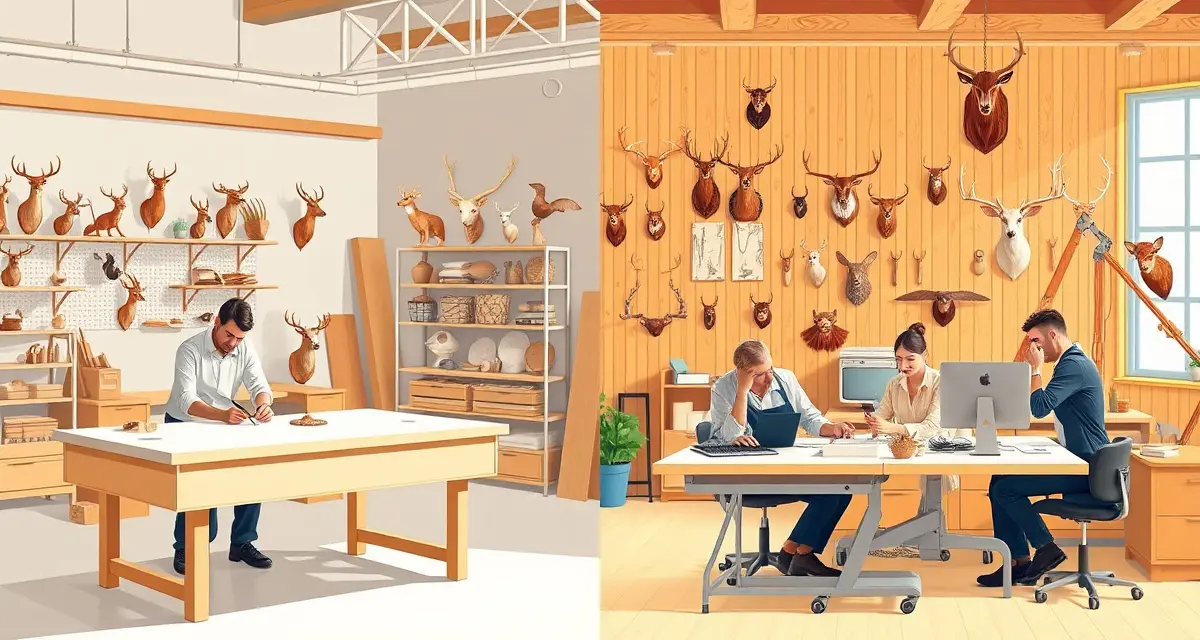
Solo Taxidermy Shop vs Team Operation: Pros and Cons
Seventy-five percent of professional taxidermists remain solo operations throughout their career. Adding a second taxidermist increases complexity by 3x, but software makes that management complexity significantly more manageable than it used to be.
This comparison covers the real trade-offs between solo and team operations so you can make the right decision for your shop's specific situation.
TL;DR
- prep assistant adds 3-5 hours of daily production time by handling the tasks that don't require full taxidermy skill.
- Adding a second taxidermist increases complexity by 3x, but software makes that management complexity significantly more manageable than it used to be.
- Most full-time solo taxidermists accept 100-250 deer per season depending on efficiency and production speed.
- High-volume solo operators using AI intake and management software can push toward 300+ at the high end.
- Revenue ceiling: Maximum solo revenue typically tops out at $150,000-$200,000 for the highest-volume, highest-efficiency operators.
- Risk coverage: When you're sick or need time off, the shop continues operating.
The Solo Taxidermy Shop
What Solo Looks Like
A solo shop is one taxidermist managing every aspect of the operation: intake, production, tannery coordination, customer communication, compliance, invoicing, and marketing. The taxidermist's personal capacity is the business's capacity ceiling.
Most full-time solo taxidermists accept 100-250 deer per season depending on efficiency and production speed. High-volume solo operators using AI intake and management software can push toward 300+ at the high end.
Advantages of Solo Operation
Complete quality control: Every mount that leaves your shop was made by you. Your name is on every piece of work. No quality variation from multiple producers.
Simple management: No staff scheduling, no training costs, no HR responsibilities. Your decisions are your own.
Full flexibility: You work when you want, how you want. You can close intake the moment you feel at capacity. You can take two weeks off in March without managing a team.
Better margins per mount: No labor costs beyond your own time. Your revenue efficiency is higher because you're not splitting margin with employees.
Customer relationship focus: Solo taxidermists often build the strongest customer relationships because every customer interacts directly with the person making their mount. This creates loyalty that team operations struggle to replicate.
Disadvantages of Solo Operation
Hard capacity ceiling: Your production ceiling is your personal production rate. You can't grow beyond what one person can do, regardless of demand.
No coverage for illness or emergency: If you're sick, production stops. If you have a family emergency, the shop stops. There's no backup.
Burnout risk during peak season: The intensity of solo operation during firearms deer season, 7-day weeks, high call volume, heavy production, creates burnout risk that impacts health, relationships, and long-term sustainability.
Revenue ceiling: Maximum solo revenue typically tops out at $150,000-$200,000 for the highest-volume, highest-efficiency operators. Team operations can scale significantly beyond this.
The Team Taxidermy Operation
What Team Operation Looks Like
A team operation ranges from a solo taxidermist with a part-time prep assistant to a multi-taxidermist shop with dedicated intake staff and a shop manager. The most common first expansion is adding a prep/intake assistant rather than a second taxidermist.
Advantages of Team Operation
More capacity: A second taxidermist nearly doubles production capacity. A prep assistant adds 3-5 hours of daily production time by handling the tasks that don't require full taxidermy skill.
Risk coverage: When you're sick or need time off, the shop continues operating. Customer commitments don't slip because of personal circumstances.
Specialization potential: A team allows specialization, one person handles deer while another handles birds, or one handles intake while the other focuses purely on production.
Scale potential: Only team operations can grow to the volume levels ($300,000+ revenue) that represent the ceiling for the industry's top performers.
Disadvantages of Team Operation
Management complexity: Adding one person to your operation creates scheduling, training, quality consistency, and communication responsibilities that don't exist when you work alone. This is a real time cost that reduces the efficiency gain from the added person.
Quality variation: Two taxidermists don't make identical mounts. Managing customer expectations about which taxidermist worked on their deer requires proactive communication.
Higher fixed costs: Wages, employer taxes, workers' compensation insurance, and potentially more shop space all create fixed costs that must be covered regardless of season volume.
Administrative overhead: More people means more documentation, more schedule coordination, and more management software dependency. Running a team on paper is extremely difficult.
Loss of customer relationship simplicity: Customers who've built a relationship with you specifically may be surprised or disappointed if their mount is completed by someone else.
The Right First Hire for Most Shops
Most taxidermists' first hire should be a prep/intake assistant, not a second taxidermist. A prep assistant who handles:
- Intake documentation and photography
- Initial cape and specimen processing (skinning, fleshing prep)
- Tannery packaging and shipment
- Customer portal management and communication
- Supply inventory and ordering
- Phone handling and status call routing
...frees 2-4 hours of your daily production time without adding a second taxidermist's wage. This hire is typically $15,000-$25,000 per year vs $35,000-$55,000 for a second taxidermist, and it resolves the time constraint before you've added production complexity.
How Software Changes the Math
The traditional argument against team operation is the management complexity cost. Software changes this calculation by handling most of the coordination work automatically.
With MountChief's taxidermy shop management software:
- Job assignments are tracked digitally, not on a whiteboard
- Stage updates by any team member are visible to everyone
- Customer communications go out automatically without requiring the owner to review each one
- Tannery shipments are logged by whoever processes them
- Compliance documentation is required at intake regardless of who runs intake
The information management burden of a two-person shop on paper is significant. The same two-person shop on software is manageable.
Decision Framework: When to Add Your First Person
Consider adding a first employee when all of these are true:
- You're consistently at or over production capacity for 2+ consecutive seasons
- You've already maximized your pricing (raised prices to where demand hasn't meaningfully declined)
- You have documented processes that can be trained
- You've implemented management software so coordination doesn't rely on your memory
- The financial math works: the new hire's cost is covered by the additional revenue they enable
If all five conditions aren't met, don't hire. Fix the missing condition first.
Frequently Asked Questions
What are the advantages of staying solo as a taxidermist?
Complete quality control, full operational flexibility, no management overhead, and better margins per mount are the primary advantages of solo operation. Seventy-five percent of professional taxidermists remain solo throughout their careers by choice, not because they can't grow, but because the trade-offs of team management don't match their goals. Solo operators who've systematized their workflow with management software can achieve strong revenue and manageable work hours without taking on the complexity of staff management.
When does it make sense to build a taxidermy team?
It makes sense when you've been at sustainable production capacity for two or more consecutive seasons, you've already raised prices to market levels without losing demand, you have documented processes ready for training, and the financial model supports the additional labor cost. The most common sequence that works: systematize with software, raise prices, consistently exceed capacity, hire a prep assistant, grow to the next volume level. Shops that jump to hiring before systematizing find that they've scaled their problems, not their efficiency.
How does software change the math for solo vs team taxidermy shops?
Software reduces the management overhead of a team operation by automating the information coordination that would otherwise require constant owner attention. Job status tracking, customer communication, tannery logs, and compliance documentation are all visible to every team member and automated where possible. The practical effect is that a two-person shop with good software operates more efficiently than a two-person shop on paper at three times the management overhead. Software doesn't eliminate the complexity of managing people, but it does significantly reduce the information management burden that makes adding a first employee feel overwhelming.
How does this apply to solo taxidermy shops?
The principles in this guide apply to solo shops just as they do to larger operations, though the scale differs. A single-person shop may have lower absolute volume but faces the same documentation, compliance, and customer communication requirements. The practical advice here scales down to any shop size.
What is the most common mistake taxidermists make with taxidermy shop solo vs team comparison?
The most common mistake is treating taxidermy shop solo vs team comparison as an afterthought rather than building it into the standard workflow from the start. Shops that encounter problems in this area typically did not establish clear processes before season, which means every situation becomes a one-off decision rather than a standard response.
Related Articles
- Tannery Comparison Guide for US Taxidermists: Region by Region
- Tips for the First Day of Deer Season at Your Taxidermy Shop
- How Do I Choose the Right Taxidermy Software for My Shop?
Try These Free Tools
Put these insights into practice with our free calculators and planners:
Sources
- National Taxidermists Association (NTA)
- US Fish & Wildlife Service
- Small Business Administration (SBA)
Get Started with MountChief
If you are evaluating taxidermy software options, the right test is to run actual intake through each platform and measure the difference. MountChief is $79 per month with all features included and setup takes hours, not days. Try MountChief free and compare it directly against whatever you are using now.