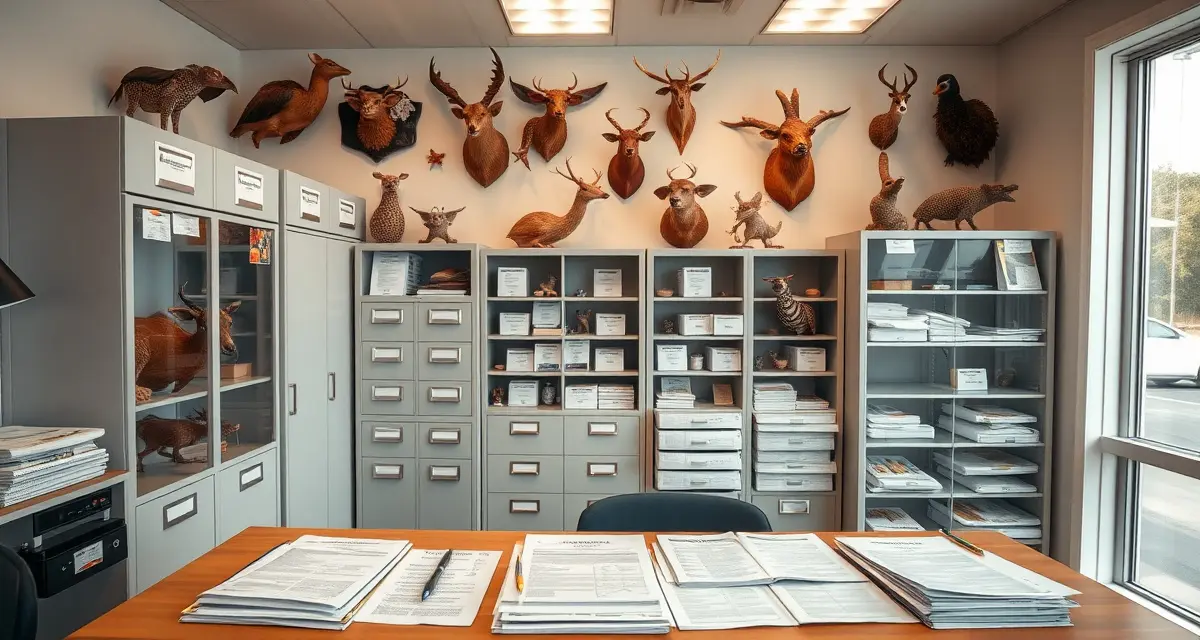
What Forms Are Legally Required for a Taxidermy Shop?
Running a taxidermy shop without the right documentation isn't just a business risk, it's a federal and state compliance issue. Understanding which forms you're legally required to maintain is foundational to operating without the threat of license suspension or worse.
TL;DR
- Most states require taxidermists to use some form of written intake record for every specimen received.
- There is no single federally mandated intake form, but federal wildlife law requires documentation for specific species.
- Migratory bird intake must be documented per federal requirements under the Migratory Bird Treaty Act.
- State-specific forms may be required for regulated species; check your state wildlife agency's requirements.
- Digital intake records are legally equivalent to paper records in most states if they contain required information.
Federal Requirements: USFWS
The most significant federal requirement is the Federal Taxidermist Permit issued by the U.S. Fish and Wildlife Service. This permit is required before you can legally accept, possess, or work on any migratory bird species. Which includes ducks, geese, swans, doves, woodcock, and many others.
Without the USFWS permit, accepting a mallard for mounting is a federal wildlife violation, regardless of what your state allows. This is non-negotiable. You must have this permit in place before your first bird walks through the door.
Federal taxidermists are also required to maintain a Federal Taxidermist Record Book. A log of all migratory birds received, including species, date of receipt, and the hunter's name, address, and Federal Duck Stamp information. USFWS agents can inspect this record at any time.
For species covered by CITES (Convention on International Trade in Endangered Species), additional documentation is required, including valid CITES permits for any covered species. This matters most for exotic and international species, as well as certain raptors and marine mammals.
State-Level Requirements
State requirements vary significantly, but most states require:
A valid state taxidermist license. Nearly every state requires taxidermists to obtain a state-issued license, typically renewed annually. Operating without this license exposes you to fines and potentially criminal charges.
Written intake records for deer and other big game. Most states require that intake records include at minimum: the customer's name and address, hunter license number, species, date of harvest, and county or zone of harvest. Verbal records don't satisfy these statutes in most jurisdictions. The record must be written or digital.
Record retention for minimum periods. Most states require you to retain intake records for a minimum of two to five years. Some require longer for certain species. A digital record system makes compliance with retention requirements straightforward.
For wildlife compliance documentation, the specific requirements vary by state. MountChief's intake forms capture all standard state-required fields by default.
Common Documentation Gaps
The most common violation in compliance inspections is incomplete intake records. Missing hunter license numbers, undocumented harvest locations, or no written record at all for a species that requires documentation.
A close second is the absence of a USFWS permit in shops that occasionally accept birds. Many taxidermists who primarily do deer and big game assume bird work is covered under their state license. It isn't.
The taxidermy intake form guide covers how to structure your intake records to capture all required information at the time of drop-off.
FAQ
What USFWS forms does a taxidermist need?
Taxidermists who accept any migratory bird species must hold a Federal Taxidermist Permit issued by the U.S. Fish and Wildlife Service. This permit requires maintaining a Federal Taxidermist Record Book logging all birds received with customer information and species details. USFWS agents have the authority to inspect this record book at any time.
Are there state-specific forms required for deer taxidermy?
Most states require written intake records for deer that include the customer's name, hunter license number, species, harvest date, and harvest county or zone. Some states have mandatory state-specific intake forms, while others accept any format that captures the required fields. Check your state wildlife agency's taxidermist regulations for the specific documentation your state requires.
What are the penalties for missing required taxidermy forms?
Penalties vary by violation type and state. Missing or incomplete state intake records typically result in fines and possible license suspension. Federal violations (such as accepting migratory birds without a USFWS permit) can result in criminal charges under the Migratory Bird Treaty Act, with fines up to $15,000 per violation and potential license revocation.
Is there a federally required intake form for taxidermists?
No single federal form is required for all taxidermy work. Federal documentation requirements apply to specific species: migratory birds require records under the Migratory Bird Treaty Act, and CITES-listed species require associated permit documentation. For general game species, intake record requirements are set by state wildlife agencies and vary by state.
Can I use digital records instead of paper forms?
Yes. Most states accept organized digital records as equivalent to paper forms as long as they contain all required information and are available for inspection. Some states may have specific requirements about format or storage, so verify with your state wildlife agency if you are switching from paper to digital records.
What fields must a legally compliant intake form contain?
At minimum for most states: customer name and address, hunting license number, species, harvest date, harvest location (state and county), and date received by the taxidermist. Additional fields are required for specific species such as skull seal numbers for bear, migratory bird license numbers for waterfowl, and CITES documentation for listed species.
Related Articles
- How Much Does Bailee's Insurance Cost for a Taxidermy Shop?
- How Do QR Code Tags Work for Taxidermy Shop Management?
FAQ
Try These Free Tools
Put these insights into practice with our free calculators and planners:
Sources
- US Fish & Wildlife Service, Office of Law Enforcement
- National Taxidermists Association (NTA)
- State wildlife agencies
Get Started with MountChief
A legally compliant intake form captures everything required by state and federal law from the first moment a customer walks in. MountChief's intake system is built around required fields for every species and flags additional documentation requirements automatically. Try MountChief to make every intake legally complete.