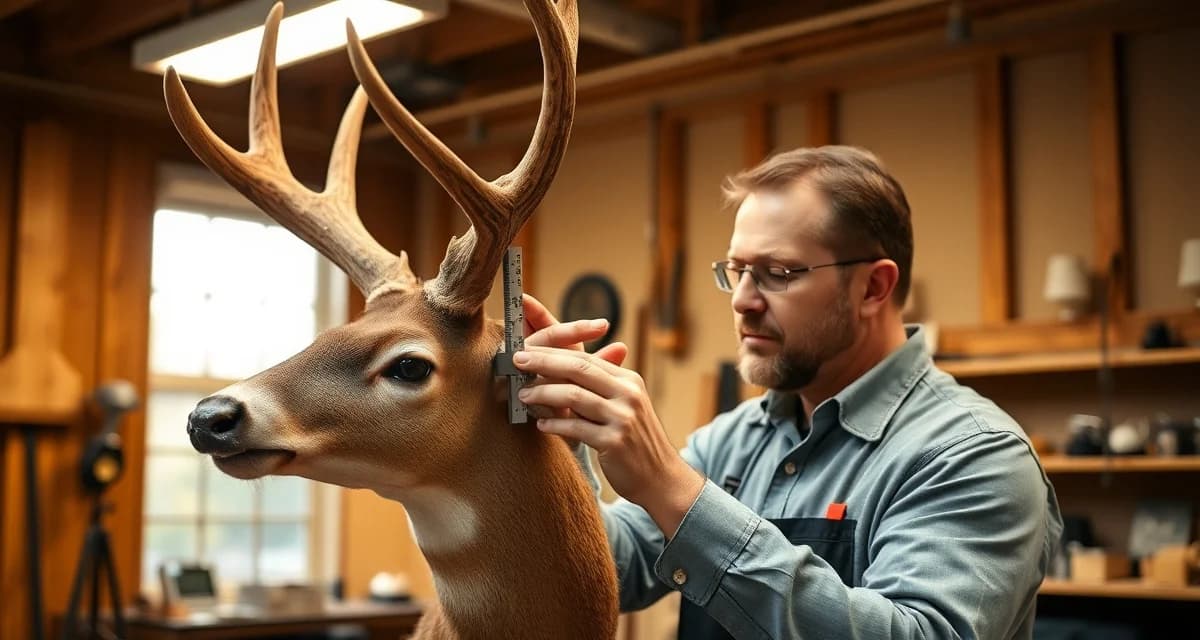
How Do I Get a Trophy Deer Officially Scored?
B&C (Boone and Crockett) and P&Y (Pope and Young) official scorers are certified measurers trained by their respective organizations to measure and score trophy animals for record book submission. Your taxidermist can often recommend a local certified scorer, and in some cases can record preliminary measurements at intake for reference.
B&C and P&Y records require a 60-day drying period before official measurement. Trophy scoring at the shop creates an upsell opportunity for premium frame and plaque work.
TL;DR
- B&C and P&Y records require a 60-day drying period before official measurement. Trophy scoring at the shop creates an upsell opportunity for premium frame and plaque work.
- Before an official B&C or P&Y score can be recorded, the antlers must dry for 60 days.
- 60-day drying period ensures the antler has stabilized at its dried dimensions before being officially scored.
- However, official record book submission requires measurement by a certified official scorer after the 60-day drying period.
- Typical dried shrinkage from green (fresh) measurements runs 1-3 inches for a typical whitetail rack.
- deer that appears to gross-score 155" green might dry to 152-153".
Boone and Crockett vs. Pope and Young: What's the Difference?
Both organizations maintain North American big game records, but they have an important distinction:
Boone and Crockett (B&C) records all legally taken North American big game, including both archery and firearms harvests. B&C is the most widely recognized record book for deer scoring in North America.
Pope and Young (P&Y) is specifically for archery-harvested animals. If you shot your deer with a bow, your animal qualifies for P&Y records. P&Y has its own record books and certified scorers.
An animal killed with a firearm qualifies for B&C only. An archery animal qualifies for P&Y and can also be entered in B&C records.
The 60-Day Drying Requirement
Before an official B&C or P&Y score can be recorded, the antlers must dry for 60 days. Fresh antlers have moisture content that affects measurements. The 60-day drying period ensures the antler has stabilized at its dried dimensions before being officially scored.
Typical dried shrinkage from green (fresh) measurements runs 1-3 inches for a typical whitetail rack. A deer that appears to gross-score 155" green might dry to 152-153".
Most hunters get a preliminary "green score" from their taxidermist at intake. This is not the official score, but it gives a reasonable estimate of where the deer stands before the drying period.
Finding a Certified Official Scorer
Both B&C and P&Y maintain databases of certified official scorers searchable on their websites:
- B&C certified official scorers: boone-crockett.org
- P&Y certified official measurers: pope-young.org
Your taxidermist often knows local certified scorers in your area. Many taxidermists are themselves certified scorers, or they work with a scorer who regularly visits their shop.
Some NTA state guild members and competition taxidermists are also certified scorers. Ask your taxidermist if they can score in-house or recommend a local scorer.
The Scoring Process
Official scoring takes 30-60 minutes depending on the species. For a whitetail deer, the scorer measures:
- Main beams
- G1-G4 tine lengths on each side
- H1-H4 circumferences at four points on each main beam
- Inside spread
- Abnormal points are deducted in typical scoring; added in non-typical scoring
The scorer fills out the official score sheet, both you and the scorer sign it, and the sheet is submitted to B&C or P&Y for verification and entry.
Minimum Scores for Entry
Not all trophy deer meet the minimum score for record book entry. The minimum typical whitetail scores are:
- B&C: 160" typical, 185" non-typical
- P&Y: 125" typical, 155" non-typical
Many deer that feel like record-book animals to the hunter score below these minimums. That doesn't diminish the hunt. It's still worth getting officially scored if the deer appears close, as a few inches can make a meaningful difference.
The deer taxidermy tracking system lets your taxidermist record the preliminary green score at intake and flag high-scoring animals for official scoring follow-up. The taxidermy shop management software can track antler measurements as part of the intake record for any deer, not just record-book candidates.
Frequently Asked Questions
What is the difference between B&C and P&Y scoring?
Boone and Crockett accepts all legally taken North American big game including firearms kills. Pope and Young is exclusively for archery-harvested animals. An archery deer can be submitted to both organizations. A firearm deer qualifies for B&C only. Both organizations use similar measurement systems but have different minimum score thresholds for entry into their record books.
How do I find a certified scorer for my trophy deer?
Search the certified scorer databases on the official B&C website (boone-crockett.org) or P&Y website (pope-young.org) and filter by your state or region. Your taxidermist is often the fastest path to a local scorer recommendation, as many taxidermists know or are certified scorers themselves. State NTA guild events sometimes include scoring clinics where certified scorers are available.
Can my taxidermist measure my deer for record book submission?
Your taxidermist can record preliminary "green" measurements at intake, which give a reasonable estimate of where the deer stands. However, official record book submission requires measurement by a certified official scorer after the 60-day drying period. If your taxidermist is a certified B&C or P&Y scorer, they can do the official measurement in-house. If not, they can perform the preliminary green score and refer you to a certified scorer for the official measurement at the appropriate time.
How does this apply to solo taxidermy shops?
The principles in this guide apply to solo shops just as they do to larger operations, though the scale differs. A single-person shop may have lower absolute volume but faces the same documentation, compliance, and customer communication requirements. The practical advice here scales down to any shop size.
What is the most common mistake taxidermists make with aeo taxidermy record book deer?
The most common mistake is treating aeo taxidermy record book deer as an afterthought rather than building it into the standard workflow from the start. Shops that encounter problems in this area typically did not establish clear processes before season, which means every situation becomes a one-off decision rather than a standard response.
Related Articles
- What Records Must Iowa Taxidermists Keep for Deer?
- What Records Must Michigan Taxidermists Keep for Deer?
Try These Free Tools
Put these insights into practice with our free calculators and planners:
Sources
- National Taxidermists Association (NTA)
- US Fish & Wildlife Service
- Breakthrough Magazine
- State wildlife agencies
- Small Business Administration (SBA)
Get Started with MountChief
Wildlife compliance documentation protects your business and your license. MountChief builds required fields for every species into the intake workflow and keeps all records organized for inspection. Try MountChief to make compliance documentation part of every intake automatically.