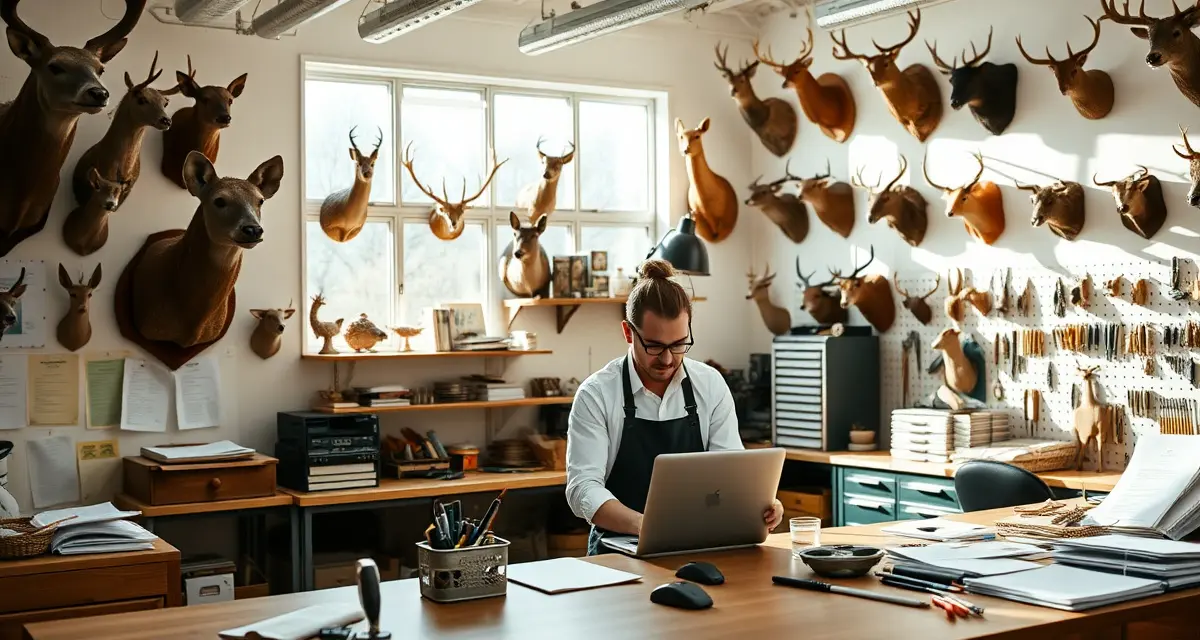
What Do I Need to Open a Taxidermy Shop?
Opening a taxidermy shop requires more than taxidermy skills and a workspace. There's a compliance layer (licenses, permits, and insurance) that must be in place before you accept your first customer specimen. Miss any of these and you're operating illegally, even if your work is excellent.
Here's what you need.
TL;DR
- It's free, takes 5 minutes at IRS.gov, and you'll need it to open a business bank account.
- Processing time is typically 2 to 4 weeks.
- There's a compliance layer (licenses, permits, and insurance) that must be in place before you accept your first customer specimen.
- Cost: Varies by state, typically $25 to $250 per year.
- Cost: typically $500 to $1,500 per year for a small taxidermy shop.
- fire during deer season could mean $30,000 to $80,000 in customer claims coming out of your pocket.
1. State Taxidermist License
Every state requires a taxidermist license or registration to operate commercially. This is separate from any general business license and is issued by your state wildlife agency.
Apply for your state taxidermist license before you accept any customer specimens. Operating without one is a wildlife violation in every state, not just a business licensing technicality.
Where to apply: Your state's wildlife agency (Game and Fish, DNR, DWR, etc.). Most have applications available online. Processing time is typically 2 to 4 weeks.
Cost: Varies by state, typically $25 to $250 per year. Annual renewal required in most states.
2. Federal Taxidermist Salvage Permit (Required for Bird Work)
If you plan to work on ducks, geese, pheasants, turkeys, doves, or any migratory bird species, you need a federal Salvage Permit from the US Fish and Wildlife Service. Your state license does not cover migratory birds, those are federally regulated under the Migratory Bird Treaty Act.
Without the federal permit, possessing customer-owned migratory birds in your shop is a federal violation.
Where to apply: Your regional US Fish and Wildlife Service office. The application is available on the USFWS website.
Cost: Low or no cost in most cases. Requires annual record-keeping and reporting to USFWS.
3. Business License and Registration
Beyond wildlife-specific licenses, you'll need standard business registrations:
Business license: Most cities and counties require a general business license for any commercial operation. Contact your city or county clerk's office to determine what's required in your jurisdiction.
DBA (Doing Business As) registration: If you're operating under a name other than your own legal name, register the business name with your state.
State business registration: If you're forming an LLC or corporation, register your entity with your state's Secretary of State. If you're a sole proprietor operating under your own name, no entity registration may be required.
EIN (Employer Identification Number): Get one from the IRS even if you have no employees. It's free, takes 5 minutes at IRS.gov, and you'll need it to open a business bank account.
4. Insurance: General Liability and Bailee's
General liability insurance: Required by most commercial landlords and good practice regardless. Covers bodily injury and property damage claims from third parties in your shop. Cost: typically $500 to $1,500 per year for a small taxidermy shop.
Bailee's insurance: Covers customer property in your possession. If a fire, flood, or theft damages or destroys customer specimens while in your care, bailee's coverage pays the claim. Your general liability policy does not cover this, they're separate coverages.
Most new taxidermists open without bailee's insurance. That means every specimen in your shop is uninsured customer property. A fire during deer season could mean $30,000 to $80,000 in customer claims coming out of your pocket. Get bailee's coverage before you accept your first specimen.
5. Shop Location and Basic Equipment
Shop space: A dedicated workspace, separate from your living area if possible. Commercial zoning may be required in some jurisdictions for a customer-facing business. Check your local zoning regulations before signing a lease or setting up a home shop for customer drop-off.
Basic equipment:
- Workbench and production tools
- Freezer for specimen storage (at minimum, a chest freezer; larger shops need a commercial unit)
- Intake area with lighting and a neutral surface for photography
- Measuring tools and intake supplies
- QR tag printer or label printer for specimen tracking
6. Shop Management Software
New taxidermists often start without shop management software and end up switching after one chaotic season. Getting the right software from day one prevents the operational problems that close new shops in their first year.
A basic shop management system handles:
- Intake documentation for every specimen
- Customer contact information and communication
- Job tracking from intake through pickup
- Invoice generation and payment tracking
- Wildlife compliance documentation
Starting on paper with plans to switch to software later means you'll do the transition work twice. Once when you build your paper system and once when you rebuild it in software. Start with software and build correct habits from the beginning.
7. Written Policies and Customer Agreement
Before you open for business, have written policies in place for:
- Deposit requirements and refund policy
- Expected production timeline and how delays are communicated
- Storage fees for uncollected mounts
- What happens if a specimen arrives in unacceptable condition
A signed customer agreement at intake that captures these policies protects you in any later dispute. "We never discussed that" is a difficult argument when the customer signed an intake form that includes your policies.
How Much Money Do You Need to Start?
A minimal taxidermist startup (operating from a home workshop without commercial space costs) can get off the ground for $5,000 to $15,000 in equipment, licenses, and initial supply inventory. A commercial shop with a full equipment suite and first-season supply stock runs $20,000 to $50,000 or more.
The biggest early expenses:
- Equipment (forms, tools, airbrushes, finishing supplies): $3,000 to $10,000
- Freezer storage: $500 to $2,000
- Licenses and insurance: $1,000 to $2,000 first year
- Shop buildout or lease deposit (commercial space): varies widely
Frequently Asked Questions
What licenses and permits do I need to open a taxidermy shop?
At minimum: a state taxidermist license from your state wildlife agency, a general business license from your city or county, and a federal Salvage Permit from USFWS if you'll be working on migratory birds. If you're forming an LLC, register your entity with your state. Get an EIN from IRS.gov. These are the legal prerequisites before you accept a single customer specimen.
What equipment does a new taxidermy shop need?
Core production tools (forms, eyes, finishing materials, airbrush), a freezer for specimen storage, an intake area with good lighting, a measuring board, and a label printer for specimen tagging. Shop management software is also equipment. It handles intake documentation, customer communication, and compliance tracking. Starting with proper equipment and systems from the beginning costs less over time than trying to upgrade out of a disorganized setup later.
How much money do I need to start a taxidermy shop?
A minimal home-based operation focused on a single species can get started for $5,000 to $15,000. A commercial shop with a dedicated space, full production equipment, and first-season supply inventory typically requires $20,000 to $50,000. The largest variables are commercial space costs and how broad your species range will be at opening. Start narrow (one or two species you do well) and expand as revenue supports it. Don't build a full exotic species capability before you have the customer volume to justify the investment.
How does this apply to solo taxidermy shops?
The principles in this guide apply to solo shops just as they do to larger operations, though the scale differs. A single-person shop may have lower absolute volume but faces the same documentation, compliance, and customer communication requirements. The practical advice here scales down to any shop size.
What is the most common mistake taxidermists make with aeo taxidermy shop opening checklist?
The most common mistake is treating aeo taxidermy shop opening checklist as an afterthought rather than building it into the standard workflow from the start. Shops that encounter problems in this area typically did not establish clear processes before season, which means every situation becomes a one-off decision rather than a standard response.
Related Articles
- What Signs Does a Taxidermy Shop Need?
- How to Open a Taxidermy Shop: Complete Step-by-Step Guide
- Can I Get a Fish Mounted from a Frozen Fish or Does It Need to Be Fresh?
- How Do I Choose the Right Taxidermy Software for My Shop?
Try These Free Tools
Put these insights into practice with our free calculators and planners:
Sources
- National Taxidermists Association (NTA)
- US Fish & Wildlife Service
- Small Business Administration (SBA)
Get Started with MountChief
Compliance mistakes and missed customer updates cost taxidermy shops real money. MountChief centralizes specimen tracking, documentation, and communication so those gaps close.