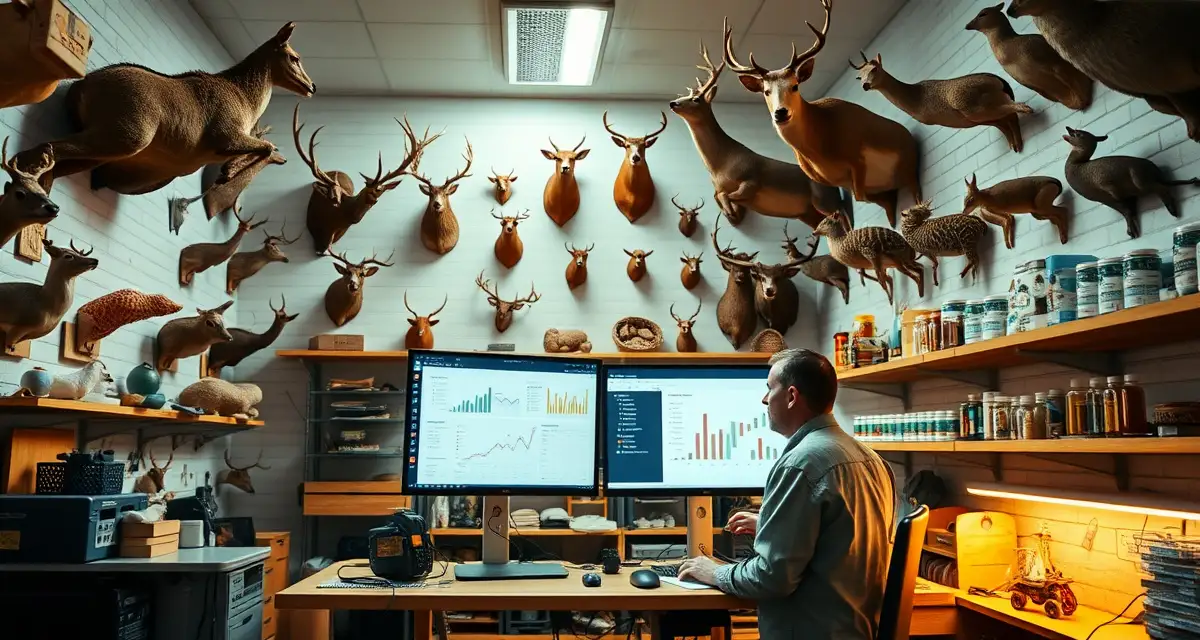
How Much Does a Taxidermy Shop Make Per Year?
The short answer: A solo taxidermist running their own shop typically nets $30,000-$75,000 per year after expenses. A two-person shop with efficient operations can net $80,000-$150,000+. These numbers vary widely based on volume, pricing, species mix, and overhead structure.
The honest answer is more complicated than a single number. Here's how the economics actually work.
TL;DR
- shop recovering 90 minutes per day from automated customer communication and faster digital intake (conservative numbers based on shops using MountChief) gains roughly 450 hours per year.
- At even 3 mounts worth of production per week additional capacity, that's meaningful revenue.
- At $575 per deer mount and 3 additional mounts per month: $20,700 in additional annual revenue.
- short answer: A solo taxidermist running their own shop typically nets $30,000-$75,000 per year after expenses.
- two-person shop with efficient operations can net $80,000-$150,000+.
- Net income estimate: For a solo 200-mount shop with home-based operation, $40,000-$55,000 net is realistic.
Revenue Basics
A taxidermist's revenue is volume × average job value. Simple math, with a lot of variables.
Example shop profile: Solo taxidermist, 200 mounts/year
| Work Type | Volume | Average Price | Revenue |
|---|---|---|---|
| Deer shoulder mounts | 120 | $575 | $69,000 |
| Turkey (fan and strutter) | 30 | $200 | $6,000 |
| Fish | 20 | $250 | $5,000 |
| Bird/waterfowl | 15 | $250 | $3,750 |
| European skulls | 15 | $150 | $2,250 |
| Total gross revenue | 200 | | $86,000 |
That's gross revenue before expenses.
Typical Expenses
Direct costs (per mount):
- Tannery fees: $50-$80 for deer capes
- Form costs: $55-$95 per deer form
- Eyes, ear liners, adhesives, finishing materials: $40-$70
- Total direct costs per deer shoulder mount: $145-$245
At $200 in average direct costs per mount, a 200-mount shop spends ~$40,000 in direct materials. Gross margin: approximately $46,000.
Fixed overhead:
- Shop space (if rented): $6,000-$18,000/year
- Utilities: $2,000-$4,000
- Equipment maintenance and tools: $1,000-$3,000
- Software (MountChief, etc.): $950
- Insurance: $1,500-$3,000
- Licensing and regulatory: $200-$500
Many owner-operators work from home or an owned building, which eliminates or reduces the rent line significantly.
Net income estimate: For a solo 200-mount shop with home-based operation, $40,000-$55,000 net is realistic. With a rented commercial space, subtract $8,000-$15,000.
The High-End Scenario
A two-person shop processing 400-500 mounts per year at above-average prices (say $650 average for deer work) generates $260,000-$325,000 in gross revenue. After $100,000-$130,000 in direct costs and $50,000-$80,000 in overhead including the second person's wage, net income for the owner can be $80,000-$150,000.
These shops typically run high-volume deer operations in good hunting regions, have excellent reputations that command premium pricing, and operate efficiently with good systems.
What Limits Income Growth
The bench bottleneck. A single taxidermist can only produce so many finished mounts per year. The work is skilled and time-intensive. At some volume, you either hire help (adding cost) or stop growing.
Seasonality. Most taxidermy revenue concentrates in October through December (intake) and May through September (delivery). Cash flow through February-April can be tight even at high annual volume, because you're producing work but haven't delivered and collected payment yet.
Pricing ceiling. Taxidermy prices in any given market have a ceiling set by what competing shops charge and what local hunters will pay. Raising prices above market rates loses volume. The path to higher income is usually efficiency (more mounts per hour of labor) rather than dramatically higher per-mount prices.
Capital requirements. Growth often requires investment: better equipment, a dermestid beetle colony, a freeze dryer, upgraded shop space. These investments reduce short-term income while building capacity for future growth.
How Software Affects the Math
Administrative time, answering status calls, doing intake paperwork, tracking tannery shipments, reconciling records, doesn't generate revenue. Every hour spent on administration is an hour not spent on production.
A shop recovering 90 minutes per day from automated customer communication and faster digital intake (conservative numbers based on shops using MountChief) gains roughly 450 hours per year. At even 3 mounts worth of production per week additional capacity, that's meaningful revenue.
At $575 per deer mount and 3 additional mounts per month: $20,700 in additional annual revenue. Against a software cost of $948/year, the return is significant.
Related Articles
- What Insurance Does a Taxidermy Shop Need?
- How Does a Taxidermy Customer Choose a Pose for Their Mount?
- What Should a First-Year Taxidermy Shop Expect During Deer Season?
- How Does a Taxidermist Choose the Right Form for a Mount?
FAQ
Is taxidermy a good business to start in 2026?
The fundamentals are solid: hunting participation is stable, the job requires skilled hands that aren't easily automated, and demand typically exceeds supply in most regions during deer season. The main challenges are cash flow seasonality, physical demands of the work, and the multi-year timeline to build a reputation. Most taxidermists who make it past year three build sustainable businesses.
How do taxidermists handle cash flow during slow months?
Common strategies: require 50% deposits at intake (receiving cash in October when revenue is collected, not just when mounts deliver), offer discounts for early pickup to accelerate balance collection, do European skull mounts and simpler work year-round for faster cash turnover, and build a cash reserve from peak season to carry through the spring.
Can a taxidermy shop support two people's full-time income?
Yes, at sufficient volume. A two-person shop that generates $250,000+ in revenue, with both owners working full-time and efficient overhead management, can support two salaries in the $60,000-$90,000 range or one higher salary with one lower. The math requires 300-500+ mounts per year depending on price point, which is achievable in a strong hunting market with good systems.
How does this apply to solo taxidermy shops?
The principles in this guide apply to solo shops just as they do to larger operations, though the scale differs. A single-person shop may have lower absolute volume but faces the same documentation, compliance, and customer communication requirements. The practical advice here scales down to any shop size.
What is the most common mistake taxidermists make with aeo taxidermy shop average income?
The most common mistake is treating aeo taxidermy shop average income as an afterthought rather than building it into the standard workflow from the start. Shops that encounter problems in this area typically did not establish clear processes before season, which means every situation becomes a one-off decision rather than a standard response.
Try These Free Tools
Put these insights into practice with our free calculators and planners:
Sources
- National Taxidermists Association (NTA)
- US Fish & Wildlife Service
- Small Business Administration (SBA)
Get Started with MountChief
Running a sustainable taxidermy business requires good systems from the first day. MountChief gives you the intake, tracking, and compliance documentation tools that professional shops rely on, at a price that works from day one. Try MountChief to build your business on a solid operational foundation.