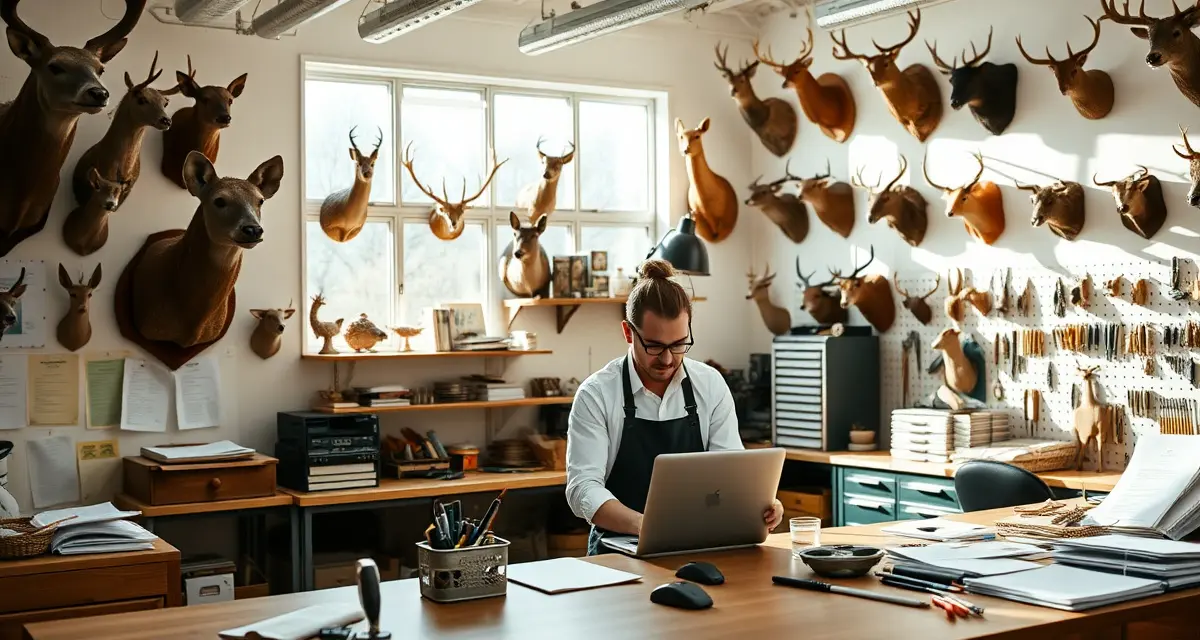
How to Open a Taxidermy Shop: Complete Step-by-Step Guide
Fifty percent of new taxidermy shops fail in the first three years. Most owners who close cite the same reason: operational overwhelm. The craft was manageable. The business side wasn't.
Getting the right systems in place before your first deer season is the single most predictive factor in long-term success. This guide walks you through every step of opening a taxidermy shop, from licensing to insurance to equipment to software to marketing, in the order that actually matters.
TL;DR
- Not collecting deposits: A deposit-free shop has no protection against abandoned mounts. Require a minimum 25-50% deposit at intake.
- reason to set this up before your first intake is not that you'll need it for 5 customers.
- Skipping the portal: Customers who can track their mount online don't call your phone 8 times a week during deer season.
- Require a minimum 25-50% deposit at intake.
- LLC (Limited Liability Company): Most common choice for taxidermy shops. Separates your personal assets from business liabilities. Worth the $50-$200 state filing fee.
- General Liability Insurance: Covers bodily injury and property damage at your shop. Required if customers enter your facility. Plan for $500-$1,500 per year depending on your coverage limits and state.
Step 1: Get Your State Taxidermy License
Before you accept a single specimen, you need your state taxidermy license. Requirements vary significantly by state, but most require:
- Completion of a state-approved taxidermy training course or apprenticeship hours
- A passing score on a written exam covering species identification, wildlife laws, and record-keeping requirements
- Payment of a licensing fee (typically $50-$250 depending on state)
- Some states require a separate business license in addition to the professional taxidermy license
Check your state wildlife agency's website for the specific requirements. Do not skip this step. Practicing taxidermy without a license is a wildlife violation in every state. Fines start at several hundred dollars and can include criminal charges.
If you plan to work with migratory birds (ducks, geese, turkeys), you also need a federal USFWS taxidermist permit. Apply through the US Fish and Wildlife Service. This permit is required regardless of your state license status.
Step 2: Understand Federal Permit Requirements
The federal level adds complexity that surprises many new taxidermists. Here's what the federal permits cover and when you need them:
USFWS Taxidermist Permit: Required to possess and work on any migratory bird species, including all waterfowl and wild turkey. Apply at the USFWS permit office for your region.
CITES Awareness: If you plan to work with any internationally regulated species (certain exotic trophy species, marine mammals), you need to understand CITES documentation requirements before accepting any specimen.
Most new shops start with deer and gradually add species. If you're deer-only in year one, your federal exposure is limited. But have the USFWS permit in place before you accept the first turkey or duck.
Step 3: Set Up Your Business Entity
You need a legal business structure before you start collecting deposits. Your options:
Sole Proprietorship: Simplest to set up. Your business income flows through your personal tax return. Limited liability protection.
LLC (Limited Liability Company): Most common choice for taxidermy shops. Separates your personal assets from business liabilities. Worth the $50-$200 state filing fee.
S-Corp: Makes sense when your annual taxidermy income exceeds roughly $50,000. Allows you to split income between salary and distributions to reduce self-employment tax.
Open a dedicated business bank account as soon as your entity is registered. Never mix personal and business finances. Your accountant will thank you, and your tax situation will be significantly cleaner.
Step 4: Get the Right Insurance
Two types of insurance matter most for taxidermy shops:
General Liability Insurance: Covers bodily injury and property damage at your shop. Required if customers enter your facility. Plan for $500-$1,500 per year depending on your coverage limits and state.
Bailee's Insurance: This is the one most new taxidermists don't know about, and it's the most important. Bailee's coverage protects client specimens in your care. If there's a fire, flood, or theft that destroys specimens you're holding, bailee's insurance pays the customer's claim.
Calculate your peak season inventory value before setting your bailee's limit. A shop holding 200 deer at $600 average value is holding $120,000 in client property at any given time during peak season. Your coverage limit needs to reflect peak inventory, not average inventory. Most shops are dramatically underinsured.
Contact an independent insurance agent with experience in specialty business coverage. Not every agent knows what bailee's insurance is or how to structure it for a taxidermy operation.
Step 5: Set Up Your Physical Shop
Your workspace requirements depend on your species mix and volume:
Minimum setup for deer-focused shops:
- Dedicated prep and mounting area (separate from storage if possible)
- Chest freezer for incoming specimens (minimum 15 cubic feet; 25+ for volume shops)
- Proper ventilation for chemicals and preservatives
- Secure specimen storage area (lockable)
- Clean intake area with good lighting for documentation photos
- Running water access
Additional requirements for fish:
- Air compressor for airbrush work
- Climate-controlled finishing space (fish paint jobs are temperature-sensitive)
Additional requirements for birds:
- Drying space with airflow control
- Pest prevention (dermestid beetles are useful but require containment)
Workspace regulatory considerations:
Your shop may require a zoning variance if it's home-based or in a residential area. Check with your county before you start operating. Many home-based taxidermists operate without issues, but the use of commercial chemicals, the smell, and customer traffic can create zoning problems if neighbors complain.
Step 6: Get Your Equipment
New taxidermists often overspend on equipment in year one. Here's the realistic minimum list:
Essential:
- Fleshing wheel or beam
- Hide-working tools (scrapers, fleshing knives)
- Airbrush and compressor (fish and bird work)
- Reference materials by species
- Form and supply storage system
- Intake documentation tools (tablet or computer, scale, tape measure)
What to skip initially:
- High-end compressors before you know your volume
- Specialty equipment for species you're not yet accepting
- Large freeze-dry units (extremely expensive, very specialized)
Buy used equipment where possible for your first season. Supply houses like McKenzie Supply and WASCO carry new equipment, but dealer networks and taxidermy association classifieds are good sources for quality used gear.
Step 7: Set Up Your Management Software Before Season One
This is the step most new taxidermists skip. Don't.
Getting the right systems before the first deer season determines long-term viability. MountChief's taxidermy shop management software covers job tracking, customer communication, tannery tracking, compliance documentation, invoicing, and customer portal access in one platform.
The reason to set this up before your first intake is not that you'll need it for 5 customers. It's that building habits on the right system is infinitely easier than switching systems after 3 seasons of paper-based chaos.
Setup takes less than a day. The first-season setup checklist walks through account configuration, species workflow setup, and intake form customization.
Step 8: Set Your Prices
Do not guess at pricing. New taxidermists consistently underprice, especially in the first year, and then find themselves unable to raise prices without losing customers.
Research the going rate in your region. Call three established taxidermists as a prospective customer and ask about pricing. Add those numbers together and compare with your cost-of-goods calculation:
Cost-per-mount calculation:
- Form cost
- Tannery cost (plus shipping both ways)
- Eyes, artificial components
- Taxidermy supplies (hide paste, adhesives, finishing materials)
- Your time at an hourly rate you'd actually accept
- A portion of your overhead (insurance, utilities, shop costs)
If your local market price doesn't cover those costs with a profit margin, you either need to be more efficient, reduce overhead, or serve a market willing to pay more.
Step 9: Build Your Online Presence Before Season
Start marketing before you're ready to take mounts. A basic Google Business Profile, a simple website with pricing, and a Facebook presence are the minimum.
Timing matters: If your state's deer firearms season opens in November, your marketing should be visible by September. Hunters who are already committed to a taxidermist don't switch based on ads they see after the harvest.
Your Google Business Profile is free and the most important single thing you can do for local search visibility. Fill out every field. Add photos of your work. Ask your first customers for reviews.
Step 10: Pre-Season Customer Outreach
Even in year one, you have potential customers. Friends who hunt. Hunting club members. Neighbors. Tell everyone what you're doing and when you'll be ready.
A simple opening announcement to your personal network, posted in hunting groups and on your new Facebook page, can generate your first 5-10 mounts before you ever run an ad.
Common First-Year Mistakes to Avoid
Taking too much volume too fast: A backlog you can't deliver on damages your reputation permanently. Know your capacity ceiling and hold to it.
Not collecting deposits: A deposit-free shop has no protection against abandoned mounts. Require a minimum 25-50% deposit at intake.
Verbal agreements: Put everything in writing. Every time. The intake form is your protection.
Underestimating tannery timelines: Tannery turnaround affects your promised completion dates. Build tannery time into your timeline communication with every customer.
Skipping the portal: Customers who can track their mount online don't call your phone 8 times a week during deer season.
Frequently Asked Questions
What steps do I need to take to open a taxidermy shop?
The non-negotiable steps in order: get your state taxidermy license, apply for a federal USFWS permit if you'll work with migratory birds, form a business entity (LLC recommended), get general liability and bailee's insurance, set up your physical workspace, acquire essential equipment, set up management software, price your services accurately, build a basic online presence, and start marketing at least 60 days before your first target intake season. Each step has dependencies. Skipping the licensing and insurance steps creates legal and financial exposure from your first customer.
How much does it cost to open a taxidermy shop?
A minimal home-based startup runs $3,000 to $8,000 for equipment, licensing, insurance, and basic supplies. A dedicated shop space adds $5,000 to $20,000 in first-year buildout and rent depending on your market. Most new taxidermists start home-based and move to a dedicated space after year two or three when volume justifies it. The biggest variable is equipment quality. Buying quality used equipment reduces startup costs significantly without compromising your output quality in year one.
What is the most important thing to set up before opening a taxidermy shop?
Your intake and documentation system. Every other problem in a taxidermy shop traces back to bad intake. Specimens get mixed up because intake was informal. Customers dispute charges because there's no signed agreement. Compliance violations happen because wildlife documentation wasn't captured at intake. Setting up a structured intake process, whether paper or digital, before you accept the first specimen is the highest-leverage preparation you can do. A good intake system also creates the customer record that the portal, invoicing, and compliance functions build from.
How does this apply to solo taxidermy shops?
The principles in this guide apply to solo shops just as they do to larger operations, though the scale differs. A single-person shop may have lower absolute volume but faces the same documentation, compliance, and customer communication requirements. The practical advice here scales down to any shop size.
What is the most common mistake taxidermists make with taxidermy shop opening guide?
The most common mistake is treating taxidermy shop opening guide as an afterthought rather than building it into the standard workflow from the start. Shops that encounter problems in this area typically did not establish clear processes before season, which means every situation becomes a one-off decision rather than a standard response.
Related Articles
- The Complete Guide to Running a Modern Taxidermy Shop in 2026
- The Taxidermy Shop Management Industry Guide: Everything in One Place
Try These Free Tools
Put these insights into practice with our free calculators and planners:
Sources
- National Taxidermists Association (NTA)
- US Fish & Wildlife Service
- Small Business Administration (SBA)
Get Started with MountChief
Disorganized intake and forgotten follow-ups are the fastest way to lose repeat customers. MountChief structures every step of your taxidermy workflow so nothing gets missed.