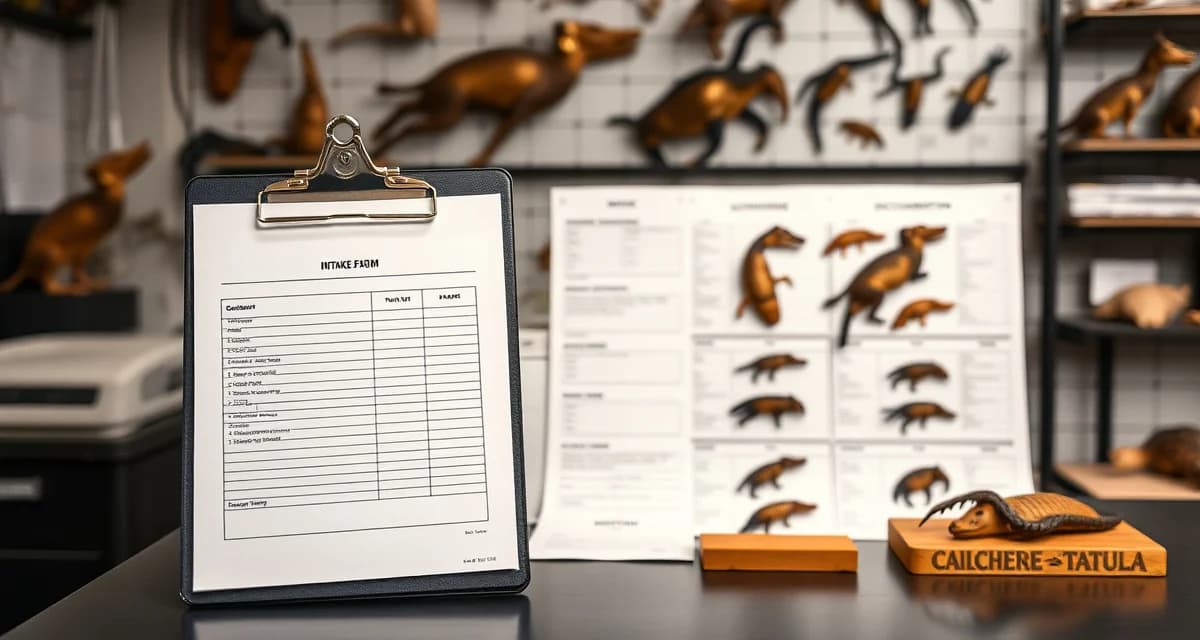
Taxidermy Intake Form Template: Download and Customize
Incomplete intake forms are the root cause of 40% of specimen mix-up incidents. Not bad luck. Not careless work. Missing information at intake that makes it impossible to track a specimen correctly through a 6-12 month production process.
A good intake form catches these problems at the start, before the specimen goes in the freezer, before the hunter drives home, before you lose the context that makes sense of the job months later.
Use the template below as your starting point. Customize it for your shop's species mix and compliance requirements. Or upgrade to AI intake with MountChief and skip the paper entirely.
TL;DR
- Missing information at intake that makes it impossible to track a specimen correctly through a 6-12 month production process.
- If you charge storage fees after 30 days, spell out the policy and get acknowledgment.
- Incomplete intake forms are the root cause of 40% of specimen mix-up incidents.
- But it doesn't help you find a job in a pile of 300 forms, and it doesn't alert you when a required field is blank.
- When you're ready to stop spending 15-20 minutes per intake and start processing jobs in under 5 minutes with AI assistance, MountChief is the next step.
- Pose and mounting preferences need to be captured now.
What a Complete Taxidermy Intake Form Must Include
Before the template, here's why each section matters.
Customer information is how you find the person when their mount is done. Complete address matters if you're shipping. Email and phone both matter because some people respond to one and not the other.
Specimen information is the foundation of your compliance records. Missing species or harvest date can mean non-compliant records during an inspection.
Pose and mounting preferences need to be captured now. Six months from now, you won't remember what the customer said. Neither will they, and they'll tell you they specifically said something different.
Condition documentation protects you. If a cape arrives damaged, you need that documented before you start work. Otherwise you own the damage.
Financial terms in writing prevent disputes. Deposit amount, balance due, payment terms. All of it on paper with a signature.
Taxidermy Intake Form Template
TAXIDERMY INTAKE FORM
Shop Name: _____________________________ License #: _________________
Date: ______________ Job #: _______________
SECTION 1: CUSTOMER INFORMATION
| Field | Entry |
|---|---|
| First Name | |
| Last Name | |
| Street Address | |
| City, State, ZIP | |
| Phone (primary) | |
| Phone (alternate) | |
| Email Address | |
| Preferred contact method: Phone / Email / Text | |
| How did you hear about us? | |
SECTION 2: SPECIMEN INFORMATION
| Field | Entry |
|---|---|
| Species (common name) | |
| Species (subspecies if applicable) | |
| Sex | Male / Female / Unknown |
| Harvest Date | |
| Harvest Location (State) | |
| Harvest Location (County) | |
| Harvest Location (Unit/Zone) | |
| Hunter License # | |
| Tag or Permit # | |
| Resident / Non-Resident | |
| Additional permit (federal duck stamp, turkey permit, etc.) | |
SECTION 3: SPECIMEN CONDITION AT INTAKE
| Field | Entry |
|---|---|
| Condition on arrival | Excellent / Good / Fair / Damaged |
| Frozen on arrival? | Yes / No / Partially thawed |
| Time in field before cooling? | |
| Cape/hide condition | Intact / Minor damage / Significant damage |
| Describe any damage or concerns | |
| Photos taken at intake? | Yes / No |
| Storage location at shop | |
SECTION 4: MOUNT TYPE AND SPECIFICATIONS
| Field | Entry |
|---|---|
| Mount type | Shoulder / Half body / Full body / Pedestal / Skull / Rug / Other |
| Shoulder cut (if applicable) | Standard / Long / Extra long |
| Pose | |
| Head turn direction | |
| Eye position | Forward / 3/4 turn / Profile |
| Ear position | Natural / Alert / Back |
| Habitat base? | Yes / No |
| Habitat description | |
| Reference photos provided by customer? | Yes / No |
For fish: Length: _____ Weight: _____ Mount side: Left / Right Skin mount / Replica
For birds: Pose: ______ Fan condition: Excellent / Good / Fair Beard length: _____ Spurs (L/R): _____/_____
SECTION 5: FINANCIAL TERMS
| Field | Entry |
|---|---|
| Quoted price | |
| Deposit required | |
| Deposit collected | |
| Payment method | Cash / Check / Card |
| Balance due | |
| Payment terms | |
| Estimated completion date | |
| Storage fee policy acknowledged? | Yes / No |
SECTION 6: NOTES AND SPECIAL INSTRUCTIONS
______________________________________________
______________________________________________
______________________________________________
AUTHORIZATION AND ACKNOWLEDGMENT
_I certify that the specimen described above was legally obtained and that all harvest documentation is accurate. I authorize the taxidermist named above to process the described specimen and agree to the payment terms stated on this form. I acknowledge the storage fee policy for unclaimed mounts._
Customer Signature: _________________________ Date: _____________
Taxidermist Signature: _______________________ Date: _____________
Customizing This Template for Your Shop
The template above covers the standard fields that apply to most taxidermy intakes. You'll want to customize it based on:
Your Primary Species
If your shop focuses heavily on deer, add fields specific to deer work: antler measurement at intake, whether the customer wants EAR antlers scored, whether they want a euro skull option if the cape is damaged.
If you do significant bird work, expand the bird section to include waterfowl species distinction (drake vs hen matters for painting), wing condition, and federal permit documentation fields.
Your State's Compliance Requirements
Every state has specific fields that compliance requires. Texas needs the TPWD tag number and harvest county. Colorado CPW requires harvest unit number and license type (resident vs non-resident). Louisiana needs alligator tag numbers for LDWF compliance.
Add a section for your state's specific requirements rather than relying on a generic form that might be missing what your inspector looks for.
Your Payment Policies
If you offer payment plans, add a payment plan section. If you charge storage fees after 30 days, spell out the policy and get acknowledgment. If you have a no-refund policy on deposits, state it explicitly and have the customer initial.
Is a Paper Intake Form Sufficient for Legal Compliance?
Paper forms are legally sufficient in most states as long as they capture the required fields and are retained for the required period.
The practical problems with paper:
- Legibility issues with handwriting under pressure
- No automatic backup if forms are lost or damaged
- No search capability (finding a specific job requires physical review)
- No automatic compliance field prompts when required fields are missing
- No connection between the paper form and the physical specimen tag
A complete, legible paper form that's properly filed meets the legal minimum. But it doesn't help you find a job in a pile of 300 forms, and it doesn't alert you when a required field is blank.
Upgrading from Paper to AI Intake
If you're ready to move beyond paper, MountChief's AI intake captures species, condition, and measurements from photos automatically. You confirm the pre-populated fields, add customer information, and process the deposit. All in under 5 minutes.
The taxidermy QR tag system then links the physical specimen to the digital job record. Every piece of information from intake is searchable, backed up, and accessible from any device.
You don't have to throw away this template immediately. Use it while you're setting up your digital system, then transition new intakes to digital as you get comfortable.
Related Articles
- Taxidermy Shop Price Sheet Template: Download and Customize
- What Should Be on a Taxidermy Intake Form?
- Taxidermy Customer Portal Without an App Download
FAQ
What fields should a taxidermy intake form include?
A complete intake form should include: customer contact information (name, address, phone, email), specimen information (species, sex, harvest date, harvest location by state/county/unit), hunter license and tag numbers, condition at intake with photo documentation, mount type and pose specifications, and financial terms (quoted price, deposit collected, balance due, payment terms, storage fee policy). Missing any of these creates legal compliance gaps or customer dispute risks.
Is a paper intake form sufficient for legal compliance?
Paper intake forms meet the legal minimum in most states as long as they capture all required fields and are retained for the required retention period (typically 2-5 years depending on state and species). However, paper forms have significant practical limitations: they're not searchable, they can be lost or damaged, they don't automatically prompt for missing required fields, and they require manual connection to physical specimen tags. Digital intake systems with compliance field validation are more reliable for ongoing compliance management.
How do I transition from paper intake forms to digital?
Start with new intakes only, don't try to migrate historical records on day one. Set up your digital intake system (MountChief), configure your species list and pricing templates, and process your next intake digitally. Run paper and digital in parallel for one to two weeks if you prefer, then go fully digital. Backfill outstanding active jobs into the digital system during a slower period. The transition typically takes one to two weeks for a solo or small shop.
How does this apply to solo taxidermy shops?
The principles in this guide apply to solo shops just as they do to larger operations, though the scale differs. A single-person shop may have lower absolute volume but faces the same documentation, compliance, and customer communication requirements. The practical advice here scales down to any shop size.
What is the most common mistake taxidermists make with taxidermy intake form template?
The most common mistake is treating taxidermy intake form template as an afterthought rather than building it into the standard workflow from the start. Shops that encounter problems in this area typically did not establish clear processes before season, which means every situation becomes a one-off decision rather than a standard response.
Try These Free Tools
Put these insights into practice with our free calculators and planners:
Sources
- National Taxidermists Association (NTA)
- US Fish & Wildlife Service
- Small Business Administration (SBA)
Start with This Template, Then Graduate
This intake form template gives you a solid foundation for documentation that covers legal requirements, customer expectations, and specimen tracking. Download it, print it, customize it, and use it.
When you're ready to stop spending 15-20 minutes per intake and start processing jobs in under 5 minutes with AI assistance, MountChief is the next step. The same information this template captures (and more) handled automatically with less effort.
Start your free MountChief trial at mountchief.com and see what AI intake looks like for your shop.
Get Started with MountChief
Professional taxidermists need more than talent at the bench. They need organized intake, clear compliance records, and reliable customer communication. MountChief delivers all three.