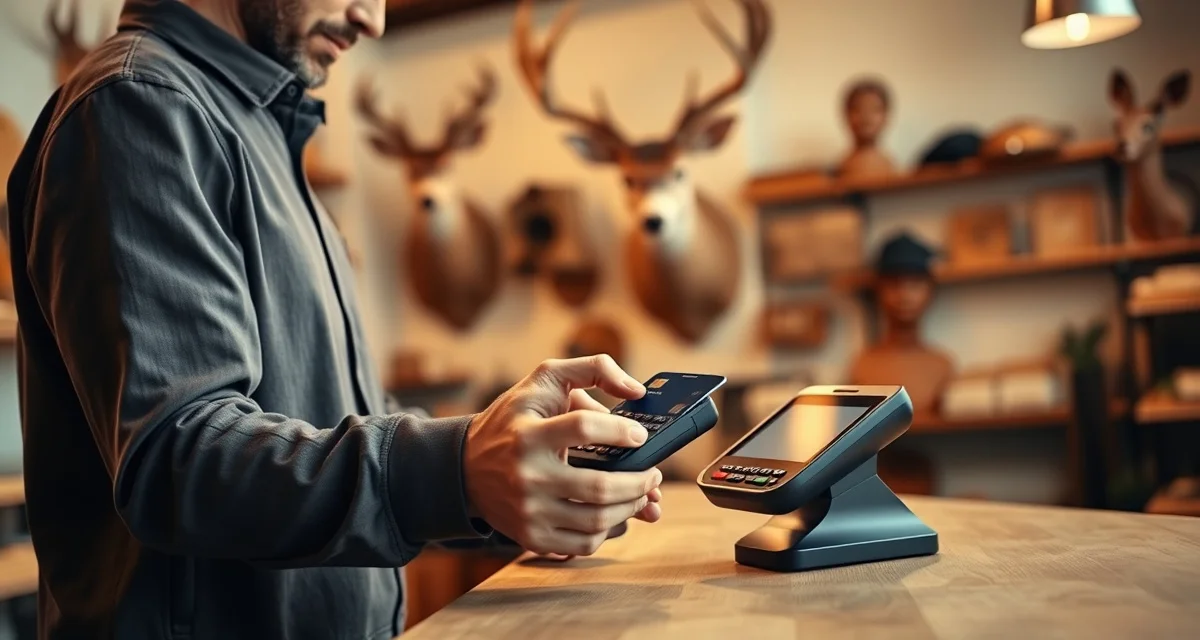
Taxidermy Shop Credit Card Processing: Best Options and Lowest Fees
Taxidermists who accept credit cards increase average transaction value by 18%. This reflects something straightforward about human spending behavior: people spend more when they're not handing over physical cash. A hunter depositing $200 on a deer mount might readily pay $250 if they're swiping a card, because the friction of the transaction is lower.
Digital payment at intake eliminates the walk-out customer who "doesn't have cash." This is worth more than it sounds. A customer who drives to your shop to drop off a deer, finds out you're cash-only, and has to come back is a customer who might stop at a competitor's shop on the way. That's lost revenue with no paperwork, no record - just a missed opportunity.
TL;DR
- A hunter depositing $200 on a deer mount might readily pay $250 if they're swiping a card, because the friction of the transaction is lower.
- Setup takes 15-30 minutes and your account is typically approved within a day.
- Your first deposit typically arrives in 1-2 business days.
- For shops processing over $100,000 in annual card volume, it's worth getting quotes from payment processors that offer negotiated rates, as their fees can drop below 2% at higher volumes.
- On a $400 mount with a $150 deposit taken at intake, you'd pay roughly $4-4.50 in processing fees.
- Processing rates are similar to Square at 2.7% + $0.05 for in-person transactions.
The Main Options
Square: The most widely used option for small service businesses. Square charges 2.6% + $0.10 per swipe for in-person transactions and 3.5% + $0.15 for keyed-in transactions. No monthly fee for the basic service. The hardware is free or low-cost for basic card readers. Square's reporting is good for tax purposes and the app is intuitive. The main limitation is that it's a standalone system - transactions don't connect to your job records automatically.
Stripe: More developer-oriented but increasingly available through consumer-facing apps. Processing rates are similar to Square at 2.7% + $0.05 for in-person transactions. Stripe is frequently integrated into web-based software platforms, which is why it appears in MountChief's payment processing and other business management tools.
MountChief Integrated Payments: When you process payments through your management software, the transaction links directly to the customer's job record, the deposit is recorded against the invoice balance automatically, and the customer's receipt is generated without duplicate entry. This integration reduces the bookkeeping step that every standalone processor requires.
PayPal: Widely recognized and trusted by customers, but transaction fees run 3.49% + fixed fee for in-person, higher than Square or Stripe. Better as a backup option for customers who prefer it than as your primary processing solution.
Fee Comparison for a Typical Taxidermy Transaction
A $200 deposit processed through:
- Square in-person swipe: $5.30 in fees (2.65% effective rate)
- Stripe in-person: $5.45 in fees
- PayPal in-person: $7.03 in fees
On an annual volume of $60,000 in card transactions, the fee difference between 2.65% and 3.5% is roughly $510 per year. That's worth paying attention to but shouldn't drive you toward a worse product - the integration and operational benefits of the right processor outweigh the fee difference.
Setting Up Card Processing
For any processor, you'll need:
- A business bank account (required for fund deposits)
- A business name and EIN or Social Security number for tax reporting
- A smartphone or tablet for mobile card readers, or a fixed terminal for counter-based processing
Setup takes 15-30 minutes for Square or Stripe. Your first deposit typically arrives in 1-2 business days.
For a complete guide to payment processing in your taxidermy shop, see the taxidermy payment processing guide.
Collecting Deposits at Intake
The most important use of your card processing capability is collecting deposits at intake. A deposit collected at the moment a customer drops off their specimen creates an immediate financial commitment and a clean record of the agreed transaction price.
For how to structure your deposit amounts and terms, see the taxidermy deposit collection guide.
Frequently Asked Questions
What is the best credit card processor for a taxidermy shop?
For most small taxidermy shops, Square or MountChief's integrated payment processing are the best options. Square is the easiest standalone option with no monthly fees and 2.6% + $0.10 per in-person swipe - reliable, well-supported, and understood by customers. If you use MountChief as your shop management platform, integrated payments are worth using because they tie directly to job records and eliminate duplicate bookkeeping. For shops processing over $100,000 in annual card volume, it's worth getting quotes from payment processors that offer negotiated rates, as their fees can drop below 2% at higher volumes.
How do I set up credit card processing at my taxidermy shop?
Choose a processor (Square, Stripe, or through your shop management software), create an account with your business information and EIN, link your business bank account, and order or download the card reader app or hardware. For Square, the basic magstripe reader is free and plugs into your phone's headphone jack - the chip reader is $49. Setup takes 15-30 minutes and your account is typically approved within a day. Test a transaction with a small amount before your first real intake. Set up a receipt template with your business name and contact information, and verify that deposits record correctly in your accounting system before season opens.
What credit card processing fees should I expect as a taxidermist?
In-person card swipe fees typically run 2.6%-2.7% plus a small per-transaction fee for the major processors (Square, Stripe). Keyed-in transactions (where you manually enter the card number) cost more, typically 3.4%-3.5% plus a larger per-transaction fee. Online payments processed through a web form run around 2.9%-3.0%. On a $400 mount with a $150 deposit taken at intake, you'd pay roughly $4-4.50 in processing fees. That's a small cost relative to the benefits of accepting cards, particularly the higher average transaction value and the elimination of cash-handling complications.
How does this apply to solo taxidermy shops?
The principles in this guide apply to solo shops just as they do to larger operations, though the scale differs. A single-person shop may have lower absolute volume but faces the same documentation, compliance, and customer communication requirements. The practical advice here scales down to any shop size.
What is the most common mistake taxidermists make with taxidermy shop credit card processing?
The most common mistake is treating taxidermy shop credit card processing as an afterthought rather than building it into the standard workflow from the start. Shops that encounter problems in this area typically did not establish clear processes before season, which means every situation becomes a one-off decision rather than a standard response.
Related Articles
- Taxidermy Shop Best Practices in 2026: Operational Standards
- Best States to Operate a Taxidermy Shop by Revenue Potential
- Case Study: How AI Intake Cut a Shop's Processing Time from 22 to 3 Minutes
- Best Taxidermy Shops in the Southeast Using Modern Software
Try These Free Tools
Put these insights into practice with our free calculators and planners:
Sources
- National Taxidermists Association (NTA)
- US Fish & Wildlife Service
- Small Business Administration (SBA)
Get Started with MountChief
Taxidermy shops that track specimens, manage customer communication, and handle compliance in one system spend less time on admin and more time on quality work. That is what MountChief was built for.