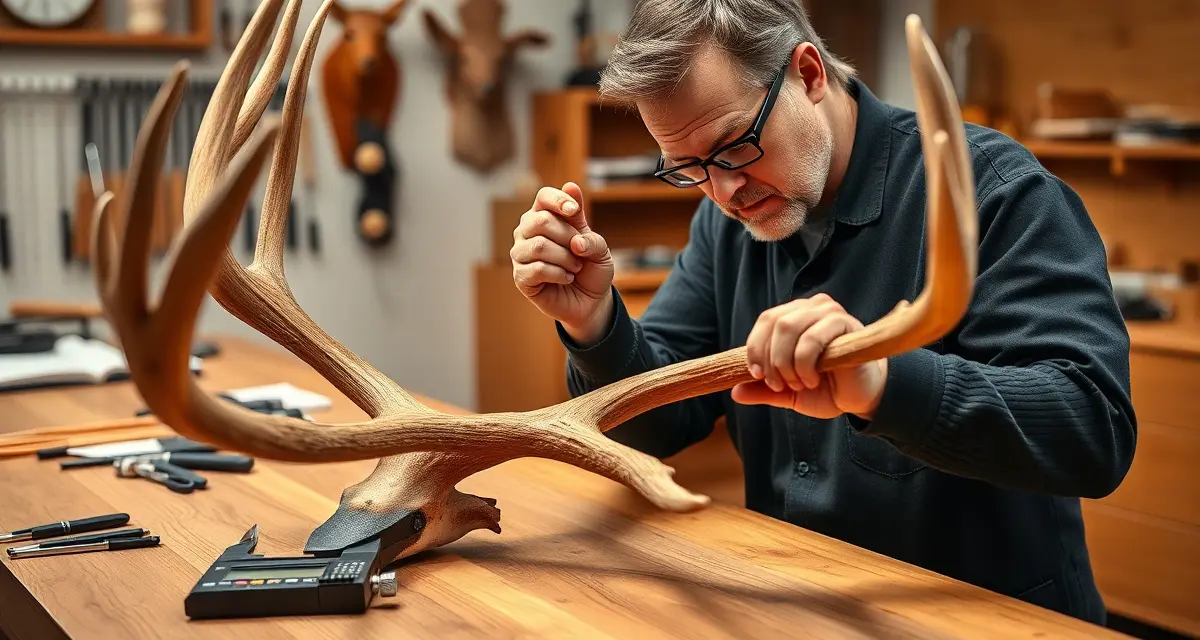
Measuring Deer Antlers at Intake: B&C Scoring Basics for Taxidermists
Trophy-class antler measurement at intake creates permanent documentation that holds real value for hunters. It's not just a service, it's a differentiator. Taxidermists who offer basic antler scoring at intake generate upsell plaque and frame sales and become the trusted expert for hunters who are emotionally invested in their harvest.
This guide covers the B&C scoring basics every taxidermist who accepts whitetail or mule deer should know, how to offer this service efficiently at intake, and how it connects to upsell opportunities.
TL;DR
- For official entry, a certified official B&C measurer must conduct the measurement after a 60-day drying period.
- The full B&C worksheet takes 10-15 minutes and is appropriate for deer that might qualify for official entry or that the hunter specifically wants scored.
- forked points (G3 branches) are measured as separate tines.
- The forked points (G3 branches) are measured as separate tines.
- A simple printed certificate with the measurements, date, and your signature is a $20-40 upsell.
- If the customer asks about their score 3 years later, you can pull it up instantly.
Why Antler Measurement at Intake Matters
Most hunters who bring in a trophy-class deer want two things: a great mount and to know their score. If you can provide both, you become their taxidermist for life.
Even for non-trophy-class deer, measuring at intake creates permanent documentation that the customer will appreciate years later. A hunter who can tell their grandchildren exactly how big the buck was, because you measured it in 2025 and it's in their mount records, has a different relationship with your shop than one who just remembers "it was a nice 8-pointer."
The measurement also protects you. If antlers are somehow damaged during the tanning or production process, a pre-existing measurement record demonstrates what was there originally.
Basic Boone & Crockett Scoring: The Key Measurements
For Whitetail Deer (Typical Category)
B&C official scoring uses non-typical and typical categories. For basic intake purposes, a gross typical score estimate requires:
Main Beam Lengths: Measure along the outside curve of each main beam from the burr (base of the antler above the skull plate) to the tip. Use a flexible tape measure.
G-Points (Tine Lengths):
- G1 (Brow tine): From the main beam point where G1 branches, to the tip of G1
- G2 (Second point): Similarly measured
- G3, G4, G5, G6 as applicable
Tine lengths use the longest straight line from the beam to the tip for each point.
Inside Spread: Measure at the widest point between the two main beams, with the tape held perpendicular to the centerline of the skull. This is the spread credit and is limited to the length of the longer main beam.
Mass Measurements (H1-H4 per side):
- H1: Circumference at the smallest point between the burr and the first point (brow tine)
- H2: Smallest circumference between G1 and G2
- H3: Smallest circumference between G2 and G3
- H4: Smallest circumference between G3 and the next point (or halfway down the beam past G3)
Gross Score Formula:
(Right beam + Left beam) + (All tine lengths) + (Inside spread) + (All 8 mass measurements) = Gross Typical Score
Note: The net typical score subtracts differences between matching measurements on each side (symmetry deductions). For intake purposes, the gross score is sufficient, it's more impressive and easier to calculate quickly.
Minimum score thresholds:
- Boone & Crockett typical whitetail (entry): 160 net
- Boone & Crockett typical whitetail (awards): 170 net
- Pope & Young (archery entry): 125 net
Most deer don't score this high. That's fine. The measurement is still valuable documentation regardless of whether it qualifies for a record book.
For Mule Deer
Mule deer scoring uses a similar framework with modifications for the forked antler structure. The forked points (G3 branches) are measured as separate tines. Mass measurements and spread calculations follow the same methodology.
Minimum for B&C typical mule deer entry: 180 net
Time-Saving at Intake
For quick intake scoring, focus on the five most impactful measurements:
- Inside spread
- Right main beam length
- Left main beam length
- Longest G2 on each side
- Longest G3 on each side
From these five data points, you can make a rough estimate of whether the deer has record-book potential. If it appears to be in the 140-150+ gross range, offer a complete official measurement.
Tools for Antler Measurement
Flexible steel tape: Essential for following the curves of the main beam. A standard cloth tape measure works for quick estimates but a proper steel flexible tape is more accurate.
Calipers: For mass measurements at the H points. Digital calipers are fast and accurate.
Steel cable: Some official scorers use a flexible cable to measure the main beam curves before measuring the cable, this is the official method for precise measurement.
Recording form: Keep a printed B&C scoring worksheet in your intake station. Fill it out during the measurement and attach it to the intake record. Digital intake systems like MountChief include measurement fields in the deer intake workflow.
Upsell Opportunities from Antler Measurement
The moment you hand a hunter their antler measurements, you've created a natural opening for upsell conversations:
Engraved plaques: A plaque with the gross score, harvest date, state, county, and hunter's name paired with the shoulder mount is a natural upsell. Most hunters who receive a score immediately want it documented.
Score certificates: Some taxidermists offer printed score certificates with the mount. A simple printed certificate with the measurements, date, and your signature is a $20-40 upsell.
B&C or P&Y entry referral: If the deer qualifies for official entry (rare, but happens), the hunter needs an official measurer. You can be that person if you pursue official scorer certification through the B&C Club.
Velvet vs hard antler documentation: For velvet bucks, the velvet measurements are often significantly larger than the hard antler equivalent. Document both if you receive a velvet mount.
Connecting Antler Measurement to Deer Taxidermy Tracking
Store antler measurements directly in the job record. MountChief's deer intake workflow includes fields for all standard B&C measurements, so the measurements stay with the job record permanently. If the customer asks about their score 3 years later, you can pull it up instantly.
The taxidermy intake form guide covers how to structure all deer intake fields including antler documentation.
Frequently Asked Questions
How do I measure deer antlers for B&C scoring?
Start with the inside spread (widest point between main beams, perpendicular to the skull centerline). Then measure both main beams along the outside curve from burr to tip. Measure each tine from its origin on the main beam to the tip in a straight line. Take mass measurements (circumference) at four points on each side: between the burr and G1, between G1 and G2, between G2 and G3, and between G3 and the next point. Add all measurements together for the gross typical score. For official entry, a certified official B&C measurer must conduct the measurement after a 60-day drying period.
What measurements do I need to estimate a deer's gross score?
The highest-impact measurements for a quick intake estimate are: inside spread, both main beam lengths, and the two G2 tines. A deer with a 16-inch inside spread, 22-inch main beams, and 10-inch G2s is likely in the 120-130 gross range. Add longer G3s, G4s, and meaningful mass and you're pushing 140+. For trophy-class deer (140+ gross), complete the full B&C worksheet with all points and mass measurements. For standard-class deer, the quick estimate plus documentation of point count is sufficient for intake records.
Should I measure every deer or only trophy-class animals at intake?
Measure every deer for the basic point count and spread, and offer the full B&C measurement for any deer that appears to have record-book potential (which you can often assess visually before measuring). The quick measurement, spread and rough main beam lengths, takes 2 minutes and creates a record customers appreciate. The full B&C worksheet takes 10-15 minutes and is appropriate for deer that might qualify for official entry or that the hunter specifically wants scored. Making basic measurements a standard part of your intake process differentiates your shop from taxidermists who only mount and return.
How does this apply to solo taxidermy shops?
The principles in this guide apply to solo shops just as they do to larger operations, though the scale differs. A single-person shop may have lower absolute volume but faces the same documentation, compliance, and customer communication requirements. The practical advice here scales down to any shop size.
What is the most common mistake taxidermists make with taxidermy shop deer antler measurement?
The most common mistake is treating taxidermy shop deer antler measurement as an afterthought rather than building it into the standard workflow from the start. Shops that encounter problems in this area typically did not establish clear processes before season, which means every situation becomes a one-off decision rather than a standard response.
Related Articles
- What Records Must Florida Taxidermists Keep for Deer?
- What Records Must Iowa Taxidermists Keep for Deer?
Try These Free Tools
Put these insights into practice with our free calculators and planners:
Sources
- National Taxidermists Association (NTA)
- US Fish & Wildlife Service
- Breakthrough Magazine
- State wildlife agencies
- Small Business Administration (SBA)
Get Started with MountChief
Whether you handle 20 mounts a year or 200, the administrative side of taxidermy scales fast. MountChief keeps intake, tracking, and communication manageable at any volume.