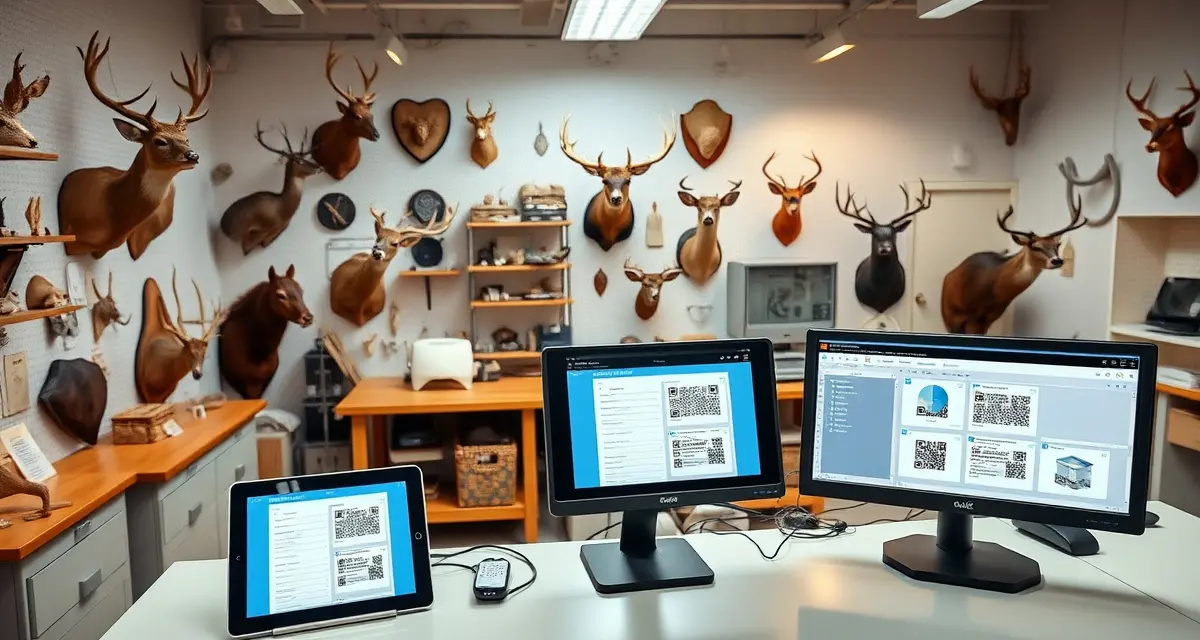
10 Quick Tips to Run a More Efficient Taxidermy Shop
Taxidermists who implement all 10 of these improvements reclaim 8-12 hours per week of production time. Most of them take under a day to set up. The biggest efficiency gain available to most shops is the intake step, dropping from 17 minutes per specimen to 3 minutes with AI is worth over 56 hours of saved labor per 200-deer season.
Here are the 10 changes with the most measurable impact on taxidermy shop efficiency.
TL;DR
- Paper tags fail within 24-48 hours in tannery conditions, the most critical tracking window.
- Shops that collect no deposit routinely lose 10-20 mounts per season to customers who never pick up, representing thousands in unrecovered costs.
- Here are the 10 changes with the most measurable impact on taxidermy shop efficiency.
- A deposit of 30-50% collected at intake eliminates abandoned mounts.
- Taxidermists who implement all 10 of these improvements reclaim 8-12 hours per week of production time.
- At 200 deer per season, that's 56+ hours saved, the equivalent of seven full working days returned to production.
1. Switch to AI Photo Intake
Paper intake takes 15-20 minutes per deer. AI photo intake takes 3 minutes for a complete, defensible record. At 200 deer per season, that's 56+ hours saved, the equivalent of seven full working days returned to production.
AI intake also catches errors that paper misses. Missing compliance fields get flagged. Required documentation is verified before the record is finalized. The result is a more complete record in a fraction of the time.
2. Give Every Customer a Portal Link at Intake
The moment your customer walks out with a portal link, they stop calling for status updates. Shops with a customer portal receive under 1 status call per day during deer season. Shops without portals receive 8-12.
At 7 minutes per status call, 10 calls per day costs 70 minutes of production time. A portal link at intake costs 10 seconds.
The link takes 30 seconds to send via text. Do it for every intake. No exceptions.
3. Install QR Tags on Every Specimen
A QR tag linked to your digital job record eliminates specimen mix-ups and creates a timestamped chain of custody that paper tags can't replicate. QR tags survive tannery chemicals. Paper tags fail within 24-48 hours in tannery conditions, the most critical tracking window.
The taxidermy QR tag system setup takes less than an afternoon. Same-day implementation before deer season opens prevents the entire mix-up problem class.
4. Require a Deposit at Every Intake
A deposit of 30-50% collected at intake eliminates abandoned mounts. Shops that collect no deposit routinely lose 10-20 mounts per season to customers who never pick up, representing thousands in unrecovered costs.
Automated deposit collection via card reader or QR payment at intake takes the same amount of time as accepting cash. It's just more reliable and produces a digital payment record.
5. Use Pre-Set Timeline Templates
Instead of calculating timelines manually at every intake, create pre-set timeline ranges by species and store them in your management software. When you complete a deer intake, the system applies your standard deer timeline template automatically.
This eliminates calculation errors, ensures consistency, and makes sure you're never overpromising a faster turnaround to secure the business.
6. Set Up a Professional Voicemail That Routes to Your Portal
Your voicemail should include your portal link so status callers get what they need without a callback. A well-crafted voicemail that directs status callers to the customer portal and new callers to your website converts 70-80% of missed calls to self-service resolution.
This single change, spending 15 minutes recording a new voicemail, saves an average of 30-40 callbacks per week during peak season.
7. Automate Invoicing on Job Completion
Don't manually write or send invoices when a mount is complete. Configure your management software to auto-generate and send the invoice when you update the job status to "complete." The customer receives their invoice simultaneously with the completion notification.
This eliminates the follow-up call for payment and catches customers while they're actively engaged and excited about their finished mount, the best possible moment for a payment request.
8. Build a Compliance Checklist Into Every Intake Workflow
Federal and state wildlife compliance can't be an afterthought. Build compliance verification into your intake workflow so you can't finalize a record without capturing the required documentation.
For turkey: federal license number field required before record closes. For waterfowl: federal duck stamp number required. For bear: skull seal number required. For exotic species: CITES flag triggers verification.
When compliance is built into the workflow, violations don't happen by accident.
9. Set Up Automated Tannery Tracking
Every tannery shipment should be logged with the shipment date, expected return date, and item count. When the return date passes without a delivery, you get a notification. When a shipment returns, you verify the count against the outgoing log.
This systematic approach prevents the most common tannery problem: discovering months later that a hide you sent out never came back. An elk cape lost at the tannery costs $900-$1,200. Tannery shipment tracking costs minutes.
10. Create Email Templates for Your 5 Most Common Messages
Write once, use forever. The five messages you send most often:
- Intake confirmation ("Your [species] is in our system. Your portal link is...")
- Tannery shipment notice ("Your [species] shipped to the tannery today...")
- Tannery return notice ("Your [species] is back from the tannery and looks great...")
- Completion notice ("Your [species] mount is complete and ready for pickup...")
- Delay notice ("Your project is taking a bit longer than expected due to [reason]...")
Pre-writing these templates in your management software reduces the time per customer message from 5-10 minutes to 30 seconds. Multiply by 200 customers and that's 25-30 hours of message-writing time per season converted to template selection.
The Cumulative Effect
Each of these tips saves time individually. Together, they eliminate most of the administrative overhead that keeps taxidermists from maximizing production time.
Shops that implement all 10 consistently report:
- 8-12 fewer admin hours per week during deer season
- 80-90% reduction in inbound status calls
- Zero abandoned mounts from deposit automation
- Zero compliance gaps from workflow-embedded verification
- Faster, higher-confidence tannery coordination
The taxidermy shop management software that enables most of these tips pays for itself many times over in the first deer season alone.
Frequently Asked Questions
What are the easiest ways to make my taxidermy shop more efficient?
The three highest-impact, lowest-effort changes are: giving every customer a portal link at intake (30 seconds of effort, eliminates daily status calls), setting up a professional voicemail that routes callers to the portal (15 minutes of effort, eliminates 30-40 weekly callbacks during season), and pre-writing your five most common customer messages as templates (30-60 minutes of effort, saves 30+ hours of message-writing per season). These three changes alone recover 8-10 hours per week during peak season with minimal setup time.
How much time can I save with taxidermy management software?
The time savings break down across several categories: AI intake saves 17 minutes per specimen (56 hours per 200-deer season), status call elimination via portal saves 70-84 minutes per day during peak season (90+ hours per deer season), automated invoicing saves 10-15 minutes per completed job, and tannery tracking eliminates the hours spent coordinating hide status manually. Adding these together, a fully implemented management software system typically saves 150-200 hours per season for a shop processing 200 deer. At any reasonable hourly value, that's a substantial return on a $79/month subscription.
Which efficiency improvement makes the biggest difference for a solo taxidermist?
The customer portal and portal link at intake. For solo operators who answer every call themselves, status call volume is the biggest daily drain on production time. A shop receiving 10 status calls per day at 7 minutes each loses 70 minutes of production time, before a single mount is touched. A portal that handles those calls requires zero of your time. For a solo operator where every production minute is directly linked to revenue capacity, eliminating status calls is worth more per hour than almost any other operational change.
How does this apply to solo taxidermy shops?
The principles in this guide apply to solo shops just as they do to larger operations, though the scale differs. A single-person shop may have lower absolute volume but faces the same documentation, compliance, and customer communication requirements. The practical advice here scales down to any shop size.
What is the most common mistake taxidermists make with taxidermy shop management listicle tips?
The most common mistake is treating taxidermy shop management listicle tips as an afterthought rather than building it into the standard workflow from the start. Shops that encounter problems in this area typically did not establish clear processes before season, which means every situation becomes a one-off decision rather than a standard response.
Try These Free Tools
Put these insights into practice with our free calculators and planners:
Sources
- National Taxidermists Association (NTA)
- US Fish & Wildlife Service
- Small Business Administration (SBA)
Get Started with MountChief
Taxidermy shops that grow beyond a handful of jobs need real systems for tracking, compliance, and customer updates. MountChief was designed specifically for that transition.