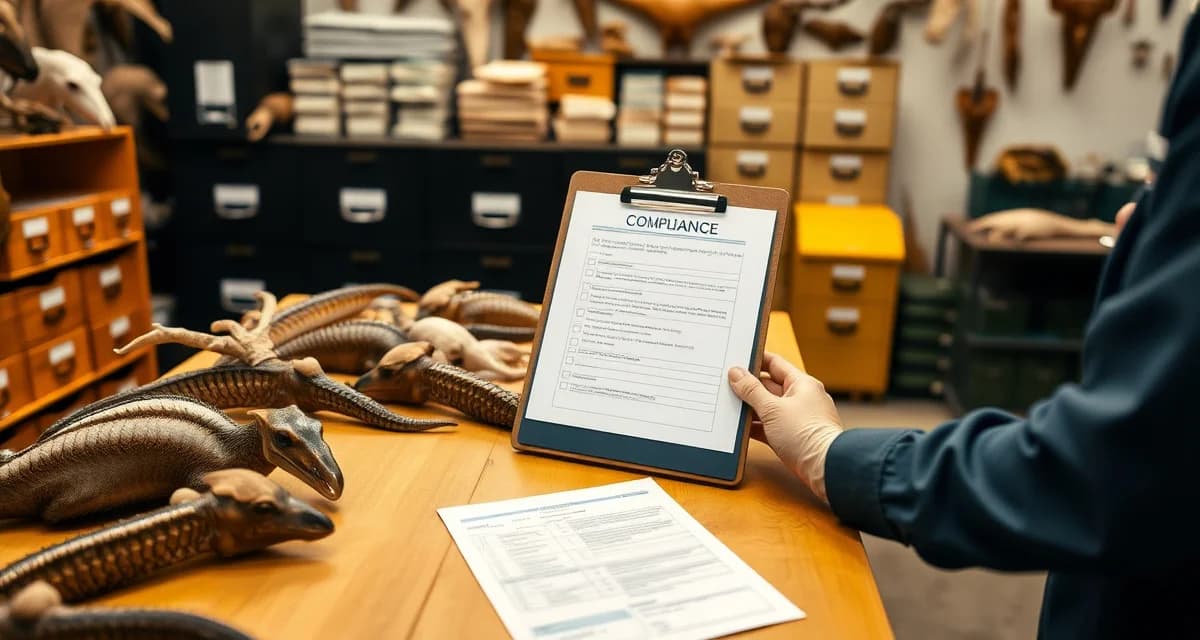
Wildlife Compliance Checklist for Taxidermy Shops
Keep this checklist at your intake station. Run through it for every specimen before you accept it into your shop. A few seconds at intake prevents serious legal exposure later.
This isn't a substitute for knowing your specific state regulations, check with your state wildlife agency for requirements in your jurisdiction. This checklist covers the baseline requirements that apply in most states.
TL;DR
- Requirements vary, some require a separate commercial taxidermist license, others cover you under a general wildlife license.
- Run through it for every specimen before you accept it into your shop.
- Keep this checklist at your intake station. Run through it for every specimen before you accept it into your shop. A few seconds at intake prevents serious legal exposure later.
- Does my state require a commercial taxidermist license?
- few seconds at intake prevents serious legal exposure later.
- This isn't a substitute for knowing your specific state regulations, check with your state wildlife agency for requirements in your jurisdiction.
Section 1: Intake Documentation Checklist
For every specimen, confirm you have:
- [ ] Customer full legal name
- [ ] Customer phone number and address
- [ ] State hunting license number (photograph the license)
- [ ] Kill tag / locking tag number (photograph the tag, leave it attached to specimen)
- [ ] Species and subspecies documented
- [ ] Sex of animal documented
- [ ] Harvest date
- [ ] County, unit, or zone of harvest
- [ ] State where harvested (especially important for out-of-state customers)
Photograph and attach to the job record:
- [ ] License (front)
- [ ] Kill tag (readable, in-frame)
- [ ] Full specimen photo
- [ ] Any pre-existing damage or condition issues
Section 2: Species-Specific Compliance Checklist
Whitetail and Mule Deer
- [ ] State hunting license
- [ ] Kill/locking tag attached and photographed
- [ ] CWD zone documentation if harvested in a restricted zone (check current zone maps for your state and source states)
- [ ] For antlered deer: confirm legal antler restrictions were met in harvest state
Elk
- [ ] State hunting license
- [ ] Elk tag/license (often separate from general license)
- [ ] Unit of harvest documented
- [ ] For bulls: antler restrictions by unit may apply in some states
Black Bear
- [ ] State hunting license
- [ ] Bear tag
- [ ] Bear teeth seal or seal number where required (varies by state)
- [ ] For hides shipped across state lines: CITES Appendix II documentation may apply in some circumstances, check with USFWS for current requirements
Wild Turkey
- [ ] State hunting license
- [ ] Turkey tag attached
- [ ] Sex documentation (most states require legal tag to indicate sex)
- [ ] Harvest date and unit
Migratory Waterfowl (Duck, Goose, Dove)
- [ ] Federal migratory bird hunting stamp (Duck Stamp), MANDATORY
- [ ] State hunting license
- [ ] Federal migratory bird permit (HIP enrollment) where required
- [ ] Species and sex documentation
- [ ] Daily bag limit confirmation is hunter's responsibility, you document what they bring
Mountain Lion / Cougar
- [ ] State hunting license and tag
- [ ] Check CITES status in your state, CITES Appendix II applies to cross-state and international shipments
- [ ] Some states require USFWS documentation for interstate transport of mountain lion parts
Alligator
- [ ] State hunting license / alligator permit
- [ ] CITES Appendix II documentation required for any interstate or international transport
- [ ] Hide tag from state agency (most alligator-harvesting states issue official hide tags)
African / International Game (Lion, Leopard, Elephant, Rhino, Hippo, etc.)
- [ ] CITES export permit from country of origin
- [ ] CITES import permit from USFWS (Form 3-177)
- [ ] ESA permit if species is US-listed (trophy import rules have changed, verify current USFWS policy)
- [ ] Shipping and freight documentation showing legal import
- [ ] Keep all CITES documentation permanently with the job record
Alligator Snapping Turtle, Certain Snakes, and Reptiles
- [ ] CITES Appendix II documentation for applicable species
- [ ] State permit or license as required
- [ ] Federal documentation for any Lacey Act-protected species
Section 3: Situation-Specific Checks
Customer From Another State
- [ ] Confirm species was legally taken in harvest state
- [ ] Check if harvest state has a transport restriction (CWD zones, carcass transport laws)
- [ ] Confirm species is legal to possess in your state
- [ ] Document the out-of-state license number
Specimen Received via Shipping (Not In-Person Intake)
- [ ] Documentation package should accompany shipment
- [ ] If documentation is missing, contact customer before starting work
- [ ] Do not accept shipments of species requiring CITES documentation without verifying permits first
Specimen Appears Questionable (No Tag, No License)
- [ ] Do not accept the specimen without documentation
- [ ] No exceptions for "I'll bring the paperwork later", document now or decline
- [ ] If you suspect illegal trafficking, you have no obligation to possess the specimen and accepting it creates risk
Specimens You're Shipping to a Tannery
- [ ] Label each specimen with QR tag or permanent tag before packing
- [ ] Document which specimens are in each shipment in MountChief
- [ ] For CITES species: verify tannery's state and permits before shipping across state lines
Section 4: Records Retention Checklist
Maintain for minimum 5 years:
- [ ] All intake forms and customer documentation
- [ ] License and tag photographs
- [ ] Specimen condition photos
- [ ] Job completion records
Maintain permanently (life of mount):
- [ ] CITES documentation for any Appendix I or II species
- [ ] USFWS import permits
- [ ] Federal duck stamp documentation for migratory bird work
Maintain as current possession log:
- [ ] Active list of all specimens currently in your possession (MountChief generates this automatically)
- [ ] Current stage of each specimen
- [ ] Date received and expected completion
Section 5: Annual Compliance Audit Checklist
Do this once a year, before deer season:
- [ ] Review current CWD zone maps for your state and top 5 source states
- [ ] Check for any changes to state licensing requirements that affect your customers
- [ ] Verify your commercial taxidermist license is current
- [ ] Review USFWS current regulations on any species you commonly work with
- [ ] Confirm your tannery is licensed in their state and compliant
- [ ] Back up all digital records to a second location
- [ ] Shred physical records past your retention period (don't accumulate decades of unnecessary paper)
- [ ] Update your intake form if any regulatory requirements have changed
Using This Checklist with MountChief
MountChief's intake process walks you through required documentation fields before you can save a job. If a field that's flagged as required is missing, the system prompts you to add it or document why it's unavailable.
For CITES species, MountChief generates a CITES documentation flag on intake that requires you to attach permit photos before the job moves past the received stage. This prevents the common mistake of starting work on a trophy before confirming documentation is in order.
Your full possession log, every specimen in-shop, at the tannery, and in transit, is available in the Reports section at any time. If a wildlife officer shows up for an inspection, you pull that report and hand it over.
Related Articles
- Best Taxidermy Software for Wildlife Compliance in 2026
- How to Handle Wildlife Compliance at Your Taxidermy Shop
- The $12,000 Wildlife Compliance Failure That Almost Closed a Taxidermy Shop
- Complete Wildlife Compliance Guide for Taxidermy Shop Owners
FAQ
What happens if a customer brings in a specimen without proper documentation?
Don't accept it. Hold the specimen only if the customer can return immediately with documentation. If you accept a specimen without proper documentation, you're in possession of potentially illegal wildlife parts, even if your intent was innocent. The safe policy: document at intake, no exceptions. Your intake form should state this requirement clearly.
Does my state require a commercial taxidermist license?
Most states do. Requirements vary, some require a separate commercial taxidermist license, others cover you under a general wildlife license. Check with your state wildlife agency. Operating without the proper license puts your ability to do business at risk and can affect your ability to legally possess specimens.
Can I legally keep an abandoned mount with CITES documentation?
Complicated. For non-CITES species, state law usually governs abandoned property and most states allow you to sell or donate after a documented waiting period. For CITES species, it's more complex, the permit was issued for a specific transaction. Consult with a wildlife attorney before disposing of any CITES-documented specimen that has been abandoned.
How does this apply to solo taxidermy shops?
The principles in this guide apply to solo shops just as they do to larger operations, though the scale differs. A single-person shop may have lower absolute volume but faces the same documentation, compliance, and customer communication requirements. The practical advice here scales down to any shop size.
What is the most common mistake taxidermists make with wildlife compliance checklist?
The most common mistake is treating wildlife compliance checklist as an afterthought rather than building it into the standard workflow from the start. Shops that encounter problems in this area typically did not establish clear processes before season, which means every situation becomes a one-off decision rather than a standard response.
Try These Free Tools
Put these insights into practice with our free calculators and planners:
Sources
- National Taxidermists Association (NTA)
- US Fish & Wildlife Service
Get Started with MountChief
Wildlife compliance documentation protects your business and your license. MountChief builds required fields for every species into the intake workflow and keeps all records organized for inspection. Try MountChief to make compliance documentation part of every intake automatically.