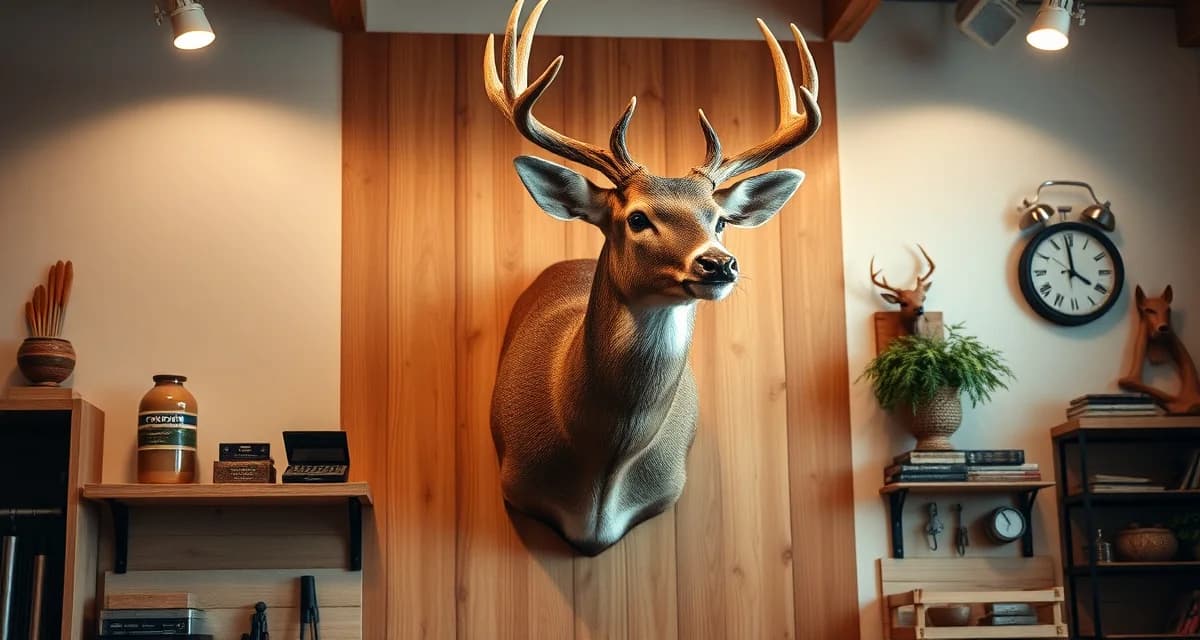
How Much Does a Deer Shoulder Mount Cost in 2026?
The short answer: Most deer shoulder mounts cost between $450 and $950 in 2026, with a national average around $600-$650. High-quality work at boutique shops can run $900-$1,200+. Budget shops may go as low as $375-$400, but quality at that price point varies significantly.
Where you fall in that range depends on region, the specific shop's reputation, the complexity of the mount, and any habitat or panel customization you add.
TL;DR
- Most deer shoulder mounts cost $450-$950 in 2026, with a national average around $600-$650.
- High-quality boutique shops may charge $900-$1,200 or more.
- Tannery costs of $40-$80 per cape come out of the taxidermist's revenue before any profit.
- A thorough shoulder mount requires 5-10 hours of skilled labor.
- Regional variation is significant: Pacific states average $650-$1,000+, Southeast $450-$700.
- Custom habitat bases and premium eyes can add $75-$300 or more to the base price.
Regional Price Ranges
Taxidermy pricing is regional. Rural shops in the Midwest often charge less than shops in the Northeast or Mountain West, partly because of regional cost-of-living differences and partly because of competitive dynamics in high-hunting-density areas.
Rough regional averages for a standard whitetail shoulder mount:
- Midwest (WI, IA, MN, MO, OH): $500-$750
- Southeast (TX, AL, MS, GA, TN): $450-$700
- Mountain West (CO, WY, MT, ID): $550-$850
- Northeast (PA, NY, VT, NH): $575-$900
- Pacific states: $650-$1,000+
Texas, because of its enormous deer hunting volume and high concentration of taxidermists competing for business, often has prices at the lower end of the range for comparable quality.
What Goes Into the Price
A $600 shoulder mount isn't just an hour of work. You're paying for:
Materials:
- Commercial deer form (foam mannikin): $50-$90
- Glass eyes: $12-$30 depending on quality
- Ear liners (commercial or custom-formed): $15-$30
- Adhesives, hide paste, finishing materials: $25-$50
- Wall panel or plaque if included: $30-$100+
Tannery costs: Most taxidermists pay $40-$80 to tan a deer cape. That comes directly out of your price before any profit.
Labor: Skinning, ear turning, lip turning, form prep, mounting, finishing, and detailing. A thorough shoulder mount takes 5-10+ hours of skilled labor depending on the pose and finish quality.
Overhead: Shop space, equipment, licensing, software, insurance. These are real costs that get built into pricing.
Add-Ons That Affect Final Price
A "standard" shoulder mount price usually means a semi-sneak or upright pose on a basic walnut panel or wall plate. The following add-ons carry additional cost:
| Add-On | Typical Additional Cost |
|---|---|
| Custom habitat base (rock, foliage, water) | $75-$300+ |
| Premium glass eyes (hand-blown, custom) | $20-$50 additional |
| Pedestal mount vs. wall mount | $100-$250 |
| Full sneak or extreme pose | $50-$150 |
| Rush service (where offered) | 25-50% premium |
| European skull accent added to shoulder mount | $75-$150 |
Why the Cheapest Quote Isn't Always the Best Deal
The difference between a $400 and a $700 deer mount usually shows up in:
Form quality. Cheaper forms produce less realistic proportions. You'll notice this in the face, nose width, eye socket depth, muzzle shape.
Eye quality. Glass eyes vary dramatically in realism. Better glass eyes with realistic iris detail and depth cost more. This is one of the most noticeable quality differences at any distance.
Ear detail. Commercial ear liners vs. hand-formed liners. Hand-formed liners produce more natural, thinner ear edges and better cartilage detail.
Hide fit. How well the tanned cape is fitted to the form, no wrinkling, seamless lip work, natural nose shape. This is purely labor and experience.
Finishing. Nose detail, mouth detail, airbrush work on exposed skin surfaces. A well-finished nose and mouth is the mark of skilled work.
A mount at $450 can be excellent if the taxidermist is skilled and efficient. One at $900 should be noticeably better. Ask to see examples of previous work at whatever price point you're considering.
When to Negotiate (and When Not To)
Taxidermists, like most skilled tradespeople, don't usually negotiate prices during their busy season. Asking a taxidermist to cut their price during November deer intake is unlikely to go anywhere and may not get your mount prioritized.
Where there's sometimes flexibility:
- If you're bringing multiple mounts in at once (three mounts might get a package deal)
- If you're scheduling during the offseason (some shops have slower periods)
- If you're a long-term repeat customer
Where there isn't: at peak season intake, for standard work.
Related Articles
- How Much Does a Taxidermist License Cost in Each State?
- How Much Does Tannery Processing Cost for Taxidermists?
- What is the Difference Between a Shoulder Mount and European Mount?
- How Long Does an Elk Taxidermy Mount Take?
FAQ
Why do taxidermists charge deposits?
Deposits are standard practice because taxidermy work requires significant upfront costs, the taxidermist pays for tanning, materials, and labor before you pay anything beyond the deposit. Deposits also secure your spot in the queue and reduce the risk of customers not picking up finished mounts. A standard deposit is 25-50% of the total cost.
Can I get a cheaper mount from a taxidermy school student?
Students working toward certification often offer discounted work, but quality is variable and wait times can be unpredictable. If budget is the primary concern, a student taxidermist can produce acceptable work. If quality is important (a trophy buck you've been hunting for years, for instance), a professional shop is worth the full price.
Is a $1,000 deer mount actually better than a $500 one?
Often, yes, but not automatically. Price reflects the shop's cost structure, regional market, and reputation as much as absolute quality. The best way to evaluate is to look at finished work, not just price. Ask to see previous mounts, especially of the same species and style you're requesting. A $500 mount from a highly skilled rural taxidermist may outperform an $800 mount from a high-overhead urban shop.
How do I know if a taxidermist's pricing is fair for my area?
Check three or four shops in your region and ask for a standard whitetail shoulder mount quote on the same pose. Regional averages are the relevant benchmark, not national averages. A shop priced 30-40% below the regional average warrants a look at their portfolio before you commit. A shop priced 30-40% above should be able to show you work that justifies the premium.
Why do deposits exist and how much should I expect to pay upfront?
Deposits are standard because the taxidermist incurs significant costs before you pay anything beyond the deposit. Tanning fees, materials, and labor are all incurred during the process. A standard deposit ranges from 25-50% of the total price. Paying a deposit also secures your spot in the production queue.
Are prices going up for deer shoulder mounts?
Yes, gradually. Material costs, tannery fees, and general overhead have increased alongside broader cost-of-living increases. Taxidermists who have not raised prices in several years are often working at thinner margins than they realize. If a shop's prices seem unusually low for your area, it may reflect a shop that has not adjusted to current costs.
Try These Free Tools
Put these insights into practice with our free calculators and planners:
Sources
- National Taxidermists Association (NTA)
- Breakthrough Magazine
- Taxidermy Today
- US Bureau of Labor Statistics (labor cost benchmarks)
Get Started with MountChief
Understanding what goes into a deer mount's price helps hunters make informed decisions and helps taxidermists explain their value. MountChief makes it easy to present pricing, collect deposits, and send customers a professional intake confirmation on the spot. Try MountChief to give every intake a professional finish.