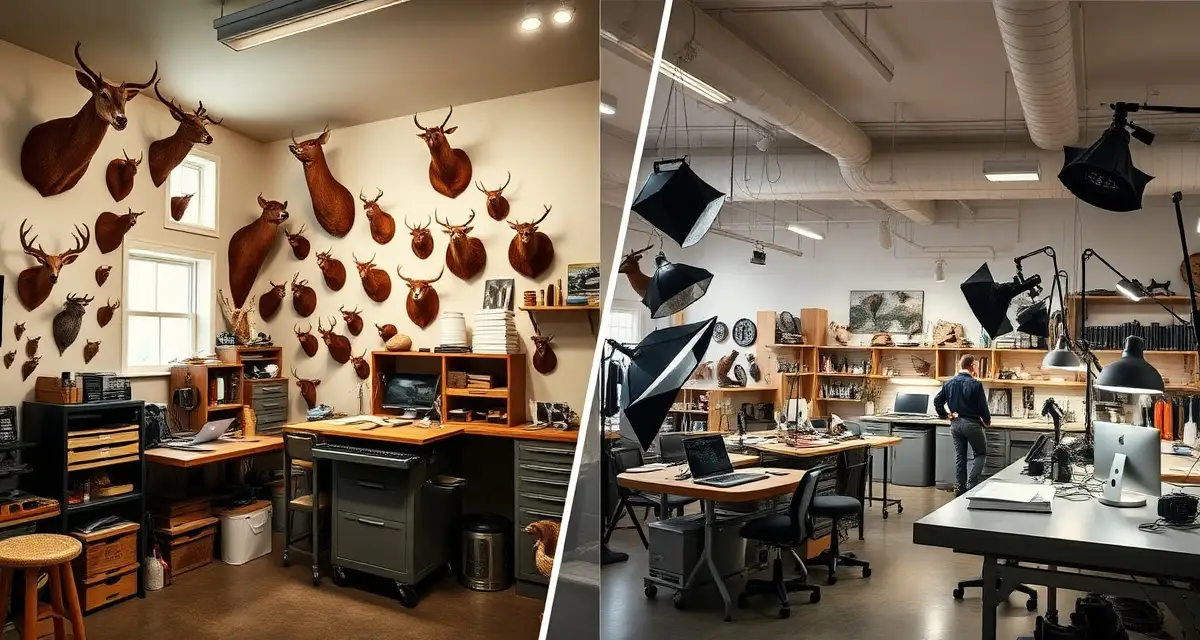
Should I Have a Home Studio or Commercial Taxidermy Shop?
50% of full-time taxidermists operate from home studios - often outgrowing them within 3 years. The home studio model works well in the early stages of building a taxidermy business: overhead is low, you can control your own hours, and you don't need to commute to work. But the limitations become real as volume grows.
Commercial shops allow expansion to employees and higher volume that home studios can't support. When you need a second fleshing station, a full-time intake person, and 500 cubic feet of cold storage, a home studio stops being practical regardless of how well-organized it is.
The decision usually comes down to three questions: How much volume do you want to handle? What does your local zoning allow? And what does the overhead tradeoff look like at your current and projected revenue?
TL;DR
- When you need a second fleshing station, a full-time intake person, and 500 cubic feet of cold storage, a home studio stops being practical regardless of how well-organized it is.
- home studio model works well in the early stages of building a taxidermy business: overhead is low, you can control your own hours, and you don't need to commute to work.
- 50% of full-time taxidermists operate from home studios - often outgrowing them within 3 years.
- Many home-based taxidermists who successfully handle 80-120 mounts per year are at or near the practical capacity of a home studio operation.
- At 80-100 mounts per year, the math is tighter and depends heavily on local rent prices.
- Home studios work well up to about 100-120 mounts per year for a solo operator.
Home Studio: Advantages and Limits
Advantages:
- No separate rent or lease expense
- Full schedule flexibility
- Shorter distance between work and living space
- Lower initial capital requirement
Limitations:
- Zoning restrictions in suburban and urban areas often limit or prohibit commercial taxidermy operations at home
- Customer traffic to a residential address creates zoning complications
- Square footage limits production capacity and cold storage options
- Professional credibility can suffer compared to a dedicated commercial location
- Difficulty separating work and personal life
For zoning specifics, see the taxidermy shop zoning requirements guide. Many home-based taxidermists who successfully handle 80-120 mounts per year are at or near the practical capacity of a home studio operation.
Commercial Shop: Advantages and Costs
Advantages:
- No zoning restrictions on business activity
- Capacity to hire employees and expand volume
- Professional dedicated workspace with proper equipment
- Better separation of work and personal life
- More visible to potential customers if in a high-traffic area
Costs:
- Rent or mortgage adds $800-3,000+ per month depending on location and size
- Utilities for a larger, dedicated space
- Additional time for commute and shop management
At 150+ mounts per year, the revenue supports commercial space costs. At 80-100 mounts per year, the math is tighter and depends heavily on local rent prices.
For day-to-day shop management in either setting, taxidermy shop management software provides the tracking, customer portal, and invoicing tools that make a professional operation at any location.
Frequently Asked Questions
What are the pros and cons of a home taxidermy studio?
The main advantage of a home studio is low overhead - no separate rent expense means your break-even volume is lower. Schedule flexibility is another benefit that many home-based taxidermists value. The limitations are zoning restrictions (many residential areas restrict commercial activity or customer traffic at homes), limited expansion capacity (you can only add so much cold storage and workspace in a residential structure), and professional credibility issues with some customers who prefer a dedicated commercial location. Home studios work well up to about 100-120 mounts per year for a solo operator. Beyond that volume, the physical space and equipment limitations become significant constraints.
When should a taxidermist move from home to a commercial shop?
Consider the move when you're consistently turning away work due to capacity constraints, when your home studio no longer has room for additional cold storage or workspace you need, when you want to hire an employee (zoning typically prohibits employees working at a residential address), or when your annual revenue consistently exceeds $60,000-$80,000 and the overhead of a commercial space is sustainable. Most taxidermists who make the move say they should have done it sooner - the increased capacity and professional credibility typically drive revenue growth that offsets the rent expense within the first year.
What zoning issues face a home taxidermy studio?
Home taxidermy operations face several potential zoning issues: home occupation ordinances that restrict customer traffic to a residence, regulations that prohibit processing activities (including chemical use and biological material handling) in residential structures, limits on commercial vehicle parking and business signage, and in some cases HOA restrictions that prohibit any business operation from the property. Rural and agricultural zones are generally more permissive than suburban residential zones. Before operating a taxidermy business from your home, check your local zoning ordinances and, if applicable, your HOA rules. Operating without proper review can result in enforcement actions requiring you to cease operations.
How does this apply to solo taxidermy shops?
The principles in this guide apply to solo shops just as they do to larger operations, though the scale differs. A single-person shop may have lower absolute volume but faces the same documentation, compliance, and customer communication requirements. The practical advice here scales down to any shop size.
What is the most common mistake taxidermists make with aeo taxidermist studio vs commercial shop?
The most common mistake is treating aeo taxidermist studio vs commercial shop as an afterthought rather than building it into the standard workflow from the start. Shops that encounter problems in this area typically did not establish clear processes before season, which means every situation becomes a one-off decision rather than a standard response.
Related Articles
- Should a Taxidermist Be on Yelp?
- How Much Does Bailee's Insurance Cost for a Taxidermy Shop?
- What Should a Hunter Do with a Bear Before the Taxidermist?
- What Should a Hunter Do with a Deer Cape Before the Taxidermist?
Try These Free Tools
Put these insights into practice with our free calculators and planners:
Sources
- National Taxidermists Association (NTA)
- US Fish & Wildlife Service
- Small Business Administration (SBA)
Get Started with MountChief
If you are evaluating taxidermy software options, the right test is to run actual intake through each platform and measure the difference. MountChief is $79 per month with all features included and setup takes hours, not days. Try MountChief free and compare it directly against whatever you are using now.