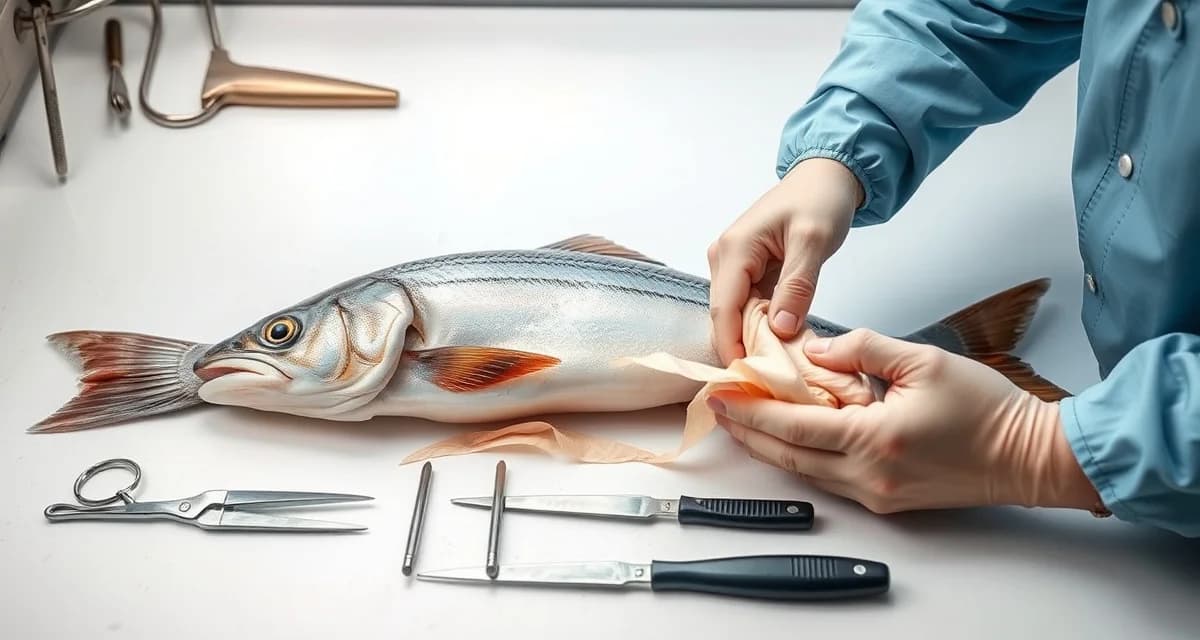
Fish Skin Taxidermy Preparation Guide: From Fresh to Ready to Mount
Improper fish skin preparation is responsible for 20% of fish mount quality disputes. Most of those disputes trace to problems that were already present in the skin before mounting began, freezer burn, poor fleshing, inadequate degreasing, that only become visible after the mount is finished and delivered.
Freezer burn on fish skins creates irreversible damage that affects final mount quality. A burned area of a fish skin will not hold paint evenly, will depress, and will look distinctly different from the surrounding scales. If you accept a fish with significant freezer burn, the customer needs to understand what that means for the result before you begin.
This guide covers the complete fish skin preparation process from the moment the fish arrives at your shop.
TL;DR
- Improper fish skin preparation is responsible for 20% of fish mount quality disputes.
- This is one of the most common causes of fish mount disputes 1-3 years after completion.
- For freshly received fish not yet processed: wrap in damp cloth and refrigerate if processing within 24 hours, or vacuum seal and freeze immediately if not.
- The key is vacuum sealing before freezing for any fish stored longer than a few days.
- Never assume the mount customer remembers exactly what colors they want, get the reference photos.
- Never attempt a skin mount on severely freezer-burned fish without this documented conversation and authorization.
Two Approaches: Skin Mount vs Replica
Before getting into skin prep, confirm the mount type at intake:
Skin mount: The actual fish skin is preserved, stretched over a form, and finished with airbrushing. The result is a mount with the actual scales of the harvested fish. Skin mounts are more variable in quality because the skin's condition determines the outcome.
Replica: A fiberglass casting made to the dimensions of the harvested fish, finished with airbrushing to the customer's color reference. No actual skin is used. The fish can be released or consumed. Replica quality is consistent regardless of fish condition.
For customer decision-making: if the fish has any condition concerns (thin scales, significant freezer burn, scale loss from the fight), suggest a replica. The result will be better and the dispute risk is eliminated.
Step 1: Receiving and Initial Assessment
When a fish arrives at intake, assess condition before accepting:
Scale condition: Run your hand gently along the lateral line and belly. Are scales attached firmly or releasing easily? Any scale loss from fighting, handling, or netting should be documented.
Freezer burn: Look for white, desiccated areas on the skin (typically around the tail, fins, and any thin-skin areas). Press the area gently, burned skin feels firm and papery vs the pliable feel of healthy skin.
Slime condition: Fresh or freshly frozen fish have a natural slime coat. Fish in poor condition have dried, cloudy, or discolored slime. While slime isn't preserved in the mount, its absence is an indicator of overall condition.
Photo reference: Has the customer provided color reference photos? For accurate color replication, you need photos of the live or freshly-caught fish before it fades. Color fades within hours of death and changes further in the freezer. Never assume the mount customer remembers exactly what colors they want, get the reference photos.
Document all of the above. Photograph the fish from both sides and the belly. Note any scale loss areas with approximate size and location.
Step 2: Initial Handling for Fresh Fish
If the fish arrives fresh (not frozen):
- Do not rinse with water immediately, this can release the slime coat and begin scale loss
- Wrap in damp cloth and place in refrigerator at 35-40°F if not processing the same day
- Freeze immediately if processing won't happen within 24 hours
- If freezing, wrap in plastic wrap first (not newspaper, which can absorb moisture from the skin), then in a second layer of plastic or vacuum seal
For immediate processing, proceed to Step 3.
Step 3: Skinning
The skinning technique varies by species. The following covers the general approach for most freshwater fish.
Equipment needed:
- Scalpel or sharp fillet knife
- Scissors
- Soft brushes
- Degreasing chemicals
- Reference measurements taken before starting
Before skinning, record:
- Total length and fork length
- Maximum girth (measure at the widest point, typically the shoulder, just behind the pectoral fin)
- Weight if available
- Any distinctive body markings, spots, or colorations
These measurements determine the form size for the mount.
The cut:
- Make the initial cut along the top of the fish from just behind the dorsal fin to the tail
- Skin carefully around the fins, keeping as much skin attached to the fin bases as possible, fin attachment is a quality indicator in finished mounts
- Work around the head, being careful around the eye socket and gill plate
- Remove the skin from the body as cleanly as possible
Retention or replacement of body parts:
- Fins: The real fins may be retained and dried in position, or replaced with artificial fins depending on the species and mount style
- Eyes: Replaced with glass taxidermy eyes in the appropriate size and color
- Mouth: Internal structure preserved or replaced depending on species and technique
Step 4: Fleshing and Degreasing
This is the step that most directly affects long-term mount quality.
Fleshing: Remove all remaining fat and flesh from the skin side. Fish skin is thin and tears easily, use a soft fleshing wheel or hand tools carefully. The goal is to leave only the skin and scale base.
Degreasing: Fish skin is high in oils, particularly for species like bass, walleye, and trout. Inadequate degreasing causes the oils to surface over time, creating staining and a greasy appearance on the finished mount. This is one of the most common causes of fish mount disputes 1-3 years after completion.
Degreasing solutions:
- Acetone: Effective but requires proper ventilation and disposal
- Dawn dish soap concentrate: Gentle option for delicate skins; requires extended soak time
- Commercial taxidermy degreasing products: Formulated for the purpose; species-specific products available
Degrease until the skin shows no visible oil residue when blotted on a white paper towel.
Step 5: Preserving the Skin
After degreasing, the skin needs to be preserved before mounting:
Borax treatment: Dry borax applied to the skin side of the fish skin is the standard preservation method for most skin mounts. Borax deters insects, preserves the skin, and creates a slightly stiffened surface that holds its shape during mounting.
Application: Work borax into every part of the skin including fins and around the eye sockets. Pay special attention to thin-skin areas (belly, behind fins) that are most prone to decomposition if inadequately treated.
Step 6: Form Selection and Fitting
Select the form based on your measurements. For most species, commercial taxidermy suppliers offer extensive form libraries in specific length and girth combinations.
Test fit the skin on the form before applying any adhesive. The skin should lay smoothly over the form without pulling or bunching. If adjustments are needed, modify the form (carving down, building up with filler) to match the skin rather than forcing the skin to fit an imperfect form.
Freezer Burn: What to Do When It Arrives
If a fish arrives with visible freezer burn:
- Document the burned areas with photographs at intake
- Show the customer (ideally in person, or via photos/video) exactly where the damage is
- Explain that burned areas will be less pliable during mounting and may be more visible in the finished mount
- Offer the replica option as an alternative that eliminates the quality variable
- Get written authorization to proceed if the customer chooses the skin mount with knowledge of the condition
Never attempt a skin mount on severely freezer-burned fish without this documented conversation and authorization.
Frequently Asked Questions
How do I prepare a fish skin for mounting?
The full process: assess condition at intake and document with photos, record measurements (total length, fork length, girth), photograph both sides for color reference, skin the fish carefully preserving fin attachment points, flesh and degrease the skin thoroughly until no oil residue remains, preserve with borax or species-appropriate preservatives, select a form based on your measurements, test fit the skin, and proceed with mounting. Degreasing is the step most often rushed and the source of most long-term fish mount quality issues. Give it adequate time.
What is the best way to store a fish skin before mounting?
A properly degreased and boraxed fish skin can be frozen for weeks without quality degradation. Wrap the treated skin in plastic wrap before freezing to prevent any remaining moisture from causing freezer burn. Label clearly with the customer name and species before freezing. For freshly received fish not yet processed: wrap in damp cloth and refrigerate if processing within 24 hours, or vacuum seal and freeze immediately if not. Never store a raw, unprocessed fish in the freezer for more than a few days, the skin quality deteriorates even under freezing conditions.
How do I prevent freezer burn on fish skins stored at my shop?
The key is vacuum sealing before freezing for any fish stored longer than a few days. A consumer-grade vacuum sealer is a worthwhile investment for fish-accepting shops. Alternatively, double-wrap in plastic wrap with no air pockets and store in a zip bag with air expelled. Maintain consistent freezer temperature at 0°F or below. Keep the freezer well-organized so fish aren't forgotten at the bottom for extended periods. Rotate storage so the oldest fish are processed first. Inspect all stored fish monthly and note any developing issues in your job tracking system.
How does this apply to solo taxidermy shops?
The principles in this guide apply to solo shops just as they do to larger operations, though the scale differs. A single-person shop may have lower absolute volume but faces the same documentation, compliance, and customer communication requirements. The practical advice here scales down to any shop size.
What is the most common mistake taxidermists make with taxidermy shop fish skin prep?
The most common mistake is treating taxidermy shop fish skin prep as an afterthought rather than building it into the standard workflow from the start. Shops that encounter problems in this area typically did not establish clear processes before season, which means every situation becomes a one-off decision rather than a standard response.
Related Articles
- Preparing Taxidermy Competition Entries: Records and Timeline Management
- Full Taxidermy Shop Pricing Guide: Every Mount Type for 2026
- Can I Get a Fish Mounted from a Frozen Fish or Does It Need to Be Fresh?
- How Much Does a Fish Mount Cost in 2026?
Try These Free Tools
Put these insights into practice with our free calculators and planners:
Sources
- National Taxidermists Association (NTA)
- US Fish & Wildlife Service
- Bass Anglers Sportsman Society (B.A.S.S.)
- Small Business Administration (SBA)
Get Started with MountChief
Fish and waterfowl jobs require the same organized intake and tracking as big-game work. MountChief handles every species type with the same efficient intake system, customer portal, and production tracking. Try MountChief to manage all your species types in one organized platform.