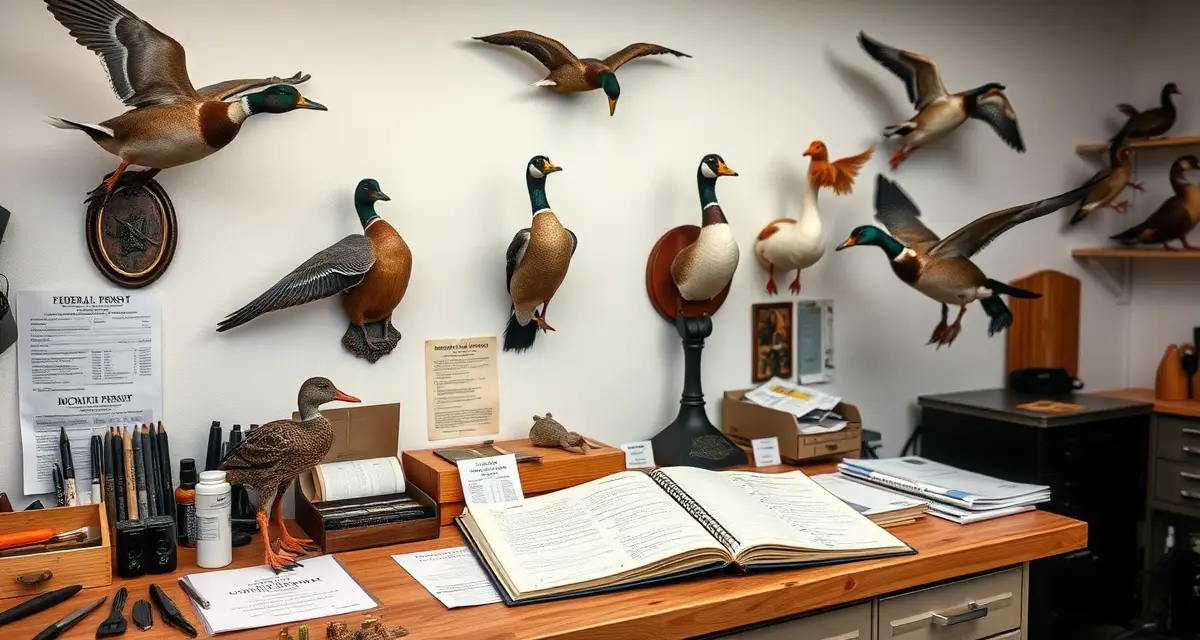
Migratory Bird Taxidermy Guide: Federal Permits and Record-Keeping
ALL North American ducks, geese, and turkeys are migratory birds under federal law. This is not a minor regulatory detail - it defines your legal obligations at a federal level for a significant portion of the work many taxidermists do. Federal taxidermist permit violations for migratory birds are criminal, not just civil, which means the consequences are in a different category than a state-level record-keeping fine.
If you're accepting ducks, geese, doves, wild turkey, coots, snipe, woodcock, or any other species listed under the Migratory Bird Treaty Act (MBTA) for mounting, you need to understand the permit framework, the record-keeping requirements, and the specific documentation you're responsible for at intake.
TL;DR
- You need a Federal Taxidermist Permit issued by USFWS under 50 CFR Part 21.
- There's a processing fee and typical issuance takes 4-6 weeks.
- The penalties for first-time violations include fines up to $15,000 per violation and potential imprisonment up to six months.
- Mourning dove mounts require your federal taxidermist permit for you to legally possess the specimens.
- The MBTA was enacted in 1918 to implement treaties between the United States, Canada, Mexico, Japan, and Russia protecting migratory bird species.
- Permit issuance typically takes 4-6 weeks.
The Migratory Bird Treaty Act
The MBTA was enacted in 1918 to implement treaties between the United States, Canada, Mexico, Japan, and Russia protecting migratory bird species. Under the MBTA, it is illegal to pursue, hunt, take, capture, kill, possess, offer for sale, sell, offer to purchase, purchase, ship, import, export, or transport any migratory bird or part of a migratory bird without authorization.
The "possess" and "transport" provisions are what apply to taxidermists. You're legally possessing migratory bird specimens when you receive them for mounting. That possession requires a permit.
The MBTA applies to all species listed in the treaties, which includes most native North American birds - not just game birds. This is why taxidermists cannot legally mount injured songbirds, protected raptors, or most other wild bird species without specific permits beyond the standard taxidermist permit.
USFWS Federal Taxidermist Permit
The U.S. Fish and Wildlife Service (USFWS) issues Federal Taxidermist Permits under 50 CFR Part 21. This permit authorizes you to possess and transport migratory birds for taxidermy purposes.
To obtain a federal taxidermist permit:
- Apply to your USFWS Regional Migratory Bird Permit Office. The regional office is determined by the state where your shop is located.
- Submit Form 3-200-19 (Federal Migratory Bird Permit Application for Taxidermists).
- You'll need your state taxidermist license number as part of the application.
- There is a processing fee.
- Permit issuance typically takes 4-6 weeks.
Your permit must be renewed on the USFWS schedule, typically every two to three years. Keep your permit posted or readily accessible in your shop. USFWS wildlife officers can request to see it during an inspection.
Operating without a federal permit while possessing migratory bird specimens is a criminal violation of the MBTA. The penalties for first-time violations include fines up to $15,000 per violation and potential imprisonment up to six months.
Species Covered Under the Federal Taxidermist Permit
Your permit authorizes you to possess and mount migratory bird specimens legally obtained by hunters. The most common species taxidermists encounter:
Waterfowl (ducks and geese):
- Mallard, pintail, teal, wood duck, and all other dabbling ducks
- Canada goose, snow goose, white-fronted goose, brant, and all other geese
- Canvasback, redhead, scaup, and all other diving ducks
Migratory upland game birds:
- Wild turkey (eastern, Osceola, Rio Grande, Merriam's, and Gould's subspecies)
- Mourning dove (where dove hunting is legal)
- Woodcock
Shore and wading birds:
- Common snipe (where legal)
What is NOT covered by the standard taxidermist permit:
- Bald and golden eagles (require a separate, very restricted permit)
- Raptors in general (hawks, owls, falcons) - most require separate permits
- Songbirds - no permit allows taxidermy of most songbirds
- Endangered or threatened species - governed by Endangered Species Act
If a customer brings you a bird species you're uncertain about, research it before accepting. Accepting species you're not permitted to possess can create serious legal problems.
Record-Keeping Requirements Under the Federal Permit
Your federal permit requires you to maintain records for every migratory bird specimen you receive. These records must include:
- Species of the bird
- Name and address of the person who provided the specimen
- How that person acquired the bird (typically: legally hunted)
- The date you received the specimen
- Your permit number and state license number
For waterfowl and turkey specifically, you should also collect and record:
- The hunter's federal duck stamp number (for waterfowl)
- State hunting license number
- State turkey tag number (for turkey)
You must keep these records for the duration of your permit plus an additional period as specified by your permit conditions. Typically, records must be kept for at least three to five years.
USFWS can audit your records at any time without advance notice. During an inspection, you need to be able to account for every migratory bird specimen in your possession with documented records.
Duck Stamps and Verification
Waterfowl hunters are required to purchase and sign a federal Migratory Bird Hunting and Conservation Stamp (duck stamp) each year. As a taxidermist, you're not technically required to verify that every waterfowl hunter purchased a duck stamp - but recording the stamp number as part of your intake creates additional documentation that supports the legality of the specimen.
Ask for the duck stamp number at intake for any waterfowl specimen. Most hunters carry it with their license. Recording it in your intake form takes 10 seconds and creates a complete paper trail.
Dove Taxidermy - A Special Case
Dove is legal to hunt in most states but is classified as a migratory bird under the MBTA. Mourning dove mounts require your federal taxidermist permit for you to legally possess the specimens. Dove is one of the species most commonly overlooked by taxidermists who don't think of it as a "federal" species - but it is.
Record dove intake with the same documentation as waterfowl: hunter name, address, license number, date, and how they acquired the bird.
Eagles and Raptors
Do not accept eagle or raptor specimens for mounting without specific authorization. Bald and golden eagles are protected under the Bald and Golden Eagle Protection Act in addition to the MBTA. Possession without a permit is a criminal violation.
If a hunter brings you an injured or dead eagle or protected raptor, do not take possession. Contact your regional USFWS office and direct the hunter there. Accepting the specimen "to help out" does not protect you legally.
For other raptors - hawks, owls, falcons - a state wildlife rehabilitator permit or raptor-specific authorization is required to possess them even for educational purposes. The standard federal taxidermist permit does not cover raptors.
Setting Up Your Record-Keeping System
For compliance with your federal permit, you need a dedicated record for every migratory bird specimen separate from your general intake records. Many taxidermists maintain a migratory bird log book alongside their general job records.
[Wildlife compliance software for taxidermy](https://mountchief.com/wildlife-compliance-software-taxidermy) can flag migratory bird species at intake and ensure the required federal documentation fields are completed before the intake record is saved. This prevents the common situation where you complete the general intake but miss the federal-specific fields in the rush of deer season.
Practical Intake Checklist for Migratory Birds
Before accepting any migratory bird specimen:
- Confirm your federal taxidermist permit is current and on file
- Identify the species - is it covered by your permit?
- Collect hunter name, address, license number, and date
- For waterfowl: collect duck stamp number
- For turkey: collect turkey tag number
- Record how they acquired the bird (legally hunted, with license and tag)
- Enter all information into your migratory bird record log
- Store the specimen per your permit conditions
State Requirements on Top of Federal
Federal permit requirements are the minimum. Many states have additional record-keeping or licensing requirements for taxidermists handling migratory birds. In most cases your state taxidermist license covers state-level requirements, but some states have specific waterfowl or turkey documentation mandates beyond the federal baseline.
Check with your state wildlife agency for any state-specific requirements that apply on top of your federal permit obligations.
Frequently Asked Questions
What species are classified as migratory birds for taxidermy purposes?
All species listed under the Migratory Bird Treaty Act are classified as migratory birds requiring federal permit authorization for taxidermist possession. The most common species taxidermists handle that fall under the MBTA include all ducks and geese (including Canada goose, snow goose, and all dabbling and diving ducks), wild turkey, mourning dove, American woodcock, common snipe, and American coot. Virtually all native songbirds are also listed under the MBTA, which is why taxidermists cannot legally mount songbirds without specific USFWS authorization. Bald and golden eagles are additionally protected under the Bald and Golden Eagle Protection Act and require separate authorization beyond the standard taxidermist permit.
What USFWS permit does a taxidermist need for migratory birds?
You need a Federal Taxidermist Permit issued by USFWS under 50 CFR Part 21. Apply through your regional USFWS Migratory Bird Permit Office using Form 3-200-19. You'll need your state taxidermist license number as part of the application. There's a processing fee and typical issuance takes 4-6 weeks. The permit must be renewed on USFWS's schedule, typically every two to three years. Keep your permit accessible in your shop, as USFWS officers can request to see it during an inspection. Operating without this permit while possessing migratory bird specimens is a criminal violation of the MBTA with penalties up to $15,000 per violation.
What intake records are required for migratory bird mounts?
Your federal permit requires you to maintain records for every migratory bird specimen including: species identification, the hunter's name and address, how they legally acquired the bird (hunted with license and tag), the date you received it, and your own permit number. For waterfowl, also record the federal duck stamp number. For turkey, record the turkey tag number. These records must be kept for the term of your permit plus the retention period specified in your permit conditions, typically three to five years. USFWS can inspect your records without advance notice, so they must be current, complete, and organized enough to be produced quickly during an inspection.
How does this apply to solo taxidermy shops?
The principles in this guide apply to solo shops just as they do to larger operations, though the scale differs. A single-person shop may have lower absolute volume but faces the same documentation, compliance, and customer communication requirements. The practical advice here scales down to any shop size.
What is the most common mistake taxidermists make with taxidermy shop migratory bird guide?
The most common mistake is treating taxidermy shop migratory bird guide as an afterthought rather than building it into the standard workflow from the start. Shops that encounter problems in this area typically did not establish clear processes before season, which means every situation becomes a one-off decision rather than a standard response.
Related Articles
- Elk Season Taxidermy Management Guide: Western Shop Operations
- Regional Taxidermy Tannery Guide: Find the Best Tannery for Your Shop
- Buying an Existing Taxidermy Shop: What to Look for and Avoid
Try These Free Tools
Put these insights into practice with our free calculators and planners:
Sources
- National Taxidermists Association (NTA)
- US Fish & Wildlife Service
- Ducks Unlimited
- Small Business Administration (SBA)
Get Started with MountChief
Taxidermy shops that track specimens, manage customer communication, and handle compliance in one system spend less time on admin and more time on quality work. That is what MountChief was built for.