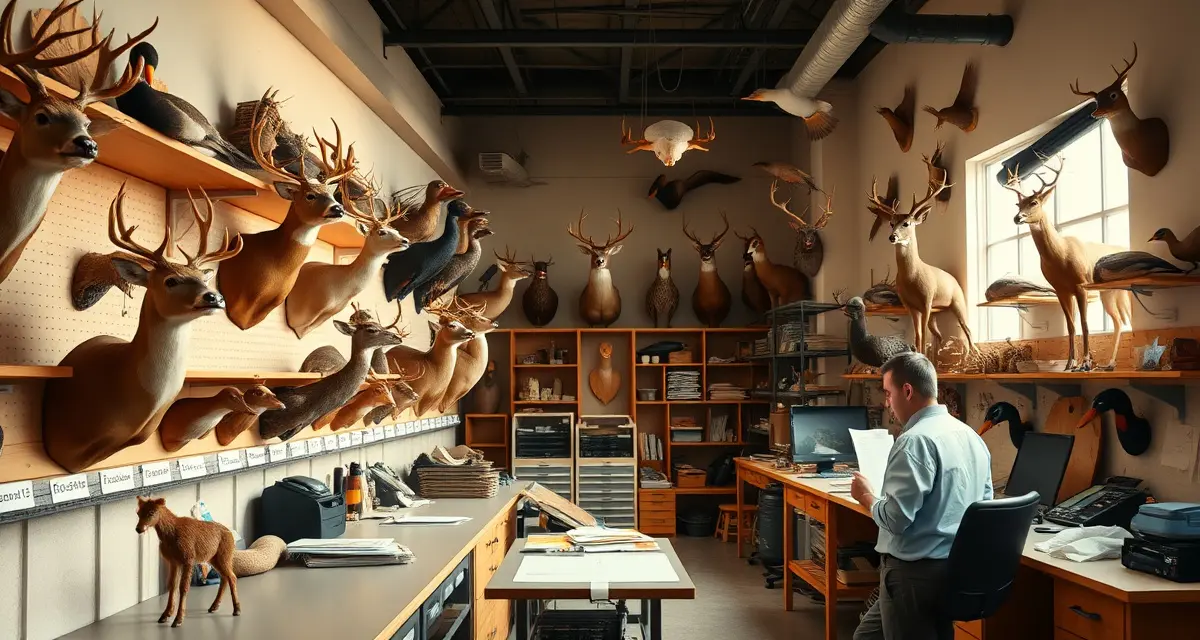
All Species Taxidermy Shop Guide: Managing Every Animal Type
Full-service shops have three times the compliance exposure of single-species shops. Each species category has distinct intake requirements, compliance documentation obligations, and production workflows that generic systems miss. Managing a multi-species operation on a single intake form designed for deer is how compliance gaps happen.
Each species category in this guide has its own intake fields, its own federal and state compliance requirements, and its own production timeline profile. This reference covers how to manage every major species category in one shop without creating the administrative chaos that drives most taxidermists to specialize.
TL;DR
- On a busy November day, you might take in 20 deer, 3 ducks, and a turkey.
- Full shoulder mount production after tannery: 15-30 hours depending on mount complexity.
- Elk capes have extended tannery timelines: 10-14 weeks.
- Total timeline: 6-12 months traditional, 12-18 months freeze-dry.
- Standard tannery timeline: 6-10 weeks.
- Total timeline: 9-12 months from intake for most shops.
Whitetail and Mule Deer
Intake Requirements
- Customer name, address, phone, email
- Harvest state, county, and license/tag number
- Cape condition assessment (field care quality, any slippage or damage)
- Reference photos: full cape from multiple angles
- Eye color selection (for mule deer, particularly)
- Mount style: shoulder, pedestal, European skull, antler-only
- Pose selection with reference photo
- Antler measurements (optional for standard mounts, required if B&C scoring)
- CWD harvest county documentation (for regulated states)
Compliance Notes
CWD regulations apply in designated zones in Wisconsin, Minnesota, Michigan, Pennsylvania, Ohio, Colorado, Wyoming, and others. Document harvest county for every deer. Know the carcass movement restrictions for your region and the harvest state.
Production Timeline
Standard tannery timeline: 6-10 weeks. Full shoulder mount production after tannery: 15-30 hours depending on mount complexity. Total timeline: 9-12 months from intake for most shops.
Elk
Intake Requirements
- All standard deer intake fields
- Cape condition with specific attention to heat exposure time (elk spoil faster than deer)
- Field care method (skinned in field, gutted only, whole animal)
- Estimated heat exposure hours
- Cape size (neck circumference, nose-to-eye measurement)
- Antler size class for form selection guidance
- Mount style: shoulder, pedestal, full life-size
- Nose cartilage condition
Compliance Notes
CWD regulations apply in major elk states (Colorado, Wyoming, Utah, New Mexico). Document harvest state and unit.
Production Timeline
Elk capes have extended tannery timelines: 10-14 weeks. Production after tannery: 25-50 hours. Total timeline: 12-18 months from intake.
Whitetail European Mounts
Intake Requirements
- Standard customer and harvest documentation
- Skull condition: are all teeth present? Any damage?
- Customer request: basic European, colored skull, painted, dipped, pedestal
- Antler quality notes
Compliance Notes
Same CWD county documentation as shoulder mounts. European mounts don't bypass CWD requirements.
Production Timeline
4-8 weeks from intake. European mounts can typically be returned in the same season.
Turkeys
Intake Requirements (Compliance-Critical)
- Customer federal migratory bird hunting license number (required)
- State turkey tag/permit number
- Harvest state, county
- Turkey subspecies: Eastern, Osceola, Merriam, Rio Grande
- Feather condition assessment
- Fan condition
- Beard count and measurements
- Spur length and condition
- Leg band number if banded (requires additional documentation)
- Mount type: full strut, standing, fan-only, fan/breast/beard combo
Compliance Notes
Federal MBTA compliance is non-negotiable. Your USFWS taxidermist permit must be current before accepting any turkey. Every turkey requires documented federal license information.
Production Timeline
Tannery for skin: 6-10 weeks. Fan drying (traditional): 2-4 weeks. Full mount production: 15-30 hours. Total timeline: 8-12 months.
Waterfowl (Ducks and Geese)
Intake Requirements (Compliance-Critical)
- Federal Duck Stamp number (required for waterfowl)
- HIP registration number (Harvest Information Program)
- State license and waterfowl permit
- Species with subspecies if known
- Band number if banded
- Harvest state, county, and date
- Plumage condition assessment
- Mount style: wall mount, in-flight, standing
Compliance Notes
All waterfowl are federally protected under the MBTA. Records must be maintained for 5 years minimum. Banded birds require additional reporting.
Production Timeline
Traditional mounting after preparation: 30-60 days. Freeze-dry: 3-6 months. Total timeline: 6-12 months traditional, 12-18 months freeze-dry.
Bear
Intake Requirements
- State skull seal number (required in most bear states)
- Species: black, brown, grizzly
- Harvest state, method, and date
- Hide size assessment
- Condition assessment: field care quality, any bullet holes or skinning cuts
- Heat exposure time and field care method
- Mount style: rug (with head or headless), life-size, skull mount
- CITES documentation for brown and grizzly bears
Compliance Notes
Skull sealing requirements vary by state. Brown bears (and grizzly bears where legal to hunt) may be CITES Appendix II, verify documentation. Bears are high-value, high-liability specimens: comprehensive documentation is essential.
Production Timeline
Tannery: 10-16 weeks. Life-size production: 60-120 hours. Total timeline: 18-24 months for life-size bears.
Fish
Intake Requirements
- Species (specific: largemouth bass, walleye, rainbow trout, etc.)
- Length (total length and fork length where applicable)
- Girth measurement
- Weight if available
- Reference photos from all angles (essential for accurate replication)
- Any distinguishing markings or coloration the customer wants preserved
- Replica vs skin mount selection
- For skin mounts: quality assessment of the skin condition
Compliance Notes
Freshwater fish have minimal federal compliance requirements for most native species. Non-native or imported species may require documentation. For saltwater species, verify any required permits.
Production Timeline
Replica: 8-16 weeks depending on shop. Skin mount: 10-20 weeks. Total timeline varies significantly by species and shop.
Small Mammals (Raccoon, Fox, Coyote, Bobcat, etc.)
Intake Requirements
- Species
- Skin condition at receipt
- Mount style: lifelike pose with form, European skull, hide only
- Custom pose notes
Compliance Notes
Mountain lion (cougar) requires CITES documentation in some cases. State regulations on bobcat may require documentation. Research state-specific requirements.
Production Timeline
4-8 weeks for most small mammals. Short production cycles relative to deer and bear.
Exotic Species
Intake Requirements
- Species identification (must be accurate, this affects compliance requirements)
- Country of harvest
- Import permit number if applicable
- CITES permit or documentation
- Taxidermy request type
Compliance Notes
This is the highest-risk category for compliance errors. Many African and Asian big game species are CITES Appendix I or II. Accepting any CITES species without proper import documentation creates federal wildlife law exposure. When in doubt, contact the USFWS permit office before accepting. The wildlife compliance software for taxidermy automatically flags potential CITES species at intake.
Managing Multi-Species Operations with One System
The challenge of a multi-species shop is maintaining species-specific intake discipline when the intake flow switches rapidly. On a busy November day, you might take in 20 deer, 3 ducks, and a turkey. Each requires a different set of compliance fields.
The solution is species-specific intake workflows in your management software, workflows that present the correct fields for the species selected, so you're never trying to remember what to ask for each type.
MountChief's taxidermy shop management software maintains separate intake workflows for each major species category, with the compliance fields embedded in the workflow. When you select "turkey," the federal license number field appears and is required. When you select "duck," the Duck Stamp number field is required. You don't need to remember the compliance checklist because it's built into the process.
The taxidermy intake form guide covers the complete field set for each species in detail.
Frequently Asked Questions
How do I manage multiple species at my taxidermy shop?
Use species-specific intake workflows that require the correct fields for each species before the record can be finalized. A single generic intake form is not sufficient for multi-species operations, it either omits required compliance fields for regulated species or creates confusion when fields are irrelevant to the species being processed. Software with species-specific workflows ensures federal license documentation is captured for turkey and waterfowl, skull seal numbers are captured for bear, and CITES review is flagged for applicable exotic species. Without this structure, compliance gaps happen during busy intake periods when attention is divided.
What species-specific intake fields does each animal require?
Deer requires harvest county for CWD compliance in regulated states. Turkey requires federal migratory bird license number and state tag number. All waterfowl require federal Duck Stamp number and HIP registration. Bear requires state skull seal number. CITES-applicable exotic species require import documentation. Fish requires length, girth, and photo reference for accurate replication. Each species has a core intake checklist, and the species-specific fields are in addition to the universal fields (customer information, harvest date and state, mount type, deposit) that apply to all species.
How do I stay compliant across deer, elk, fish, and bird taxidermy in one shop?
Build compliance verification into the intake workflow for each species so it can't be accidentally skipped. Use a management system that presents species-appropriate compliance fields automatically. Conduct an annual compliance audit before each deer season to verify your current records meet federal and state requirements. Maintain all records for a minimum of 5 years for federally regulated species. Know the specific requirements for each state your customers hunt in, not just your home state. Multi-species shops benefit most from automated compliance tools because the volume of compliance requirements across species is too large to reliably manage from memory.
How does this apply to solo taxidermy shops?
The principles in this guide apply to solo shops just as they do to larger operations, though the scale differs. A single-person shop may have lower absolute volume but faces the same documentation, compliance, and customer communication requirements. The practical advice here scales down to any shop size.
What is the most common mistake taxidermists make with taxidermy shop all species guide?
The most common mistake is treating taxidermy shop all species guide as an afterthought rather than building it into the standard workflow from the start. Shops that encounter problems in this area typically did not establish clear processes before season, which means every situation becomes a one-off decision rather than a standard response.
Related Articles
Try These Free Tools
Put these insights into practice with our free calculators and planners:
Sources
- National Taxidermists Association (NTA)
- US Fish & Wildlife Service
- Small Business Administration (SBA)
Get Started with MountChief
Compliance mistakes and missed customer updates cost taxidermy shops real money. MountChief centralizes specimen tracking, documentation, and communication so those gaps close.