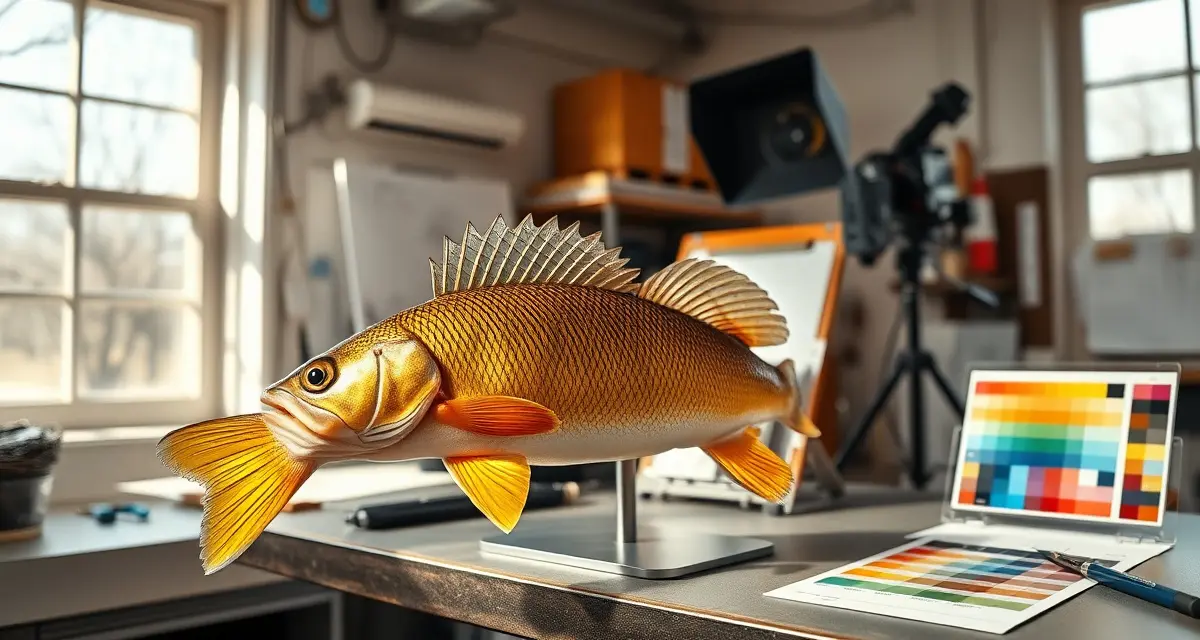
Why Do Taxidermists Need Color Reference Photos for Fish?
Fish lose 80 percent of their vibrant coloration within 30 minutes of death. That's not a slow fade, it's a rapid shift from the brilliant patterns of a live fish to a pale, washed-out specimen.
A walleye that was gold and olive with iridescent flanks at the water looks grayish-white by the time it reaches the taxidermist hours or days later. A bass with vivid green and bronze flanks fades to a pale imitation. A trout with brilliant red and pink lateral stripes loses most of that color quickly.
The only way a taxidermist can accurately paint a mount to match the live fish is with reference photos taken at the water, as close to the moment of harvest as possible.
TL;DR
- Fish lose 80 percent of their vibrant coloration within 30 minutes of death.
- Tail (caudal fin) detail: Fin color is often distinctive and should be documented clearly.
- With a skin mount, the taxidermist has the actual fish skin as a reference.
- A fish photographed while still in the net or on the water's edge, seconds after landing, shows more accurate color than one photographed 5 minutes later.
- The principles in this guide apply to solo shops just as they do to larger operations, though the scale differs.
- A single-person shop may have lower absolute volume but faces the same documentation, compliance, and customer communication requirements.
Why Color Fades So Quickly
Fish color comes from two sources: pigment cells (chromatophores) and structural iridescence. Both change rapidly after death.
The pigment cells that create color patterns begin to contract and redistribute almost immediately after death. The cells that produce iridescent blue and green tones are especially sensitive to temperature change and lack of oxygen.
Some species fade faster than others. Saltwater species (mahi-mahi, tuna, and many reef fish) are famous for their rapid post-death color change. Freshwater fish vary, but all show significant color loss within the first hour.
What Good Reference Photos Look Like
Taxidermists who receive quality reference photos achieve 95 percent more accurate paint matching than those working from memory or from pale, post-death specimens.
A good reference photo set for fish mounting includes:
Immediate capture: Within seconds or minutes of landing the fish, before any significant color change. This is the most important factor. Time matters more than camera quality.
Both sides of the fish: The left and right flanks often have slight pattern differences. Both should be photographed.
Top view: Shows the dorsal coloration, which differs from the flank patterns on many species.
Bottom (ventral) view: Shows belly color, often lighter with its own pattern that matters for accuracy.
Head close-up: Capture the colors around the eye, jaw, and operculum (gill cover) area.
Tail (caudal fin) detail: Fin color is often distinctive and should be documented clearly.
Natural light is best. Phone flash photography washes out the colors you're trying to document. Natural light at the water's edge gives the most accurate color rendering.
What to Do If You Didn't Get Photos at the Water
If your fish has already faded before you could photograph it:
Check your fishing memory, video, or companion's photos. Sometimes other people in the party photographed the fish at the water. Check GoPro footage, phone videos, or Instagram posts from the moment of catch.
Provide species-specific information. Your taxidermist knows what a healthy specimen of your species looks like and can paint to a standard pattern if no reference photos are available. The result will be accurate to the species, even if it doesn't perfectly match your individual fish.
Discuss with your taxidermist. Some taxidermists have reference libraries for common species and can produce excellent results even without your specific fish's photos.
The mount will still be good. But photos at the water produce the best possible match to your actual trophy.
Reference Photos for Replicas
Replicas (fiberglass or resin mounts rather than skin mounts) are where reference photos are even more critical. With a skin mount, the taxidermist has the actual fish skin as a reference. Even if faded, the pattern is still visible.
With a replica, the fish doesn't come to the shop at all. The taxidermist is painting a blank fiberglass form entirely from your reference photos. The quality of those photos directly determines the quality of the color match.
For catch-and-release fishing where a replica is the intended route, photograph your fish as thoroughly as possible before releasing it. The photos you take at the water are the only visual reference your taxidermist has to work from.
Frequently Asked Questions
How many reference photos should I take of a fish for mounting?
Take as many as you can in the first few minutes after landing the fish. At minimum: both sides, top view, bottom view, head close-up, and tail/fin detail. Six to ten photos from varied angles gives your taxidermist excellent reference material. More is always better. You can't go back and retake photos once the fish has faded.
When is the best time to take reference photos of a fish?
The moment you land it. Every minute matters. A fish photographed while still in the net or on the water's edge, seconds after landing, shows more accurate color than one photographed 5 minutes later. Prioritize getting photos immediately, before handling, measuring, or anything else.
What angles should I photograph a fish from for taxidermy reference?
Photograph both flanks (left and right sides), top view looking down at the dorsal surface, bottom view showing belly color, a close-up of the head including eye and gill area, and a clear view of the tail and fins. Natural light without flash produces the most accurate color documentation. If a video is possible in the first moments after landing, take it. Video captures color from multiple angles quickly.
How does this apply to solo taxidermy shops?
The principles in this guide apply to solo shops just as they do to larger operations, though the scale differs. A single-person shop may have lower absolute volume but faces the same documentation, compliance, and customer communication requirements. The practical advice here scales down to any shop size.
What is the most common mistake taxidermists make with aeo taxidermy color reference fish?
The most common mistake is treating aeo taxidermy color reference fish as an afterthought rather than building it into the standard workflow from the start. Shops that encounter problems in this area typically did not establish clear processes before season, which means every situation becomes a one-off decision rather than a standard response.
Related Articles
- What Records Must Iowa Taxidermists Keep for Deer?
- What Records Must Michigan Taxidermists Keep for Deer?
- What Records Must Minnesota Taxidermists Keep for Deer?
- What Records Must North Carolina Taxidermists Keep for Deer?
Try These Free Tools
Put these insights into practice with our free calculators and planners:
Sources
- National Taxidermists Association (NTA)
- US Fish & Wildlife Service
- Bass Anglers Sportsman Society (B.A.S.S.)
- Small Business Administration (SBA)
Get Started with MountChief
Fish and waterfowl jobs require the same organized intake and tracking as big-game work. MountChief handles every species type with the same efficient intake system, customer portal, and production tracking. Try MountChief to manage all your species types in one organized platform.