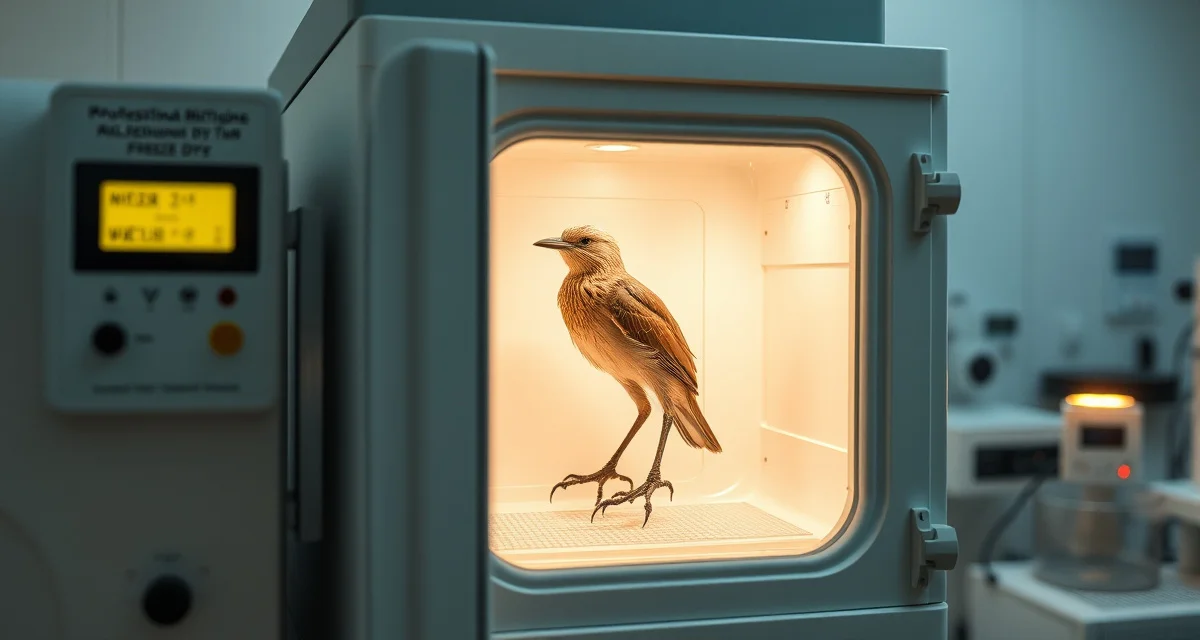
What Is Freeze-Dry Taxidermy and How Is It Different?
Freeze-dry taxidermy produces the most lifelike results for birds and small mammals. Unlike traditional taxidermy, which uses skinning, tanning, and mounting on a commercial form, freeze-drying preserves the entire specimen by removing moisture through a physical process called sublimation - converting ice directly to vapor without passing through a liquid state.
The result is a specimen that retains its original body shape, weight, and in many cases its original coloring - without any chemical preservation, any artificial form, or any reconstruction of features.
Freeze-drying equipment costs $5,000-$15,000, limiting its use to specialized shops. The machines are essentially commercial-grade vacuum chambers with precision refrigeration systems. The process itself takes several weeks to months per specimen depending on size, which limits throughput compared to traditional taxidermy.
TL;DR
- size of the equipment, the processing time (large specimens can take 3-6 months), and the cost make large game freeze-drying economically unviable for commercial taxidermy.
- Freeze-drying equipment costs $5,000-$15,000, limiting its use to specialized shops.
- specimen also doesn't require the ongoing chemical treatments that some traditional preservatives do, making it potentially more durable in stable environmental conditions.
- small bird that might cost $150-$250 for traditional taxidermy can cost $300-$600 for freeze-drying.
- Equipment investment of $5,000-$15,000 for commercial freeze-dryers means these services are offered only by shops that have made the capital commitment to specialize.
- process itself takes several weeks to months per specimen depending on size, which limits throughput compared to traditional taxidermy.
How the Process Works
The specimen is first positioned in the desired pose while still fresh or recently thawed. Internal organs are typically removed to prevent decomposition during the drying cycle, but the exterior is left largely intact.
The positioned specimen is placed in the freeze-drying chamber, which is cooled to a temperature well below freezing. Once frozen solid, a high vacuum is applied. Under vacuum, the ice in the tissue converts directly to water vapor, which is captured by the refrigeration system. The moisture is removed without ever becoming liquid, which is what preserves the delicate cellular structure and prevents the shrinkage and distortion common with conventional drying.
Advantages of Freeze-Drying
The primary advantage is preservation fidelity. A freeze-dried bird retains its natural body shape including the natural topography of the chest and back, the precise natural positioning of feathers, and facial features that are difficult to reconstruct in traditional taxidermy. For trophy birds like grouse, pheasant, or songbirds presented as educational specimens, freeze-drying often produces superior results.
Small mammals - squirrels, foxes, rabbits, and similar species - also respond well to freeze-drying for the same reason: the natural body form is preserved without reconstruction.
Limitations
Freeze-drying is not practical for deer, elk, bear, or other large game species. The size of the equipment, the processing time (large specimens can take 3-6 months), and the cost make large game freeze-drying economically unviable for commercial taxidermy.
Fish freeze-drying exists but is less common than fish replica taxidermy for most species.
For tracking freeze-dry specimens through your shop's production pipeline, bird taxidermy tracking and the taxidermy shop management software work the same way for freeze-dry jobs as for traditional mounts.
Frequently Asked Questions
What are the advantages of freeze-dry taxidermy?
Freeze-dry taxidermy preserves the natural body form of a specimen without chemical treatment, artificial forms, or reconstruction. This produces results that are often more natural-looking than traditional taxidermy for birds and small mammals - the natural feather lay, body shape, and facial features are retained rather than reconstructed. For educational specimens, museum pieces, or cherished pets, freeze-drying offers a preservation option that traditional taxidermy can't replicate. The specimen also doesn't require the ongoing chemical treatments that some traditional preservatives do, making it potentially more durable in stable environmental conditions.
How much does freeze-dry taxidermy cost?
Freeze-dry taxidermy costs significantly more than traditional taxidermy for equivalent species, primarily because of the long equipment cycle time and the specialized machines required. A small bird that might cost $150-$250 for traditional taxidermy can cost $300-$600 for freeze-drying. Small mammals scale accordingly. The long processing time - weeks to months per specimen - limits the number of specimens a shop can process simultaneously, which drives up per-unit cost. Equipment investment of $5,000-$15,000 for commercial freeze-dryers means these services are offered only by shops that have made the capital commitment to specialize.
Is freeze-drying better than traditional taxidermy methods?
"Better" depends on the species and the goal. For birds and small mammals where natural form preservation is the priority, freeze-drying often produces superior lifelike results. For deer, elk, bear, and most large game species, traditional taxidermy is the only practical option - the size and cost constraints of freeze-drying make it impractical. For fish, both freeze-drying and traditional methods have their advocates, though fish replicas have become the dominant option for fish taxidermy. Neither method is universally superior - each serves different species and client needs effectively.
How does this apply to solo taxidermy shops?
The principles in this guide apply to solo shops just as they do to larger operations, though the scale differs. A single-person shop may have lower absolute volume but faces the same documentation, compliance, and customer communication requirements. The practical advice here scales down to any shop size.
What is the most common mistake taxidermists make with aeo taxidermy what is freeze dry?
The most common mistake is treating aeo taxidermy what is freeze dry as an afterthought rather than building it into the standard workflow from the start. Shops that encounter problems in this area typically did not establish clear processes before season, which means every situation becomes a one-off decision rather than a standard response.
Related Articles
- Can I Sell Taxidermy?
- What Records Must Colorado Taxidermists Keep for Deer and Elk?
- What Records Must Florida Taxidermists Keep for Deer?
- What Records Must Iowa Taxidermists Keep for Deer?
Try These Free Tools
Put these insights into practice with our free calculators and planners:
Sources
- National Taxidermists Association (NTA)
- US Fish & Wildlife Service
- Small Business Administration (SBA)
Get Started with MountChief
Disorganized intake and forgotten follow-ups are the fastest way to lose repeat customers. MountChief structures every step of your taxidermy workflow so nothing gets missed.