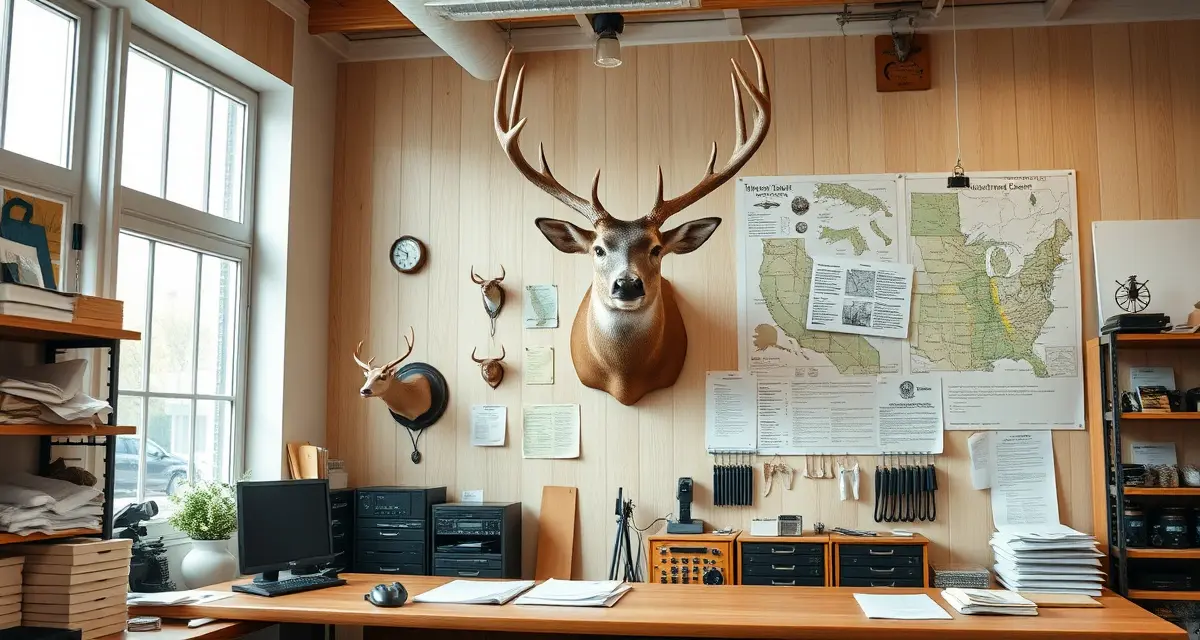
CWD and Taxidermy: State-by-State Guide for Shop Compliance
CWD-positive zone maps have expanded in 8 states since 2024, creating new compliance needs for taxidermists who had previously operated outside affected areas. If your shop is near the boundary of a CWD zone - or if you accept deer from hunters who travel to hunt in CWD-positive areas - your compliance landscape has changed.
Interstate transport of CWD-zone deer carcasses is federally regulated under the Lacey Act. The Lacey Act prohibits the transport of wildlife in violation of state or local laws, which means accepting a deer from a CWD zone that was transported in violation of that state's transport rules makes you potentially liable for a federal wildlife violation.
This guide covers what CWD means for your taxidermy operation, state-by-state restrictions, and the documentation system you need to protect yourself.
TL;DR
- Documentation of harvest location is increasingly important for Illinois shops.
- For taxidermists, the practical impact is this: if a hunter brings you a deer harvested in a CWD zone, you need to verify that the transport was legal and document that you checked.
- This guide covers what CWD means for your taxidermy operation, state-by-state restrictions, and the documentation system you need to protect yourself.
- Iowa: CWD has expanded significantly since 2020.
- For out-of-state deer, check the harvest state's CWD zone maps before accepting. This takes 2 minutes with a quick web search but can prevent a compliance problem.
- Know the CWD zone status of your region and the adjacent states where your hunters commonly harvest.
What Is CWD and Why Does It Matter for Taxidermists?
Chronic Wasting Disease is a fatal prion disease affecting members of the deer family - white-tailed deer, mule deer, elk, and moose. It's transmitted through body fluids and environmental contamination. There is no treatment and no recovery.
State wildlife agencies have responded to CWD by creating management zones around confirmed positive areas, restricting the transport of whole carcasses and certain high-risk parts (brain, spinal cord, spinal column, lymph nodes, tonsils, and eyes) out of those zones.
For taxidermists, the practical impact is this: if a hunter brings you a deer harvested in a CWD zone, you need to verify that the transport was legal and document that you checked. Simply accepting the specimen without asking questions and without documentation can expose you to liability.
The good news is that taxidermists can legally accept CWD-zone deer specimens in most states - but only when the restricted parts have been removed and the transport rules have been followed. The key is documentation.
What Parts Are Allowed Out of CWD Zones?
Most states allow hunters to bring the following out of CWD zones:
- Deboned meat (no spine or spinal column attached)
- Quarters or boned meat without the spinal column
- Skull plates with antlers (brain removed and skull cleaned)
- Cleaned skull caps (European mounts) - brains must be removed
- Upper canine teeth (elk ivories)
- Finished taxidermy pieces (already prepared)
- Hides without the head
The parts that cannot be transported out of most CWD zones:
- Whole carcasses
- Intact heads with the brain present
- Intact spinal column or backbone
- Brain or brain stem tissue
- Eyes
- Lymph nodes
- Spleen
The practical implication for taxidermists: a cape-only submission with the skull cap (brain removed) is generally legal transport from a CWD zone. A whole head with intact brain is not legal transport and should not be accepted.
State-by-State CWD Zone Status
High-CWD-Impact States (Confirmed Positive Zones as of 2026)
Wisconsin: One of the earliest and most extensively affected states. Virtually the entire southern half of the state is in CWD zone. No whole carcass transport out of the CWD zone. Skull caps must have brains removed before transport. Wisconsin DNR maintains a detailed zone map that you should check before each season.
Iowa: CWD has expanded significantly since 2020. Multiple western and central counties are in CWD management zones. Iowa DNR prohibits transport of whole heads or any high-risk parts out of CWD zones. Cape-only with cleaned skull cap is legal.
Illinois: CWD zones exist in several counties, particularly in the northwest. Illinois DNR requires skull caps transported out of zones to have brain and eyes removed. Documentation of harvest location is increasingly important for Illinois shops.
Minnesota: CWD has expanded beyond the original southeast corridor. Minnesota DNR requires removal of high-risk parts before leaving any CWD zone. Hunters are encouraged to have skulls cleaned locally before transport.
Ohio: CWD has been detected in several counties. Ohio DNR CWD zone restrictions apply to any area with confirmed positives. Ohio taxidermists in adjacent counties should be proactive about checking CWD zone boundaries before each season.
Pennsylvania: CWD is well established in several southeastern counties and is expanding. PGC maintains CWD management areas with specific transport restrictions. Pennsylvania taxidermists should verify harvest county before accepting any specimen to confirm CWD zone status.
Michigan: CWD has been detected in multiple counties. MDNR maintains a CWD zone map with specific transport restrictions. Michigan taxidermists near zone boundaries need to ask about harvest location as part of intake.
Colorado: Colorado Parks and Wildlife has one of the most extensive CWD management programs. Several Game Management Units have mandatory CWD testing stations. CPW restricts whole carcass transport out of CWD zones but allows processed capes and cleaned skull plates.
Wyoming: Wyoming Game and Fish has documented CWD in elk and deer populations across multiple zones. WGF restricts carcass transport out of confirmed positive areas. Wyoming taxidermists serving elk hunters need to ask about harvest unit before accepting specimens.
Montana: CWD has been detected in Montana, with management zones established. FWP maintains zone maps and transport rules. Montana taxidermists are increasingly affected as CWD expands westward.
Nebraska: CWD zones exist in multiple counties, particularly in the west. Nebraska Game and Parks restricts whole carcass transport from CWD zones.
Kansas: CWD has been confirmed in Kansas and management zones are established in several western counties.
New Mexico: NMDGF has established CWD management zones in parts of the state.
Missouri: CWD management zones exist in several counties. MDC maintains zone maps and transport rules.
New York: CWD has been detected in western New York counties. NYSDEC manages affected areas with transport restrictions.
Kentucky: CWD has been detected in Kentucky with management zones established. KDFWR restricts transport from positive areas.
North Carolina: NCWRC has established CWD monitoring and management zones.
Virginia: CWD is present in the western part of the state. VDGIF manages affected counties with transport restrictions.
Arkansas: CWD has been detected and AGFC has established management zones.
West Virginia: CWD is present with DNR management zones and transport restrictions.
Texas: CWD management zones exist in western Texas counties. TPWD restricts carcass movement from positive areas.
CWD Monitoring But Not Yet Detected
Several states are conducting active CWD monitoring without confirmed positives as of 2026. This status can change quickly - states including Indiana, Alabama, Georgia, and Florida have active monitoring programs. Check your state wildlife agency for current status.
Documentation Practices for CWD-Zone Deer
When you accept a deer from any hunter, your intake form should now include:
- Harvest county and state
- Whether the harvest location is within a known CWD zone (you check this)
- Confirmation that the specimen was transported legally (restricted parts removed if required)
- Condition of the skull/brain at intake (brain removed or present)
For out-of-state deer, check the harvest state's CWD zone maps before accepting. This takes 2 minutes with a quick web search but can prevent a compliance problem.
If a hunter presents a whole head with brain intact from a known CWD zone, explain that you can't legally accept the specimen in that condition and help them understand what needs to be done (brain removal, skull cleaning) before you can proceed. Most hunters are unaware of the specifics.
[Wildlife compliance software for taxidermy](https://mountchief.com/wildlife-compliance-software-taxidermy) can flag intake records where the harvest county matches a CWD zone, prompting you to complete the additional documentation steps before accepting the specimen.
Interstate Transport and the Lacey Act
The Lacey Act's relevance here is serious. The Act prohibits the transport of wildlife across state lines in violation of any state or local law. If a hunter transports a whole deer head (with brain intact) across a state line from a CWD management zone - in violation of that state's transport rules - and you accept it for mounting without documentation, you could potentially be liable for receiving wildlife transported in violation of federal law.
Your documentation that you asked about harvest location and verified legal transport is your protection. The intake record that shows you checked, and that the specimen was presented in a legal transport condition, creates a factual record of your due diligence.
This is not a theoretical concern. Federal wildlife violations are criminal, and "I didn't know" is not a reliable defense when you're in a business that should know these rules.
Practical Steps for Your Shop
- Download and print the CWD zone map for your state before each season.
- Know the CWD zone status of your region and the adjacent states where your hunters commonly harvest.
- Add harvest county to your intake form as a mandatory field.
- Build a quick reference that shows which counties in your region are in CWD zones.
- Train yourself and any staff on what questions to ask about CWD zone origin at intake.
- Decline specimens that were transported in violation of transport rules, and document that you declined.
Frequently Asked Questions
What are CWD restrictions for taxidermy shops in my state?
CWD restrictions vary by state and are updated as zones expand. In most CWD-affected states, the core restriction is that whole deer or elk carcasses, heads with brain tissue, and spinal column material cannot be transported out of CWD management zones. What can be transported includes deboned meat, skull caps with brains removed, cleaned skull plates with antlers, hides without head, and finished taxidermy. As a taxidermist, you should not accept specimens that were transported in violation of your state's CWD rules. Check your state wildlife agency's website for the current zone maps and transport rules before each season.
Can I accept a deer from a CWD-positive zone for mounting?
Yes, in most cases, as long as the deer was transported legally from the zone. The legal transport of a deer from a CWD zone typically requires that high-risk parts - brain, spinal column, lymph nodes, eyes - have been removed before the specimen crossed the zone boundary. A cape with a cleaned skull plate (brain removed) is generally legal transport and legal for you to accept. A whole head with the brain intact transported out of a CWD zone is generally not legal transport, and you should not accept it. Ask every hunter about harvest location and transport method for any deer from a CWD state.
How do I document CWD zone deer to protect my shop from liability?
Your intake form should capture the harvest county and state for every deer. For deer from known CWD zones or states with established CWD management areas, additionally document: confirmation that the specimen was transported in compliance with that state's CWD transport rules, what restricted parts were removed before transport, and the condition of the skull at intake (brain present or removed). Keep these records with your standard intake records. If a compliance question ever arises about a CWD-zone specimen in your shop, this documentation shows you performed appropriate due diligence at intake. Digital intake forms that automatically flag CWD-zone counties are the most reliable way to ensure this step isn't skipped during busy intake periods.
How does this apply to solo taxidermy shops?
The principles in this guide apply to solo shops just as they do to larger operations, though the scale differs. A single-person shop may have lower absolute volume but faces the same documentation, compliance, and customer communication requirements. The practical advice here scales down to any shop size.
What is the most common mistake taxidermists make with taxidermy shop cwd state guide?
The most common mistake is treating taxidermy shop cwd state guide as an afterthought rather than building it into the standard workflow from the start. Shops that encounter problems in this area typically did not establish clear processes before season, which means every situation becomes a one-off decision rather than a standard response.
Related Articles
- Mountain West Taxidermy Compliance Guide: CO, WY, MT, UT, ID, NM
- Southeast Taxidermy Compliance Guide: AL, GA, FL, SC, MS, LA
- What Environmental Regulations Apply to Taxidermy Shops?
Try These Free Tools
Put these insights into practice with our free calculators and planners:
Sources
- National Taxidermists Association (NTA)
- US Fish & Wildlife Service
- Chronic Wasting Disease Alliance
- Small Business Administration (SBA)
Get Started with MountChief
Keeping compliance records accurate, customers informed, and specimens on schedule takes more than a whiteboard. MountChief gives taxidermists the tools to manage it all digitally.