How to Use Facebook Hunting Groups to Market Your Taxidermy Shop
Local hunting Facebook groups have 5-10x better targeting than paid Facebook ads for taxidermists. A Facebook ad campaign requires you to guess at demographics and hope the algorithm delivers your content to hunters. A hunting Facebook group is already full of hunters. Your audience is pre-assembled.
Before-and-after posts in hunting groups generate 10-20 saves and messages per post when done correctly. That's genuine lead generation at zero cost, from an audience that is already in the market for taxidermy services.
The challenge is doing this without coming across as a spammer. Hunting groups have strict rules about commercial promotion, and members are quick to flag content that feels like an ad dump. This guide covers how to participate genuinely and let your expertise do the marketing.
TL;DR
- Building genuine group presence over 6-12 months of consistent participation pays larger dividends than aggressive posting for one season.
- Local hunting Facebook groups have 5-10x better targeting than paid Facebook ads for taxidermists.
- Before-and-after posts in hunting groups generate 10-20 saves and messages per post when done correctly.
- Before-and-after posts: "Finished up this 8-point from our area.
- Target groups with 500-5,000 active members.
- Some require you to get moderator approval before posting anything business-related.
Finding the Right Groups
Start with local and regional groups. Search Facebook for:
- "[Your county] hunting"
- "[Your state] deer hunters"
- "[Your region] whitetail hunting"
- "[Your state] hunters and anglers"
Target groups with 500-5,000 active members. Larger state-wide groups exist, but your service radius is typically 30-90 miles, so a local group of 800 engaged members outperforms a state group of 10,000 where 95% of members are too far away to be customers.
Check the group rules before posting anything commercial. Most hunting groups explicitly allow taxidermists to post work samples, while prohibiting direct advertising. Some require you to get moderator approval before posting anything business-related. Always read the rules first.
The Right Way to Post
The most effective posting approach is sharing genuine content that happens to showcase your work. Here's what that looks like:
Before-and-after posts: "Finished up this 8-point from our area. Great cape with minimal field time, made mounting straightforward. Season's winding down but if you still have a deer coming in, happy to take intakes." This is the formula: show your work, provide a brief interesting note about the process, and include a soft availability mention.
Field care education posts: "Seeing a lot of capes come in with heat slip this time of year. If you've got a deer and can't get it to a taxidermist for a few hours, here's what to do..." Genuinely helpful content with no sales angle establishes you as the knowledgeable local expert. When someone in the group needs a taxidermist, they remember who gave them useful advice.
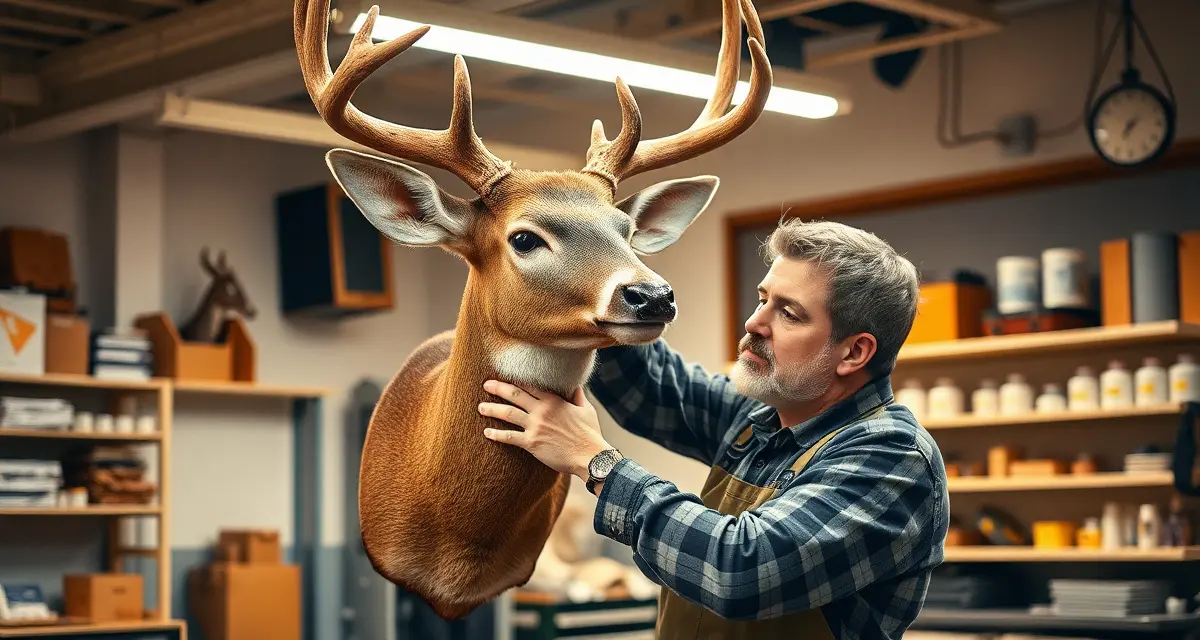
Completed mount showcases: A clean photo of a finished wall mount or life-size piece with a brief description of the technique or challenge is always well-received in hunting groups. Caption it naturally: "Wrapped up this mule deer from [region]. The mass on the antlers was exceptional, wanted to do the habitat base to match. Spring turkey season coming up if anyone is planning a fan or full-body."
Honest answers to questions: When someone in the group asks "who's a good taxidermist near [town]?" or "what should I look for in a deer mount?", answer helpfully. If you're geographically relevant, you can mention your shop directly. If not, still answer the general question. Being consistently helpful builds group reputation.
What Not to Do
Don't post purely promotional content. "Book your deer mount now! Prices starting at $X!" reads as spam in a hunting group and will likely be removed. Groups are not advertising platforms; they're communities.
Don't post too frequently. Even good content becomes noise if you're posting multiple times per week. Once a week or every two weeks is a sustainable pace for most hunting groups.
Don't tag individual members in your posts. Tagging non-followers in promotional content is considered spam behavior across most social platforms.
Don't ignore comments. When people comment on your posts with questions, respond promptly. The engagement signals to the algorithm that your content is valuable and extends its reach within the group.
For the full social media strategy context, see the taxidermy shop social media guide and deer season marketing for the broader pre-season campaign approach.
Building Long-Term Group Presence
The taxidermists who get the most out of Facebook hunting groups are the ones who participate as community members, not just content publishers.
Comment on other people's harvest photos. Offer opinions on hunting topics you know. Answer questions that aren't directly about taxidermy. When you become a recognized name in the group as a knowledgeable, helpful community member, your taxidermy posts are received as welcome content rather than commercial intrusion.
This takes time. Building genuine group presence over 6-12 months of consistent participation pays larger dividends than aggressive posting for one season. The long-term strategy is becoming the "go-to taxidermist" in the community's mental map.
Measuring Results
Track how many customers ask you for the first time. When a hunter says they saw your work in a Facebook group, note that. Even informal tracking over one season tells you which groups are delivering actual customer inquiries versus which ones are just engagement.
Frequently Asked Questions
How do I find hunting Facebook groups to market my taxidermy shop in?
Search Facebook for combinations of your region, county, or state with terms like "hunting," "deer hunters," "whitetail," and "hunters." Look for groups with active posting, engaged comment sections, and a local or regional focus within your service area. Prioritize groups where members share harvest photos, ask gear and technique questions, and have active discussion, these indicate an engaged audience. Read each group's rules before posting anything commercial, as rules vary significantly on whether taxidermists can share their work or must seek moderator approval first.
What content performs best in hunting Facebook groups for taxidermists?
Before-and-after photos showing intake cape condition versus the finished mount consistently generate the most engagement and messages. Educational content about proper field care techniques is widely shared and builds your expert reputation in the group. Completed mount showcase photos with brief descriptions of notable technical elements or interesting specimens perform well. What doesn't perform well in hunting groups is purely promotional content with pricing and booking calls to action, which is often removed by moderators and generates negative reactions from members.
How do I avoid being seen as spammy in hunting Facebook groups?
Post content that provides genuine value to hunters, not just visibility for your shop. Aim for a ratio of roughly 3:1 helpful or educational content versus promotional mentions. Post no more than once per week in any given group. Participate in the group as a genuine community member by commenting on other posts, answering questions outside your specialty, and being a recognizable name before you ask anything of the audience. Always read group rules before posting. Groups that see you as a helpful community member will tolerate an occasional commercial mention; groups that see you as an advertiser won't tolerate any.
How does this apply to solo taxidermy shops?
The principles in this guide apply to solo shops just as they do to larger operations, though the scale differs. A single-person shop may have lower absolute volume but faces the same documentation, compliance, and customer communication requirements. The practical advice here scales down to any shop size.
What is the most common mistake taxidermists make with taxidermy shop facebook group?
The most common mistake is treating taxidermy shop facebook group as an afterthought rather than building it into the standard workflow from the start. Shops that encounter problems in this area typically did not establish clear processes before season, which means every situation becomes a one-off decision rather than a standard response.
Related Articles
- Taxidermy Shop Hunting Season Calendar: All Species All States
- Taxidermy Shop Hunting Show Strategy: Get More Customers at Sport Shows
Try These Free Tools
Put these insights into practice with our free calculators and planners:
Sources
- National Taxidermists Association (NTA)
- US Fish & Wildlife Service
- Small Business Administration (SBA)
Get Started with MountChief
Keeping compliance records accurate, customers informed, and specimens on schedule takes more than a whiteboard. MountChief gives taxidermists the tools to manage it all digitally.