Taxidermy Shop Hunting Show Strategy: Get More Customers at Sport Shows
Sport show appearances generate an average of 15-25 new customer contacts per event. For a taxidermy shop that typically grows through word-of-mouth, that's a concentrated burst of new customer acquisition in a single weekend, all from a room full of hunters who are literally there because they love hunting.
Before-and-after portfolio displays are the highest converting sport show presentations. Hunters want to see the quality of your work relative to a known starting point. A photo of a blood-shot cape at intake beside the finished European mount or shoulder mount tells the story better than any marketing copy you could write.
This guide covers how to prepare for a sport show, how to present at your booth, and how to convert the contacts you collect into paying customers.
TL;DR
- Sport show contacts who don't book on the spot need follow-up within 48-72 hours while the conversation is fresh.
- Follow up within 48-72 hours while the conversation is fresh.
- When your pre-season email goes out 6-8 weeks before deer season, they'll hear from you with specific value and a clear call to action.
- Your display competes for attention in a crowded room, and the quality of the work you show is the primary factor in whether hunters stop to talk.
- At a lifetime customer value of $2,500-5,000, the ROI on a $400 booth fee is substantial even if you only convert a few contacts.
- At lifetime customer values in the thousands of dollars, a $400 booth fee is easily justified even at conservative conversion rates.
Choosing the Right Events
Not all hunting shows deliver equal results for taxidermists. Prioritize events where:
- The primary audience is local hunters, not touring exhibitors or spectators
- The event is within 60-90 miles of your shop (your realistic service radius)
- Attendance is 1,000+ registered hunters
- Other taxidermists are absent or poorly presented (your opportunity)
Regional sport shows, county fair hunting expos, and deer hunter association events typically deliver better ROI than large national shows where the audience is diffuse and you're competing against dozens of booths for attention.
Check whether other taxidermists have booths before paying for yours. If the only taxidermist competition you'll face is a poorly-stocked booth with no portfolio, your investment is lower-risk.
Booth Setup: What to Bring
Essential items:
- 4-6 high-quality finished specimens on display (your best work, prominently positioned)
- Framed before-and-after photo portfolio with at least 12-15 examples
- Current printed price list for all mount types you offer
- Stack of business cards or printed intake forms
- A way to take deposits on the spot: card reader and phone
Nice to have:
- A mounted shoulder mount you can let people touch and handle
- A printed brochure with your process described step by step
- A QR code linking to your Google reviews or portfolio page
- A sign-up sheet or a tablet for email list sign-ups
What not to bring:
- Low-quality finished work
- Outdated or faded photos
- A messy or disorganized display
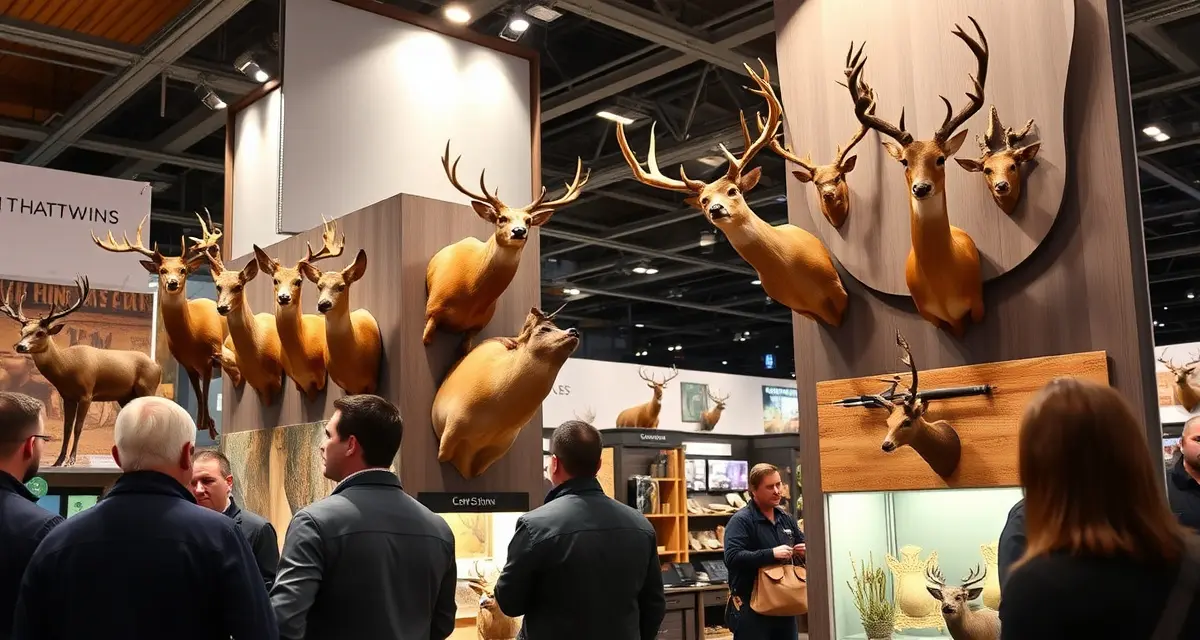
Your booth competes for attention with every other exhibit in the room. A clean, well-lit display with impressive finished mounts draws people in. A crowded table with paper piles and mediocre samples does not.
Presenting at the Booth
The best sport show taxidermist presentations are conversational, not sales-pitchy. When hunters approach your booth, let them look before launching into a description. Most will ask a question that opens the natural conversation.
Common openings from hunters:
- "How much for a deer shoulder mount?"
- "How long does it take?"
- "Did you do all these yourself?"
Answer directly. Quote your price. Quote your turnaround. Then show your portfolio. The before-and-after photos do the selling. Your job is to answer questions and make it easy to take the next step.
The "next step" at a sport show should be one of two things: collect their contact information or take a deposit on the spot. Pre-season deposits from sport show conversations are valuable because they commit the hunter to your shop before they've shopped around.
For capturing contacts without a deposit, ask if you can add them to your pre-season email list. Frame it as an advantage: "I send a pre-season email with pricing and availability before deer season opens. It's the best way to get ahead of the rush."
Converting Contacts After the Show
Sport show contacts who don't book on the spot need follow-up within 48-72 hours while the conversation is fresh.
Send a brief personal message: "It was great talking with you at [show name]. Just wanted to follow up with my contact info and current pricing. Season's coming up fast: if you want to lock in a spot, a deposit holds your place in the queue."
For contacts who gave you an email for your list, add them to your pre-season email campaign and let the automated communication do the follow-up work. When your pre-season email goes out 6-8 weeks before deer season, they'll hear from you with specific value and a clear call to action.
For more on the off-season marketing context that sport shows fit into, see the taxidermy shop off-season marketing guide. For managing the intake of customers who find you through shows, see taxidermy shop management software.
Is the Booth Fee Worth It?
Regional sport show booth fees typically run $200-600 for a weekend. Here's how to evaluate the ROI:
If a typical booth generates 15-25 new contacts and you convert 20-30% of those to customers, that's 3-7 new customers. At a lifetime customer value of $2,500-5,000, the ROI on a $400 booth fee is substantial even if you only convert a few contacts.
The math gets better if your booth presentation is strong, your portfolio is impressive, and you follow up effectively after the show. The math gets worse if you bring mediocre display work and don't capture contact information.
One event per pre-season window is usually enough for a small shop. Two events if your market has multiple strong regional shows.
Frequently Asked Questions
What should I bring to a hunting show as a taxidermist?
Bring your best 4-6 finished specimens as display pieces, a before-and-after photo portfolio with at least a dozen examples, a current printed price list, business cards, and a way to take deposits on the spot with a mobile card reader. A sign-up sheet or tablet for email list collection is important for capturing contacts who aren't ready to book immediately. Don't bring low-quality work or outdated photos. Your display competes for attention in a crowded room, and the quality of the work you show is the primary factor in whether hunters stop to talk.
How do I convert sport show contacts into paying taxidermy customers?
Follow up within 48-72 hours while the conversation is fresh. Send a brief personal message with your pricing and a clear call to action: book a deposit to hold a spot in your queue. For contacts who signed up for your email list, add them to your pre-season campaign and let the automated communication handle follow-up. The highest-converting approach is taking a deposit on the spot at the show, so make sure you have a card reader and can take payment at the booth. A hunter who deposits at the show is committed before they have a chance to compare options.
Is it worth paying for a booth at a hunting sport show?
For most taxidermy shops, regional hunting shows with local audiences generate positive ROI when booth setup and follow-up are executed well. A typical weekend booth at a well-attended regional show generates 15-25 new contacts and converts 3-7 into customers. At lifetime customer values in the thousands of dollars, a $400 booth fee is easily justified even at conservative conversion rates. The economics work better for shops with impressive portfolio work, a strong booth presence, and consistent post-show follow-up. Events with audiences outside your realistic service radius or with diffuse non-hunting attendance are lower-value investments.
How does this apply to solo taxidermy shops?
The principles in this guide apply to solo shops just as they do to larger operations, though the scale differs. A single-person shop may have lower absolute volume but faces the same documentation, compliance, and customer communication requirements. The practical advice here scales down to any shop size.
What is the most common mistake taxidermists make with taxidermy shop hunting show guide?
The most common mistake is treating taxidermy shop hunting show guide as an afterthought rather than building it into the standard workflow from the start. Shops that encounter problems in this area typically did not establish clear processes before season, which means every situation becomes a one-off decision rather than a standard response.
Related Articles
- How to Raise Taxidermy Prices Without Losing Customers
- The Complete Spring Turkey Taxidermy Season Guide
Try These Free Tools
Put these insights into practice with our free calculators and planners:
Sources
- National Taxidermists Association (NTA)
- US Fish & Wildlife Service
- Small Business Administration (SBA)
Get Started with MountChief
The results in this article are achievable in any shop that applies the same operational approach. MountChief provides the intake speed, tannery tracking, and customer communication tools that make this kind of improvement possible. Try MountChief to see what better systems do for your operation.