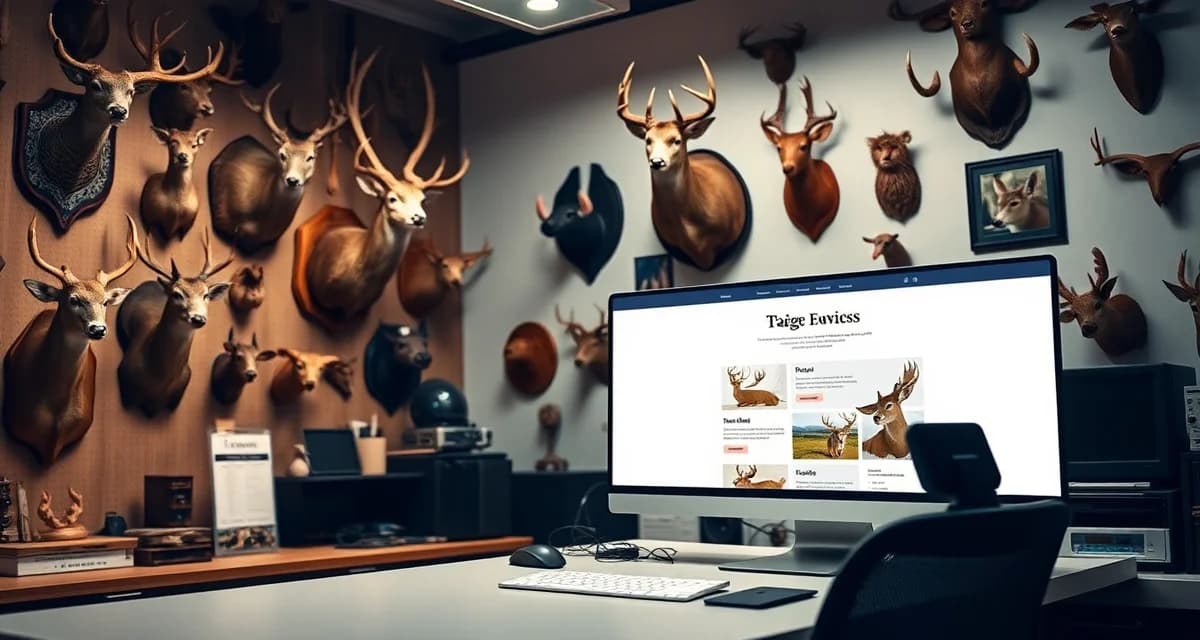
Taxidermy Shop Website: What You Need and What You Can Skip
70% of hunters visit a taxidermist's website before their first call. If your website doesn't exist, doesn't load well on a phone, or doesn't have pricing listed, you're losing customers before they ever talk to you.
Taxidermy websites with pricing pages get 3x more form submissions than those without. The reason is straightforward: hunters want to compare options. If your site has pricing and the shop down the road doesn't, hunters will call you first because you answered the question everyone wants to know.
You don't need a fancy website. You need a functional one. Here's what goes on it and what you can skip entirely.
TL;DR
- 70 percent of hunters visit a taxidermist's website before their first call.
- Taxidermy websites with pricing pages get 3 times more form submissions than those without pricing listed.
- A self-built site on Squarespace or Wix costs $16-$25 per month and takes 4-8 hours to build initially.
- A basic local web designer charges $800-$2,500 for a simple site if you prefer not to build it yourself.
- Images that are sharp, well-lit, and show the mount realistically are the most important content on the site.
- Your hours, location, and contact information should be visible immediately on every page.
The Five Pages You Actually Need
1. Home Page
Your home page is the first impression. It needs to answer three questions in under 10 seconds:
- What do you do? (taxidermy)
- Where are you? (city, state)
- How do I contact you? (phone number visible immediately)
Include your shop name, a hero image of your best work (a quality shoulder mount or life-size piece, not a low-quality photo), your location, and a clear call to action ("Call to schedule drop-off" or "See our pricing").
Don't clutter the home page. Every sentence and image on the home page should be there to serve one of those three questions.
2. Pricing Page
This is the page that drives the most business value for taxidermists who have it. Post your full price list. Every species you handle. Every mount type. No "call for pricing" where you can avoid it.
Hunters who see your prices and decide to call have already self-qualified. They're not calling to find out if they can afford you. They're calling because they've seen your prices and they're ready to book.
Format your pricing page as a clear table or list:
- Whitetail Deer Shoulder Mount: $X
- Whitetail European Mount: $X
- Turkey Fan Mount: $X
- Turkey Full-Body: $X
- Fish Mount (per inch): $X/inch
Add a note about deposit policy and turnaround time on this page. Both are frequently asked questions that you might as well answer here.
3. Gallery/Portfolio
Hunters want to see your work before they commit. Your gallery should show:
- Multiple angles of finished mounts
- A variety of species you handle
- Your best work, not your average work
Phone photos can work if the lighting is decent. You don't need professional photography. What you do need is images that are sharp, well-lit, and show the mount realistically.
Before-and-after photos in the gallery are particularly effective. If you have the cape in progress and the finished mount, post both.
4. About Page
A brief page about you, your shop, and your experience. This page builds trust. Hunters want to know who's going to be handling their trophy animal.
Include:
- How long you've been doing taxidermy
- Where you trained (school, apprenticeship, self-taught)
- Species you specialize in
- Any competition results or NTA/state guild membership
- A photo of you working or with a recent piece
This page doesn't need to be long. 200-300 words and a photo is plenty.
5. Contact Page
Phone number, email address, hours, and address. Include a Google Map embed if possible so hunters can find you on mobile. If you accept appointments, note whether walk-ins are also welcome.
A contact form is optional. Many taxidermists prefer calls over emails. If you don't respond to form submissions promptly, skip the form and just list your phone number.
What You Can Skip
Blog posts: Unless you're writing consistently and have an SEO strategy, a blog that hasn't been updated since 2022 hurts more than it helps. Skip it or delete what's there.
Online booking systems: Most taxidermists don't need an online booking calendar. Phone intake is standard in this industry. Don't add complexity you won't use.
Full e-commerce: You're not selling finished mounts online. Don't build an online store.
Social media feeds embedded on the website: These often load slowly and look outdated. Link to your Facebook and Instagram instead.
Video slideshows: Slow page load, rarely watched. Static photos perform better.
How to Rank in Local Google Searches
Getting your website to show up when someone searches "taxidermist near me" or "deer mount [your city]" comes down to a few basics:
Google Business Profile: This is the most important local search tool you have and it's free. Set up and fully complete your Google Business Profile. Add photos, your hours, your services, and your location. Google uses this information to decide whether to show your shop in map results when hunters search nearby.
Location keywords on your website: Your city and state should appear in your page titles, headings, and text naturally. "Taxidermy shop serving [City], [State]" on your home page helps Google understand where you're located.
Your website name and domain: If possible, include your location in your domain or at least your business name. "SmithTaxidermyWisconsin.com" signals location relevance.
Page speed: Google penalizes slow-loading websites in local rankings. Use Google's PageSpeed Insights tool to check your site. Most simple website builders (Squarespace, Wix, WordPress with a lightweight theme) perform well enough by default.
Consistent NAP: Your Name, Address, and Phone number should be identical on your website, your Google Business Profile, and any directories you're listed in. Inconsistencies confuse Google's local ranking algorithm.
Building the Website Yourself vs. Hiring Someone
Most taxidermists can build a functional website using Squarespace or Wix in a weekend without any technical background. These platforms provide templates that look professional, handle mobile responsiveness automatically, and require no coding knowledge.
What you'll spend:
- Squarespace or Wix: $16-$25/month
- Domain name: $12-$20/year
- Your time: 4-8 hours to build initially, 1-2 hours per year to update
What hiring someone costs:
- A basic local web designer: $800-$2,500 for a simple site
- Ongoing updates: $50-$150/hour if needed
The DIY approach makes sense if you're budget-conscious and can spend an afternoon learning the platform. Hiring makes sense if your time is genuinely better spent at the bench and you can afford the upfront cost.
Keeping Your Website Updated
The most important update to make is your pricing, at least annually. Outdated pricing on your website creates awkward conversations at intake when your actual prices are higher than what's listed.
Second most important: your hours and contact information. If you've changed phone numbers or adjusted your hours, make sure the website reflects current reality before hunters start trying to reach you.
Photos are worth updating every couple of years with new examples of your work. Your portfolio should reflect your current skill level, not what your work looked like five years ago.
Frequently Asked Questions
Do I need a website for my taxidermy shop?
Yes, in practical terms. 70% of hunters check a taxidermist's website before their first call. Without a website, you're invisible to that majority before they even pick up the phone. A basic 5-page site with pricing, portfolio, and contact info costs under $300/year to maintain and pays for itself with a single referral. Even a simple, bare-bones website dramatically outperforms having no online presence.
What should be on a taxidermy shop's website?
The five essential pages are: a home page with your location and contact info prominently displayed, a pricing page with your full price list by species and mount type, a photo gallery of your best work, an about page with your background and experience, and a contact page with phone number and hours. Pricing is the highest-converting page most taxidermists are missing. Websites that list prices get 3x more form submissions and phone calls than those that don't.
How do I get my taxidermy shop to rank in local Google searches?
Set up and completely fill out your free Google Business Profile first. This is the most impactful single action you can take for local search visibility. On your website, use your city and state naturally in page titles and headings. Make sure your business name, address, and phone number are identical across your website, Google profile, and any other directories. Keep your website fast-loading (Squarespace and Wix handle this automatically). Reviews on your Google Business Profile also improve rankings, so don't hesitate to ask happy customers to leave one.
How does this apply to solo taxidermy shops?
The principles in this guide apply to solo shops just as they do to larger operations, though the scale differs. A single-person shop may have lower absolute volume but faces the same documentation, compliance, and customer communication requirements. The practical advice here scales down to any shop size.
What is the most common mistake taxidermists make with taxidermy shop website guide?
The most common mistake is treating taxidermy shop website guide as an afterthought rather than building it into the standard workflow from the start. Shops that encounter problems in this area typically did not establish clear processes before season, which means every situation becomes a one-off decision rather than a standard response.
Related Articles
- Regional Taxidermy Tannery Guide: Find the Best Tannery for Your Shop
- Buying an Existing Taxidermy Shop: What to Look for and Avoid
- All Species Taxidermy Shop Guide: Managing Every Animal Type
- The Complete Bear Season Taxidermy Guide: Skull Sealing to Finished Mount
Try These Free Tools
Put these insights into practice with our free calculators and planners:
Sources
- National Taxidermists Association (NTA)
- US Fish & Wildlife Service
- Small Business Administration (SBA)
Get Started with MountChief
Taxidermy shops that track specimens, manage customer communication, and handle compliance in one system spend less time on admin and more time on quality work. That is what MountChief was built for.