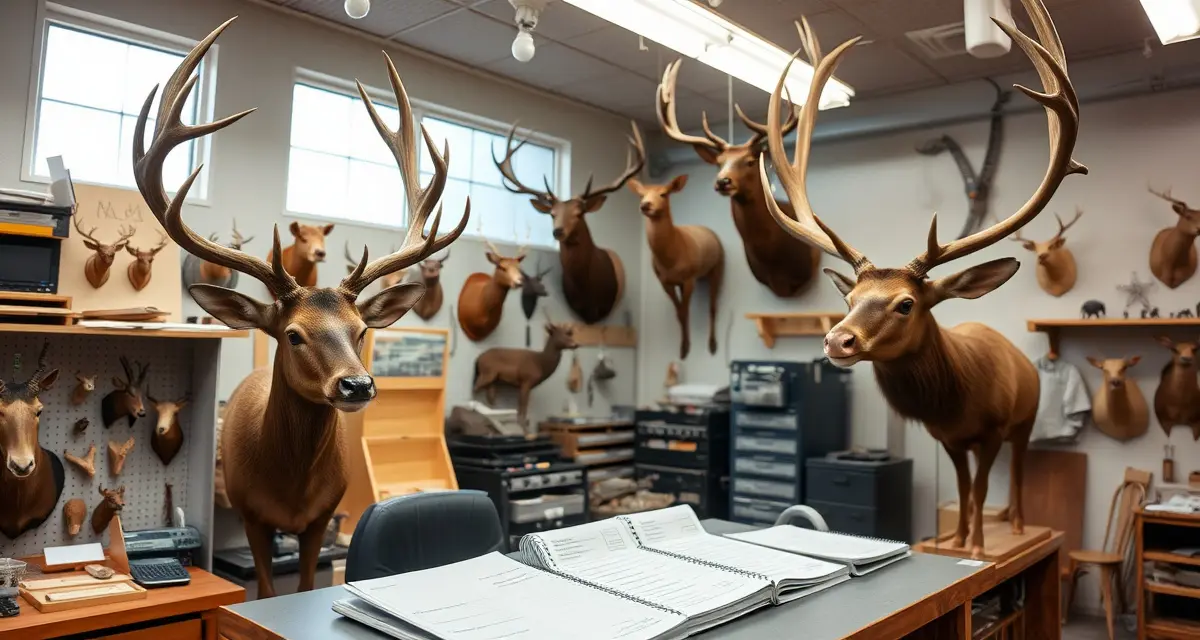
Taxidermy Shop Management Software for Washington Shops
Washington Roosevelt elk and Rocky Mountain elk subspecies require separate documentation. Like Oregon to the south, Washington is one of the few states where both major North American elk subspecies occur, and accurate subspecies identification and documentation is part of your record-keeping obligation.
Add Washington's black bear season that opens in August (creating an early-season intake surge before deer and elk) and you have a multi-species, multi-month intake calendar that benefits from dedicated management software.
MountChief's Washington configuration builds WDFW (Washington Department of Fish and Wildlife) permit requirements and multi-species compliance into the intake workflow.
TL;DR
- Black bear mounts from Washington (shoulder, rug, or skull) require WDFW documentation including the bear tag number, harvest GMU, and harvest date.
- Records must be retained for a minimum of 3 years and available for WDFW inspection.
- Washington Roosevelt elk and Rocky Mountain elk subspecies require separate documentation.
- Having your intake system set up and ready before August 1 prevents the scramble of trying to process bear intakes without proper systems in place.
- This creates an intake event before most hunters or taxidermists are thinking about fall hunting season.
- August black bear intakes can catch shops that are still in summer mode.
Washington's Multi-Elk-Subspecies Environment
Washington's geography is divided by the Cascade Mountains into distinctly different ecological zones, each supporting different wildlife populations.
Roosevelt Elk in Western Washington
Roosevelt elk (Cervus canadensis roosevelti) inhabit the Olympic Peninsula, the Coast Range, and the western Cascades. The Olympic Peninsula has one of the highest densities of Roosevelt elk in their range. These are large-bodied, heavy-antlered animals with a scoring system under Boone and Crockett that differs from Rocky Mountain elk.
For taxidermists, Roosevelt elk intakes from western Washington customers require:
- Species documented as Roosevelt elk (not just "elk")
- WDFW GMU (Game Management Unit) where the animal was harvested
- License and tag information
- Subspecies-appropriate form and antler support considerations (Roosevelt antlers differ in structure from Rocky Mountain bulls)
Rocky Mountain Elk in Eastern Washington
Rocky Mountain elk inhabit the eastern Cascades and Blue Mountains of northeastern Washington. These are the same subspecies as Montana, Idaho, and Wyoming elk.
For WDFW documentation purposes, Rocky Mountain elk from eastern Washington GMUs should be documented separately from Roosevelt elk to maintain accurate subspecies records.
MountChief's Washington intake workflow includes subspecies selection for elk, ensuring your records accurately reflect the animal's subspecies based on the harvest GMU.
Washington's Black Bear Season: Early Intake Surge
Washington's black bear season opens in August, the earliest major game season in the state's calendar. This creates an intake event before most hunters or taxidermists are thinking about fall hunting season.
August black bear intakes can catch shops that are still in summer mode. Having your intake system set up and ready before August 1 prevents the scramble of trying to process bear intakes without proper systems in place.
Black bear mounts from Washington (shoulder, rug, or skull) require WDFW documentation including the bear tag number, harvest GMU, and harvest date. Washington WDFW conducts inspections of licensed taxidermists, and bear records are commonly reviewed.
WDFW Documentation Requirements for Washington Taxidermists
Washington taxidermists must maintain records for all wildlife received. WDFW-required documentation includes:
- Customer name, address, and contact information
- Species (including subspecies for elk)
- Sex of specimen
- WDFW hunting license number
- Tag or permit number
- Game Management Unit where the animal was harvested
- Harvest date
- Date received at the shop
For special permits (limited-entry elk, sheep, goat, moose), the special permit number is essential documentation.
Records must be retained for a minimum of 3 years and available for WDFW inspection.
Washington's Full Species Calendar
Beyond elk and bear, Washington taxidermists handle:
White-tailed deer and mule deer: Both species occur in Washington. Eastern Washington has both mule deer and whitetail populations. Documentation should specify the deer species.
Black-tailed deer: Columbian blacktail deer inhabit western Washington. As in Oregon, these are a distinct subspecies from mule deer and should be documented as blacktail.
Mountain goat: Limited-entry permits for high-demand units. These are high-value, once-in-a-lifetime intakes requiring careful documentation.
Bighorn sheep: Similarly limited-entry and high-value. WDFW tracks these permits closely.
Waterfowl: Western Washington provides excellent duck and goose hunting along the coast and Puget Sound lowlands. Federal migratory bird permit requirements apply.
Taxidermy shop management software with multi-species intake capabilities handles this breadth of species without requiring separate systems for different categories.
Related Articles
- Taxidermy Shop Management Software for California Shops
- Taxidermy Shop Management Software for Colorado Shops
- Taxidermy Shop Management Software for Connecticut Shops
FAQ
What WDFW records must Washington taxidermists maintain?
Washington taxidermists must maintain records for all wildlife received, including customer name and address, species and subspecies (particularly for elk and deer), sex, WDFW hunting license number, tag or special permit number, Game Management Unit, harvest date, and date received. For limited-entry species (mountain goat, bighorn sheep, moose, some elk units), the special permit number is critical documentation. Records must be retained for a minimum of 3 years.
Does Washington require a taxidermy license?
Yes. Washington requires taxidermists to hold a Taxidermist License issued by WDFW. The license must be renewed annually. Federal permits are required for migratory birds. Taxidermists should also verify their compliance with any county-level business licensing requirements.
How do Washington shops manage multiple elk subspecies documentation?
The key is capturing the harvest GMU at intake, which establishes the subspecies. Roosevelt elk come from western Washington GMUs; Rocky Mountain elk come from eastern Washington GMUs. MountChief's Washington configuration includes subspecies fields for elk that are populated based on the GMU you enter, eliminating the need to rely on memory or the customer's knowledge of subspecies differences. This creates accurate compliance records that match the actual animal.
How does this apply to solo taxidermy shops?
The principles in this guide apply to solo shops just as they do to larger operations, though the scale differs. A single-person shop may have lower absolute volume but faces the same documentation, compliance, and customer communication requirements. The practical advice here scales down to any shop size.
What is the most common mistake taxidermists make with taxidermy shop management washington?
The most common mistake is treating taxidermy shop management washington as an afterthought rather than building it into the standard workflow from the start. Shops that encounter problems in this area typically did not establish clear processes before season, which means every situation becomes a one-off decision rather than a standard response.
Try These Free Tools
Put these insights into practice with our free calculators and planners:
Sources
- National Taxidermists Association (NTA)
- US Fish & Wildlife Service
- Small Business Administration (SBA)
Washington Multi-Species Compliance, Built In
Two elk subspecies. An August bear season that front-runs fall hunting. Four deer species across the state. Federal waterfowl requirements. Washington's multi-species taxidermy environment requires intake systems that adapt to the species, not the other way around.
MountChief's Washington configuration handles WDFW documentation for all regulated species, with subspecies fields for elk and deer, and species-specific intake prompts for limited-entry trophy species.
Start your free MountChief trial and manage Washington compliance from your next intake forward.
Get Started with MountChief
From the moment a specimen arrives to the day a customer picks it up, MountChief keeps every detail, document, and conversation in one organized system.