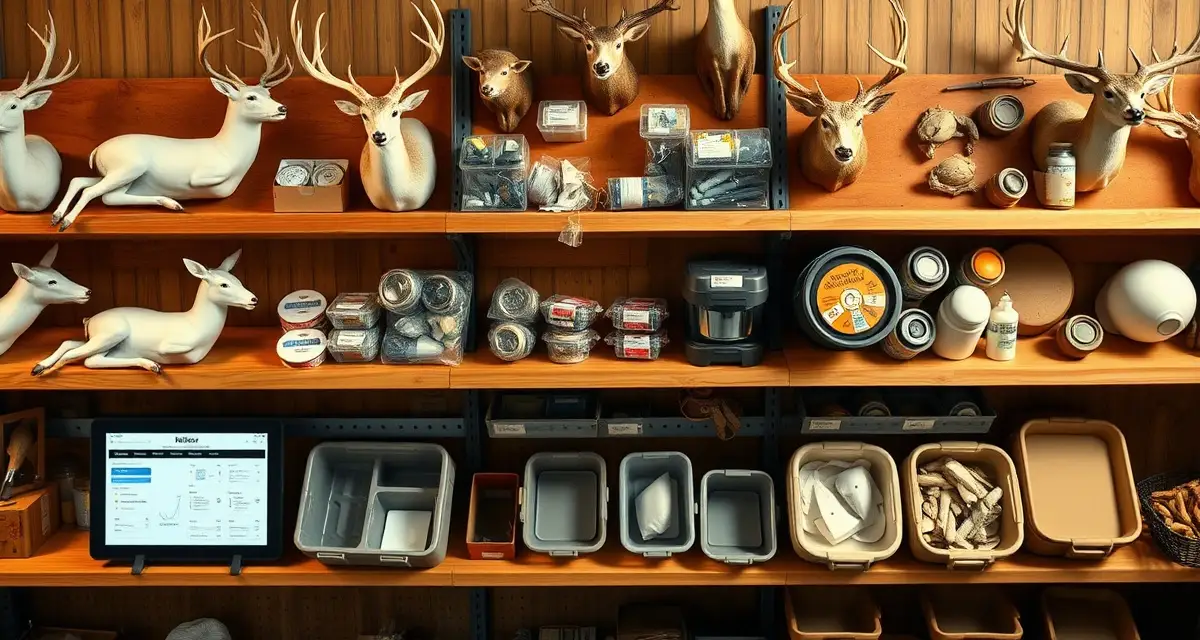
Taxidermy Shop Inventory Management: Track Forms, Supplies, and Materials
Running out of deer forms during peak season costs shops 2-5 business days. You're waiting for a supplier to process an order, then waiting for shipping, and in the meantime the job you needed that form for is sitting idle. Multiply that across two or three ordering events during a busy November and you're looking at a week of lost production time.
Proactive inventory planning before deer season prevents the most common production delays. This guide covers what to track, how to track it, and how to avoid the supply chain problems that slow down the shops that don't plan ahead.
TL;DR
- Custom-size boxes for deer shoulder mounts need to be on hand before you start completing jobs, not ordered after you have 10 mounts waiting to ship.
- If you wait to order until you actually need a form in November, you may wait 2-3 weeks for it.
- That gives you 8-12 weeks of supplier lead time, which is almost always enough.
- If you use 5 standard deer forms per week during peak season and your supplier takes 10 days to deliver, you need to reorder when you have 10-15 forms left (covering lead time plus safety stock).
- If 60% of your deer jobs have been straight-ahead forms in the 19-21" neck size range, that's your primary stock to maintain.
- Deer eye sizes range from 30mm to 36mm; know what your typical jobs require.
What Taxidermy Shops Should Track in Inventory
Most taxidermists don't think of themselves as running an inventory-heavy business. You're not a retailer. But the materials you use are time-sensitive during peak season, and running out at the wrong moment has real consequences.
Here's the core inventory to track:
Forms and Mannikins
Deer forms are your highest-volume inventory item and the longest-lead-time item to reorder. Standard-size forms from major suppliers (McKenzie, WASCO, Research Mannikins) typically ship within 3-7 business days, but can stretch to 2-3 weeks during peak fall season when every shop in the country is ordering simultaneously.
Track forms by:
- Species (deer, elk, turkey, fish)
- Size/configuration (neck circumference for deer, form length for fish)
- Pose (straight, right turn, left turn, upward, sneak for deer)
Know your historical mix of form sizes and poses from prior seasons. If 60% of your deer jobs have been straight-ahead forms in the 19-21" neck size range, that's your primary stock to maintain.
Eyes
Glass eyes are inexpensive individually but running out is annoying and avoidable. Keep a working inventory of eyes for your most common species in standard sizes. Stock 50-100 pairs of deer eyes before season. Eyes are small, don't expire, and order minimums are low.
Track by species and size. Deer eye sizes range from 30mm to 36mm; know what your typical jobs require.
Chemicals and Finishing Supplies
Ear liner material: One set per deer job. Order enough for your projected season plus a 20% buffer.
Hide paste: Goes quickly during production. Order in gallon containers, not pint-size jars, if you're doing significant volume.
Finishing paints (nose, eye detail): These are small quantities but specific colors matter. Don't run out of nose paint when you're finishing 20 deer in December.
Hydrogen peroxide: For European mounts and whitening. A gallon goes a long way, but keep it in stock.
Freeze-dried insert material, lip tape, and epoxy: These are consumables that run out predictably based on job volume. Track them against your intake count.
Tannery Supplies
If you do any in-house tanning or preservation work, track your chemical inventory separately. DP powder, pickle solution, and related chemicals have shelf life considerations and should be ordered proactively rather than reactively.
Packaging and Shipping
If you ship finished mounts to out-of-state customers, track boxes, packing materials, and fragile foam. Custom-size boxes for deer shoulder mounts need to be on hand before you start completing jobs, not ordered after you have 10 mounts waiting to ship.
How to Set Reorder Points
A reorder point is the inventory level at which you place a new order. Setting a reorder point correctly means you never hit zero stock during the season.
Formula: Reorder point = Lead time demand + Safety stock
- Lead time demand: How much of the item you use during the time it takes to get a new order
- Safety stock: A buffer for unexpected delays or higher-than-expected usage
Example for deer forms (straight-ahead, 20" neck):
- Average usage: 5 forms per week during October/November
- Lead time from supplier: 10 days (roughly 2 weeks)
- Lead time demand: 10 forms
- Safety stock: 5 additional forms as buffer
- Reorder point: 15 forms
When your inventory of this form drops to 15, place a new order. That order will arrive before you run out, even with a slight delay.
Set reorder points for your five most critical inventory items before the season starts. The others you can manage less formally.
Tracking Inventory in Practice
Some taxidermists keep inventory on a physical clipboard or whiteboard. That works for small-volume shops. As volume grows, a digital system that ties inventory to job records is more reliable.
MountChief's shop management software includes inventory tracking that can flag when supplies drop below your set reorder points. When you create a new job, the system can note which form and supplies are allocated to that job, giving you a running count of what's committed versus what's available.
The deer season prep guide includes a pre-season inventory checklist that covers what to have on hand before September archery openers.
Pre-Season Inventory Audit
The best time to audit your inventory and place pre-season orders is August. By August, you know roughly what your season is shaping up to be based on your pre-season bookings and prior-year trends.
Pre-season audit process:
- Count current inventory for all tracked items
- Compare to your projected seasonal usage (based on prior years plus any expected growth)
- Identify what needs to be ordered before season opens
- Place orders in August, before supplier demand spikes in September and October
Suppliers run out of popular form sizes and configurations during October. If you wait to order until you actually need a form in November, you may wait 2-3 weeks for it.
Avoiding the "One Form Away From Done" Problem
One of the most frustrating production situations is having a job fully staged, the cape back from the tannery, all materials ready, but one specific form on back-order. The job sits idle while you wait.
The way to prevent this is ordering forms earlier in the process, ideally before the cape ships to the tannery rather than when it returns. For custom form sizes (elk, oversized deer, bear), order the form when you create the job at intake. That gives you 8-12 weeks of supplier lead time, which is almost always enough.
For standard deer forms, maintain a standing inventory rather than ordering per-job. Stock your most common size/pose combinations and treat them as recurring inventory, not per-job purchases.
Seasonal Inventory Adjustments
Your inventory needs shift through the year. December and January are when you're working through the deer season backlog, so demand stays high for deer supplies through winter. Spring turkey season requires a different set of supplies. Summer fish work requires yet another.
Review your inventory against your active job queue at the start of each season so you're not sitting on deer supplies in June when you need bird supplies.
Frequently Asked Questions
What supplies should a taxidermy shop track in inventory?
The most important items to track are forms by species and size (your longest-lead-time supplies), glass eyes by species and size, ear liner material, hide paste, finishing paints and chemicals, and any shipping supplies if you're delivering finished mounts. European mount shops add hydrogen peroxide and skull cleaning supplies to the list. Track any item that would stop production if you ran out during peak season.
How do I know when to reorder taxidermy forms?
Set a reorder point based on your usage rate and your supplier's lead time. If you use 5 standard deer forms per week during peak season and your supplier takes 10 days to deliver, you need to reorder when you have 10-15 forms left (covering lead time plus safety stock). Check your most critical form inventory weekly during the September-November season. For custom forms, order at the time of intake rather than waiting for the tannery to return the cape.
Can taxidermy software help with supply chain management?
Yes. Shop management platforms that include inventory tracking let you set reorder points for specific items, alert you when inventory falls below those points, and see how much of each form type is currently committed to active jobs versus available for new intake. This prevents the common situation of taking in a job with a specific form type in mind and discovering you already committed all of your remaining stock to prior jobs.
How does this apply to solo taxidermy shops?
The principles in this guide apply to solo shops just as they do to larger operations, though the scale differs. A single-person shop may have lower absolute volume but faces the same documentation, compliance, and customer communication requirements. The practical advice here scales down to any shop size.
What is the most common mistake taxidermists make with taxidermy shop inventory management?
The most common mistake is treating taxidermy shop inventory management as an afterthought rather than building it into the standard workflow from the start. Shops that encounter problems in this area typically did not establish clear processes before season, which means every situation becomes a one-off decision rather than a standard response.
Related Articles
Try These Free Tools
Put these insights into practice with our free calculators and planners:
Sources
- National Taxidermists Association (NTA)
- US Fish & Wildlife Service
- Small Business Administration (SBA)
Get Started with MountChief
Taxidermy shops that grow beyond a handful of jobs need real systems for tracking, compliance, and customer updates. MountChief was designed specifically for that transition.