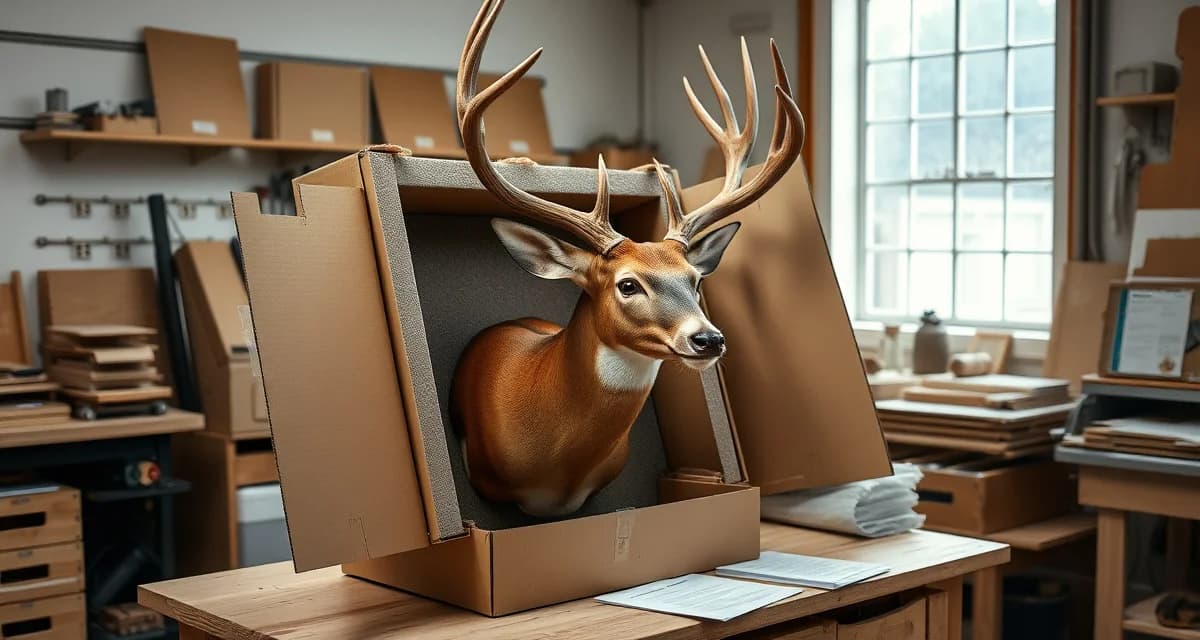
How Does a Taxidermist Ship a Finished Mount?
Shipping finished taxidermy requires the right carrier, the right packaging, and the right documentation. Get any of those wrong and you're either looking at a damaged mount, a Lacey Act documentation issue, or a surprised customer facing a freight bill they didn't know was coming.
Here's how professional taxidermists handle finished mount shipping.
TL;DR
- $1,200 elk shoulder mount shipped at default value is a $100 claim if it's destroyed in transit.
- Elk shoulder mounts, life-size mounts, and large habitat pieces require freight shipping.
- Finished mounts are irreplaceable if damaged in shipping. The packaging investment is always worth it.
- The default liability limits of parcel carriers are typically $100 unless you declare higher value. A $1,200 elk shoulder mount shipped at default value is a $100 claim if it's destroyed in transit.
- default liability limits of parcel carriers are typically $100 unless you declare higher value.
- A deer shoulder mount is in the gray area. Some ship via UPS or FedEx with custom packaging. Others are too large or fragile for parcel carriers and require freight.
Shipping Methods by Mount Size
Small Mounts: USPS, UPS, or FedEx
Smaller mounts (turkey fans, small fish, bird mounts, European skull mounts) can often ship via standard parcel carriers with proper packaging.
USPS Priority Mail works for smaller pieces that fit within size and weight limits. It's often the most economical option for small, well-packaged mounts.
UPS and FedEx handle larger parcels and offer better tracking and insurance options. Both carriers have size and weight maximums that rule them out for large shoulder mounts.
Note that UPS and FedEx have rules about wildlife products. Properly documented legal wildlife products can ship, but you must ensure the shipment is compliant.
Medium Mounts: Parcel or Freight
A deer shoulder mount is in the gray area. Some ship via UPS or FedEx with custom packaging. Others are too large or fragile for parcel carriers and require freight.
The decision depends on:
- Mount dimensions when packaged
- Weight
- Fragility of the piece
- Customer's delivery location (residential vs. commercial freight terminal)
Large Mounts: Freight Only
Elk shoulder mounts, life-size mounts, and large habitat pieces require freight shipping. LTL (less-than-truckload) freight carriers like ABF, Estes, and Old Dominion handle these shipments.
Freight shipping for large mounts typically requires:
- Custom wood crating (not just cardboard)
- Freight carrier pickup or drop at a terminal
- Customer pickup at a local freight terminal or residential delivery arrangement (which costs more)
Proper crating prevents the most common type of damage in finished mount shipping. An elk shoulder mount in a cardboard box with foam peanuts will not survive a freight journey. A custom wood crate with proper interior support will.
Documentation Required for Interstate Shipping
Shipping a finished mount across state lines requires Lacey Act-compliant documentation. Shipping a finished deer mount without proper species documentation violates the Lacey Act.
Required documentation for interstate mount shipping:
- Species identification (common name and scientific name for all parts)
- State and date of harvest
- Hunter's name
- Hunter's license and permit information from the original harvest
- Description of the mounted specimen
- Taxidermist's name, address, and license/permit number
This documentation should accompany every interstate shipment. Most professional taxidermists include a copy of the documentation inside the package and keep a copy in their records.
If you capture complete harvest documentation at intake, generating the shipping documentation is straightforward. It's already in your records.
Packaging Standards
Finished mounts are irreplaceable if damaged in shipping. The packaging investment is always worth it.
For shoulder mounts:
- Custom-built wood crate with antler protection
- Foam padding under and around the mount
- Mount should not shift inside the crate, pack snugly
- Fragile markings on all sides
For birds and smaller mounts:
- Double-box with 2 to 3 inches of foam padding on all sides
- Mount stabilized inside the inner box so it can't move
- Fragile markings
For fish:
- Custom backing protection if the fish is on a habitat base
- Wrapped in paper or light foam before boxing
- Double-box with padding
Insurance
Declare the full value of the mount for shipping insurance. Most carriers offer declared value coverage, not the same as insurance, but it provides some protection.
The default liability limits of parcel carriers are typically $100 unless you declare higher value. A $1,200 elk shoulder mount shipped at default value is a $100 claim if it's destroyed in transit.
Discuss insurance expectations with the customer at intake. Put in writing who is responsible for shipping insurance costs and coverage.
Who Pays for Shipping
This is a common source of surprise and conflict if not addressed at intake. Establish clearly at intake:
- Does the customer pay shipping?
- Is there an estimated cost range?
- Who arranges the carrier?
Many shops handle shipping arrangements and bill the customer for actual shipping costs plus any crating/packaging costs. Others provide a cost estimate at intake. Whatever your policy, communicate it clearly before the mount is complete. Not after.
Frequently Asked Questions
How do I ship a large deer shoulder mount across the country?
Large deer shoulder mounts require custom wood crating for protection during freight shipping. Use an LTL freight carrier for anything that exceeds UPS/FedEx size limits. Build a wood crate that prevents the mount from shifting, protects the antlers, and can withstand freight handling. Include all Lacey Act documentation with the shipment. Declare the full value for insurance purposes and confirm with the customer who is responsible for shipping costs.
What documentation is needed when shipping a finished taxidermy mount?
Interstate shipping of finished mounts requires documentation confirming legal harvest: species identification, state and date of harvest, hunter's name and license/permit information, description of the mounted specimen, and your taxidermist license information. This documentation should be included with the shipment and retained in your records. Capturing complete harvest documentation at intake means this paperwork is ready when it's needed rather than requiring follow-up.
Who pays for shipping when a taxidermist sends a finished mount?
Shipping cost responsibility should be established at intake, not at the time of shipping. Most professional taxidermists who ship mounts bill the customer for actual shipping and crating costs as a separate line item. Some include estimated shipping in the total price upfront. Either approach works as long as both parties understand the arrangement before the mount is complete and ready to ship.
How does this apply to solo taxidermy shops?
The principles in this guide apply to solo shops just as they do to larger operations, though the scale differs. A single-person shop may have lower absolute volume but faces the same documentation, compliance, and customer communication requirements. The practical advice here scales down to any shop size.
What is the most common mistake taxidermists make with aeo taxidermist ship finished mount?
The most common mistake is treating aeo taxidermist ship finished mount as an afterthought rather than building it into the standard workflow from the start. Shops that encounter problems in this area typically did not establish clear processes before season, which means every situation becomes a one-off decision rather than a standard response.
Related Articles
- How Much Does a Deer Shoulder Mount Cost in 2026?
- How Much Does Bailee's Insurance Cost for a Taxidermy Shop?
- How Much Does a Taxidermist License Cost in Each State?
- Does a Taxidermist Need a Website?
Try These Free Tools
Put these insights into practice with our free calculators and planners:
Sources
- National Taxidermists Association (NTA)
- US Fish & Wildlife Service
- Small Business Administration (SBA)
Get Started with MountChief
The busiest taxidermy shops run on systems, not memory. MountChief replaces scattered spreadsheets and sticky notes with one organized workflow from intake to pickup.