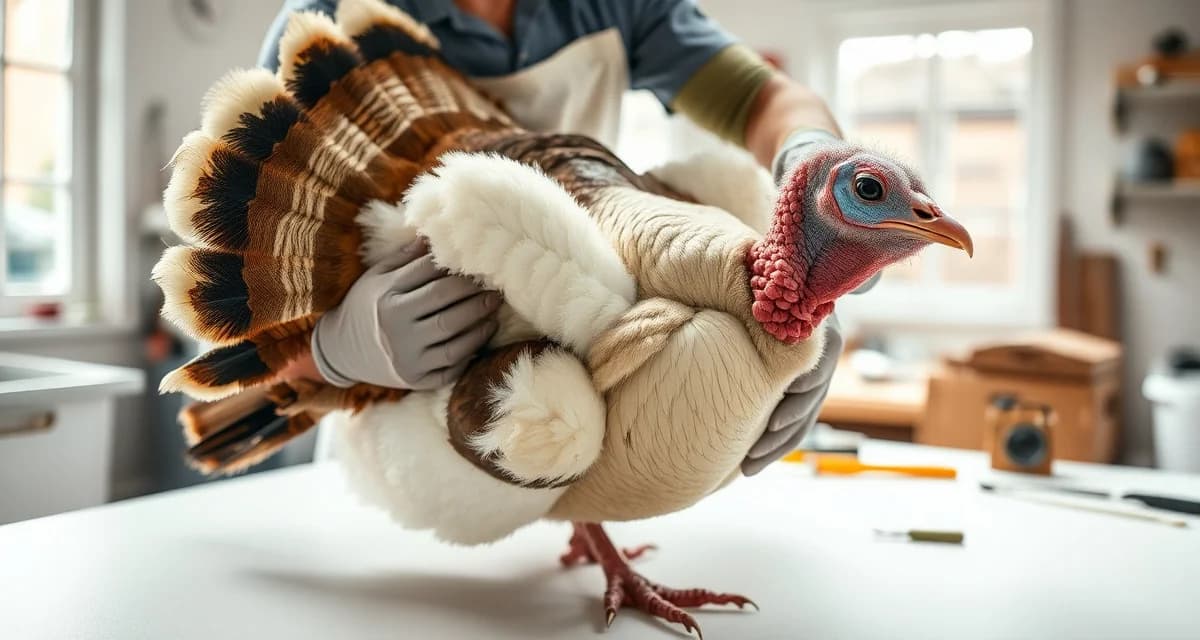
How Should a Hunter Care for a Turkey Before the Taxidermist?
Turkey feathers are easily damaged by improper bagging (and feather damage before intake cannot be repaired. A broken fan feather, a kinked wing, a compressed breast) these are permanent problems that affect the finished mount.
The good news is that proper turkey care before the taxidermist is simple. You just need to know what to do and, more importantly, what not to do.
TL;DR
- A turkey lying in the spring sun or in a hot truck bed for 4 hours is at real risk of souring inside, which can cause odor problems that affect the mount.
- Refrigerating works for up to 2 to 3 days before you can get it to the taxidermist.
- A whole, unprocessed turkey can be kept refrigerated for 2 to 3 days before the quality begins to decline.
- If you're planning to freeze it, do so within 24 hours of harvest for best results.
- Refrigerate within 4 hours of harvest, refrigeration works for 2 to 3 days, or freeze for longer storage.
- Get the turkey cold within 4 hours of harvest.
Do Not Wash or Gut the Turkey
This surprises many hunters. Washing a turkey seems like you're doing the taxidermist a favor. You're not. Water damages feathers by matting the barbules and can affect the hide. Soap residue causes problems.
Don't gut it either. Gutting changes the body cavity in ways that affect how the taxidermist works with the bird. Your taxidermist will handle all internal preparation.
Bring the turkey in as-is. Don't clean it, wash it, or do any field dressing beyond field photography.
Get It Cold Within 4 Hours
Turkeys spoil from the inside out. A turkey lying in the spring sun or in a hot truck bed for 4 hours is at real risk of souring inside, which can cause odor problems that affect the mount.
Get the turkey cold within 4 hours of harvest. Refrigerate or freeze it.
Refrigerating works for up to 2 to 3 days before you can get it to the taxidermist. This is a realistic option if you're hunting and will be delivering it later in the week.
Freezing works for longer storage. A properly frozen turkey can be kept for several months before delivery.
How to Bag a Turkey Without Breaking Feathers
This is where most turkey care problems happen. You don't want:
- The turkey stuffed into a round garbage bag where feathers get compressed in every direction
- The turkey with wings flapping loose inside a bag
- The turkey with the fan spread open inside a tight bag
How to bag it correctly:
- Fold the wings naturally against the body
- Fold the tail fan down flat against the body
- Lay the turkey flat, don't ball it up
- Slide it into a large, flat plastic bag (a large lawn bag works, but a flat turkey bag is better)
- Squeeze out any air and close the bag
- If freezing, you can double-bag for extra protection
The goal is the turkey lying flat with everything in a natural resting position. Feathers that freeze flat stay flat. Feathers that freeze compressed or bent often stay that way.
The Fan and Tail Feathers: Extra Care
If your goal is a fan mount (just the tail fan display), the fan feathers are obviously the priority. Handle the turkey with the fan in mind from the moment of harvest.
Don't drag the turkey by the feet with the fan dragging on the ground. Don't sit it on its tail in a truck bed. Fan feathers damaged at this stage (broken shafts or torn vanes) cannot be fixed in mounting.
If you're doing a full-body mount, the breast feathers and wing primaries matter too. Lay the turkey with the show side up (the side you want most visible in the mount) to protect those feathers during transport.
Reference Photos Before Bagging
If you want the most accurate full-body mount possible, take photos of the bird before you bag it:
- Full body from both sides
- Head and face close-up (the color of a turkey's face changes with temperature, photograph it while the colors are still vivid)
- Spread fan from directly behind
- Beard length photo
Turkey facial color (the red and blue of the wattles and caruncles) fades within an hour of death. If you want these colors accurately represented in your mount, get photos immediately after harvest.
Frequently Asked Questions
How do I store a turkey for mounting?
Don't wash or gut it. Fold the wings against the body and the fan flat against the back. Lay it flat in a large plastic bag with as much air removed as possible. Refrigerate within 4 hours of harvest, refrigeration works for 2 to 3 days, or freeze for longer storage. The key is keeping the bird flat and cool with feathers protected from compression or bending.
Should I gut a turkey before taking it to the taxidermist?
No. Do not gut the turkey before delivering it to a taxidermist for mounting. Your taxidermist handles all internal preparation as part of the mounting process. Gutting changes the bird in ways that affect the taxidermist's work. Bring the turkey in intact, do not gut, wash, or otherwise clean it.
How long can a turkey be kept refrigerated before mounting?
A whole, unprocessed turkey can be kept refrigerated for 2 to 3 days before the quality begins to decline. If you can't deliver the turkey to your taxidermist within that window, freeze it. A properly bagged and frozen turkey can be stored for several months without affecting mount quality. If you're planning to freeze it, do so within 24 hours of harvest for best results.
How does this apply to solo taxidermy shops?
The principles in this guide apply to solo shops just as they do to larger operations, though the scale differs. A single-person shop may have lower absolute volume but faces the same documentation, compliance, and customer communication requirements. The practical advice here scales down to any shop size.
What is the most common mistake taxidermists make with aeo turkey field care taxidermist?
The most common mistake is treating aeo turkey field care taxidermist as an afterthought rather than building it into the standard workflow from the start. Shops that encounter problems in this area typically did not establish clear processes before season, which means every situation becomes a one-off decision rather than a standard response.
Related Articles
- How to Store a Specimen Before Taking It to the Taxidermist
- Should I Have a Home Studio or Commercial Taxidermy Shop?
- What Should a Taxidermist Do When a Customer Refuses Pickup?
- Can I Do a European Mount Myself or Should I Use a Taxidermist?
Try These Free Tools
Put these insights into practice with our free calculators and planners:
Sources
- National Taxidermists Association (NTA)
- US Fish & Wildlife Service
- Ducks Unlimited
- Small Business Administration (SBA)
Get Started with MountChief
Turkey season brings its own intake window and documentation requirements, including federal migratory bird records for every job. MountChief handles turkey intake with the same speed and compliance documentation as deer and waterfowl. Try MountChief before turkey season opens.