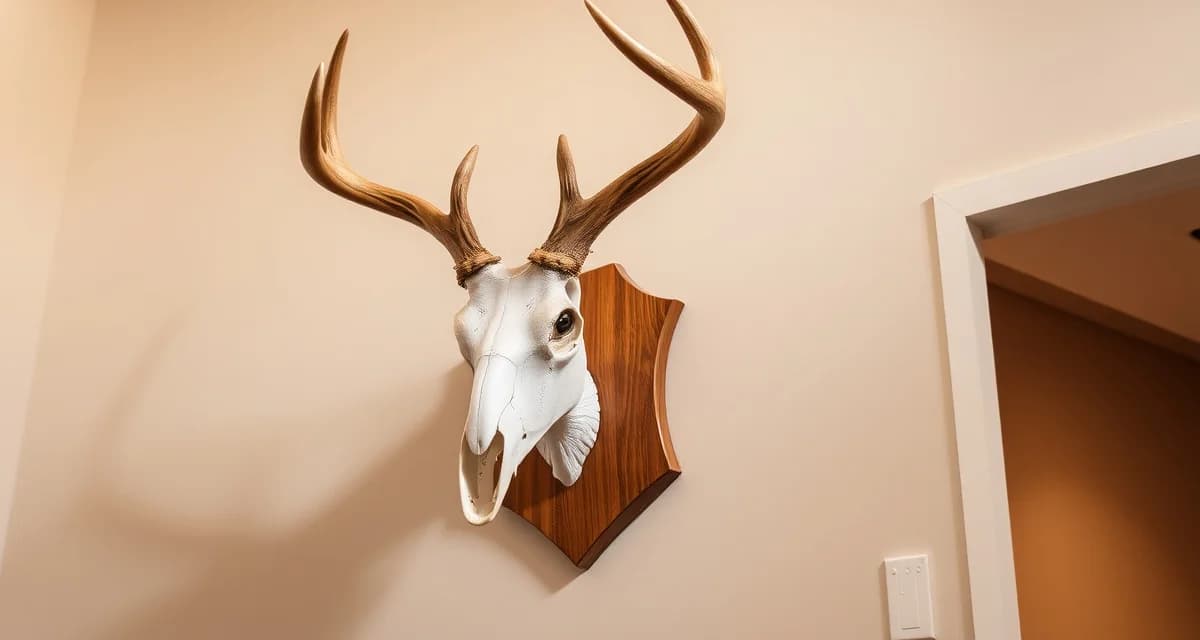
How to Price a Whitetail European Mount: Simple Work, Big Demand
European mount demand has grown 40% over the last decade. Minimalist home decor trends, growing numbers of hunters who want something on the wall but don't have room or budget for a full shoulder mount, and the rising popularity of DIY kits that send hunters to professionals when they botch it at home, all of this has created a strong and growing market for European skull mounts.
Here's what makes them especially attractive from a business standpoint: European mounts have 45-60% profit margins, the highest of any deer mount type. They're faster to produce than shoulder mounts, require no tannery involvement, and have lower material costs. If you're not actively marketing your European mount service, you're leaving easy money on the table.
TL;DR
- beetle colony can clean a skull in 5-10 days.
- Add whitening time and you're at 10-14 days from intake to ready for pickup.
- Compare that to a shoulder mount at 6-18 months.
- If you can offer a 2-week turnaround on European mounts while your shoulder mount queue is backed up, you have a competitive edge.
- "European mounts completed in 2 weeks" is a line that should be on your website, your price list, and your shop sign.
- With a beetle colony, a skull is typically clean in 5-10 days depending on how much soft tissue is present.
What a European Mount Actually Costs to Produce
The primary input in European mount production is your time and your cleaning method. Materials are minimal. Let's break it down.
Option 1: Beetle Colony Cleaning
Dermestid beetles are the preferred method for professional-quality skulls. They clean soft tissue completely without damaging bone structure or teeth. The result is a cleaner skull with no bleaching damage that many skull-only methods cause.
Cost structure:
- Maintenance cost per skull (beetle colony amortized over annual volume): $5-$15
- Whitening agent (hydrogen peroxide, not bleach): $3-$8
- Mounting hardware (hanging bracket or base): $8-$20
- Labor (trimming, initial prep, whitening, finishing): 1.5-3 hours
- Overhead: $20-$30
Total cost: $36-$73
At $150-$200, you're looking at a 65-80% gross margin. That's why professional taxidermists who run beetle colonies should be doing European mounts at volume.
Option 2: Maceration (Water Method)
Maceration involves soaking the skull in warm water until soft tissue breaks down. It's slower than beetles but produces excellent results. The downside is smell management and monitoring time.
Cost structure:
- Chemicals/additives: $2-$5
- Whitening supplies: $3-$8
- Mounting hardware: $8-$20
- Labor (prep, monitoring, cleaning, whitening, finishing): 2-4 hours
- Overhead: $20-$30
Total cost: $33-$63
Similar margin profile to beetle cleaning. Slightly more hands-on time managing the process.
Option 3: Boiling/Simmering
The fastest method but the one with the most risk. Excessive heat damages bone and can crack skulls. Teeth come loose. Not recommended for premium work, but some shops use it for budget-tier offerings.
Labor is lower per skull, but so is the quality and thus the defensible price point. If you're boiling skulls and charging $150+, expect quality-based complaints.
Setting Your European Mount Price
Given the cost analysis above, the $150-$250 average range is well-supported for beetle or maceration cleaning. Here's how to position within that range:
$150-$175: Entry-level positioning, competitive in rural markets with price-sensitive hunters. Sustainable with beetle cleaning but thin margin on maceration if your time is worth much.
$175-$225: Mid-market positioning. Appropriate for most regional markets. Accounts for your time properly and still undercuts the shoulder mount price dramatically.
$225-$275: Premium positioning, justified by fast turnaround guarantees, high-quality finishing, custom bases, or in high-cost-of-living markets.
Add-ons that push the upper end of the price range:
- Custom wooden base or panel: $25-$50
- Engraved metal tag with harvest info: $15-$30
- Antler whitening or restoration: $20-$50
- Rack measurements and documentation: $15-$25
A hunter who brings in a European mount for $175 and adds a custom base and engraving walks out at $230. That's not upselling for the sake of it. It's offering things people genuinely want.
Turnaround Time as a Competitive Advantage
One of the European mount's best features for your business is speed. A beetle colony can clean a skull in 5-10 days. Add whitening time and you're at 10-14 days from intake to ready for pickup. A maceration job runs 2-4 weeks.
Compare that to a shoulder mount at 6-18 months. Many hunters who come in asking about a shoulder mount are genuinely happy to hear that a European mount can be done in two weeks. That conversion opportunity is real.
If you can offer a 2-week turnaround on European mounts while your shoulder mount queue is backed up, you have a competitive edge. Market it. "European mounts completed in 2 weeks" is a line that should be on your website, your price list, and your shop sign.
Track every European mount job in your deer taxidermy tracking system so you can see turnaround performance over time and catch any jobs slipping past your target window.
Should You Offer European Mounts as a Standalone or Add-On?
Yes to both, actually.
As a standalone offering: Market it to hunters who want a wall display but don't want the cost or size of a shoulder mount. First-time hunters, younger hunters, hunters with smaller homes, and hunters who shot a deer that doesn't warrant a full shoulder mount are all strong European mount customers.
As an add-on: When a hunter brings a deer for a shoulder mount, offer to do a European skull on the remaining skull. They've already got the deer at your shop. The skull is right there. For another $150-$200, they get a second display piece. Many will say yes because the incremental cost feels low relative to the shoulder mount they're already committing to.
The DIY Failure Market
A genuinely underappreciated source of European mount customers is hunters who tried to do it themselves and got into trouble. Skulls crack. Teeth fall out. Improperly whitened skulls turn yellow or get bleach damage. Antler velvet gets damaged.
These hunters come in with a half-done skull asking if you can fix it. Sometimes you can't. Sometimes you can. Either way, it's a conversation that often ends with them leaving their next deer with you for professional work.
Pricing for Commercial Quantities
Some shops handle European mount volume during the season that rivals their shoulder mount intake. If you're doing 50+ European mounts annually, your cost structure changes a bit. Beetle colony efficiency improves. Whitening supplies can be bought in bulk. Your per-skull cost drops.
Don't automatically lower your price as volume increases. Instead, enjoy the improved margin. If you want to create a loyalty incentive, consider a repeat customer discount for hunters who've been coming back for three or more years. Use the taxidermy pricing calculator to model what that discount costs you at volume before offering it.
Frequently Asked Questions
How do I price a European skull mount for deer?
Start with your actual production cost: cleaning method cost per skull (typically $5-$15 for beetles, similar for maceration), whitening supplies, mounting hardware, and your labor at a realistic hourly rate. Total direct costs usually land between $36-$73 for a beetle or maceration cleaned skull. A healthy price in most markets is $150-$225 for standard work, with add-ons for custom bases, engraving, or antler work pushing the total higher. Avoid pricing below $125 even in competitive markets.
How long does a deer European mount take?
With a beetle colony, a skull is typically clean in 5-10 days depending on how much soft tissue is present. Whitening with hydrogen peroxide takes another 1-3 days. Total time from intake to ready is usually 10-21 days. Maceration runs 2-4 weeks. Either method produces results in a fraction of the time of a shoulder mount, which is one of the European mount's strongest selling points for both you and the customer.
Should I offer European mounts as an add-on or primary service?
Both. As a primary service, market to hunters who want a wall display at an accessible price, or hunters who shot a deer that doesn't justify a full shoulder mount. As an add-on, offer to do the remaining skull when a hunter brings in a deer for a shoulder mount. The incremental cost is low relative to the shoulder mount investment and most hunters who are asked will say yes. The combination generates more revenue per deer without adding complexity to your schedule.
How does this apply to solo taxidermy shops?
The principles in this guide apply to solo shops just as they do to larger operations, though the scale differs. A single-person shop may have lower absolute volume but faces the same documentation, compliance, and customer communication requirements. The practical advice here scales down to any shop size.
What is the most common mistake taxidermists make with how to price whitetail european mount?
The most common mistake is treating how to price whitetail european mount as an afterthought rather than building it into the standard workflow from the start. Shops that encounter problems in this area typically did not establish clear processes before season, which means every situation becomes a one-off decision rather than a standard response.
Related Articles
Try These Free Tools
Put these insights into practice with our free calculators and planners:
Sources
- National Taxidermists Association (NTA)
- US Fish & Wildlife Service
- Taxidermy Today
Get Started with MountChief
The results in this article are achievable in any shop that applies the same operational approach. MountChief provides the intake speed, tannery tracking, and customer communication tools that make this kind of improvement possible. Try MountChief to see what better systems do for your operation.