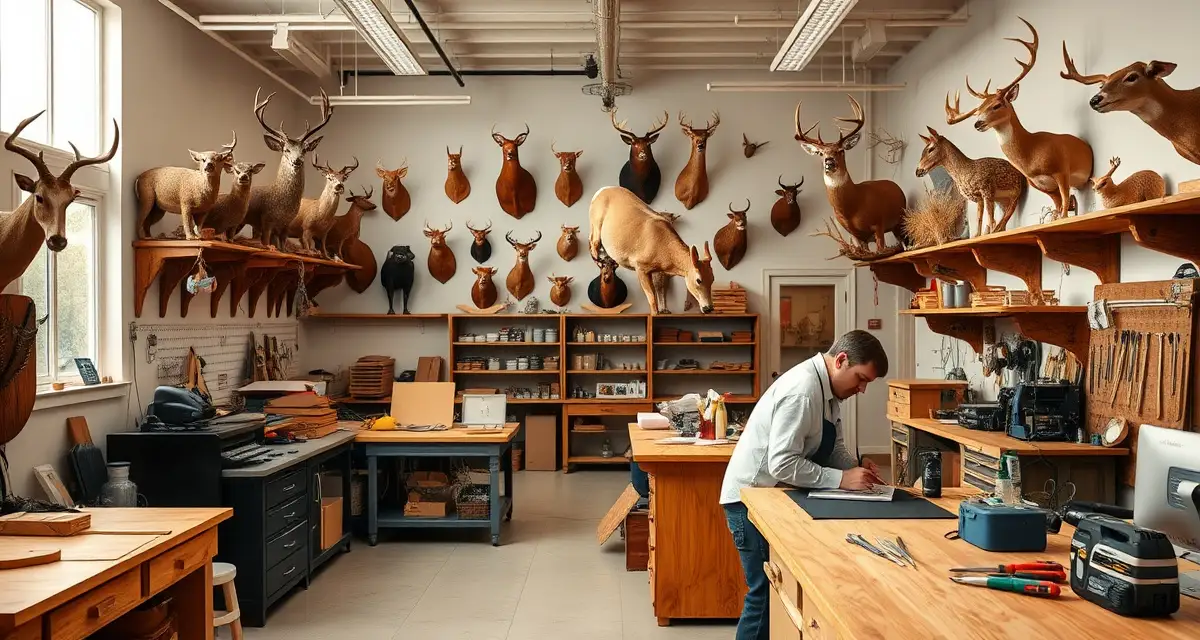
How to Grow a Taxidermy Shop: From 100 to 400 Mounts Per Year
Growing a taxidermy shop isn't just about getting more customers. Getting more customers is the easy part. If you do good work, word spreads. The hard part is building the operational systems to handle the growth without the quality dropping, the compliance slipping, or the owner burning out.
The taxidermists who make the jump from 100 to 400 mounts without disaster have one thing in common: they digitized their operations before the growth demanded it. Software adoption is the single biggest factor in taxidermy shop growth rate. Shops that digitize at 100 to 150 mounts grow to 300 or more within three seasons, consistently.
This is the playbook for that growth.
TL;DR
- At 300+ mounts, you need to know which weeks are your busiest, what your revenue breakdown by species is, where your production bottlenecks are, and what your average job value is over time.
- At 200+ deer in a season, you need intake to be fast and consistent whether you're doing it or someone else is.
- Shops with pre-season marketing programs that target past customers fill 30 percent of their capacity before deer season opens.
- Material costs have risen 25 percent since 2020.
- Is my intake process fast enough to handle 30 to 40 percent more volume without turning customers away?
- Typically within the first month of deer season for shops in the 150+ mount range.
Stage 1: The Solo Operator (50 to 150 Mounts)
Most taxidermy shops start here. One person, working out of a garage, small building, or shared space. Maybe a spouse or family member helps with pickups and intake during peak season.
At this stage, the business is sustainable through sheer personal commitment. You know every customer. You know where every hide is because you put it there. You answer every call personally.
The problem is that this model doesn't scale. At 150 mounts, you're approaching the ceiling of what one person can manage through personal knowledge and paper records. The moment you push past that, things start to slip.
What to do at Stage 1
Get your intake documented properly. Every deer, elk, fish, and bird should have a written (or digital) intake record with harvest information, condition documentation, and mount specifications confirmed by the customer. This discipline, started early, prevents the chaos that comes later.
Start collecting deposits consistently. Non-refundable deposits at intake eliminate your exposure to abandoned mounts. This is the financial habit that makes growth viable. You're not holding the cost of 150 active jobs with no money against them.
Get your pricing right. Before you grow, make sure your pricing covers your actual costs with margin. Growing on underpriced work just magnifies the problem. Run your numbers on every species category.
Consider your first software. At 100 to 150 mounts, the ROI on taxidermy management software is already clear. The time savings on intake and customer communication alone pay for most platforms in the first month of season.
Stage 2: The Crossroads (150 to 250 Mounts)
This is where most taxidermy shops stall or break. At 150 to 250 mounts, you've clearly outgrown the solo model, but you're not sure whether to hire help or build systems.
Most taxidermists hire too soon. They bring on a second person before they've built the systems that second person needs to operate effectively. The result is more expense without commensurate efficiency gain.
The right sequence is: build systems first, then hire.
What to build at Stage 2
AI-powered intake. At 200+ deer in a season, you need intake to be fast and consistent whether you're doing it or someone else is. AI intake with required fields and photo documentation creates a process that works at speed without sacrificing completeness. See how this integrates with shop management software.
QR tag tracking. With 200 simultaneous active jobs, you cannot rely on memory or paper labels to know where every hide is. QR tags applied at intake follow specimens through tannery and production. This is the infrastructure that makes high-volume management possible.
Customer portal. At 200 mounts, status call volume becomes a real production drag. A customer portal reduces that to near zero. Your phone rings for genuine questions, not for "where is my deer?" calls.
Tannery tracking. At higher volume, you're probably running multiple tannery shipments per season. You need a system that tracks what went where and what's come back.
When to add staff at Stage 2
Add a second person when:
- You're regularly at 100 percent of your production capacity during peak season
- You're turning customers away because you physically can't do more work
- The production quality is suffering because you're rushing
Do NOT add a second person because:
- Customer calls are overwhelming (fix with a portal)
- Intake is taking too long (fix with AI intake)
- Records are disorganized (fix with software)
The first three problems are system problems, not staffing problems. Solve them with software first.
Stage 3: The High-Volume Shop (250 to 400 Mounts)
At 250 to 400 mounts, you're running a real business. You probably have at least one employee. You're managing a significant production queue across multiple species, multiple tanneries, and a substantial customer base.
The operational demands at this stage are different in kind from Stage 1. You can't know where every job is by memory. You can't personally handle every customer interaction. You need systems that work whether you're in the shop or not.
What changes at Stage 3
Team management. With multiple staff members, you need role-based access to your management system. Your intake person sees intake records. Your taxidermist sees the production queue. Your billing person handles invoicing. Everyone works in their area without stepping on each other.
Reporting. At 300+ mounts, you need to know which weeks are your busiest, what your revenue breakdown by species is, where your production bottlenecks are, and what your average job value is over time. This data drives decisions about staffing, capacity, and pricing.
Quality control documentation. At high volume, the temptation is to move fast and trust the work. But quality disputes scale with volume. Consistent production documentation (photos at key stages, QR tracking, clear job specifications) protects you and protects your reputation.
Customer relationship management. At 400 mounts, you have a large repeat-customer base. Shops with pre-season marketing programs that target past customers fill 30 percent of their capacity before deer season opens. See the growth software strategy for managing a high-volume operation.
Pricing for Stage 3
High-volume shops have higher overhead than solo operations. Rent, payroll, equipment, insurance. These costs require higher volume or higher prices (ideally both) to sustain.
Don't let volume growth outpace your pricing review. Material costs have risen 25 percent since 2020. If your prices haven't moved to reflect that, you're growing revenue while compressing margins.
Review your pricing annually. At minimum, evaluate it before each deer season.
The Growth Timeline
Taxidermists who follow this sequence consistently make the 100-to-400 jump in 3 to 5 seasons:
Year 1: 100 to 150 mounts. Get intake documented. Start collecting deposits. Price correctly.
Year 2: 150 to 200 mounts. Implement management software. AI intake, QR tags, customer portal, tannery tracking. Grow into the system's capacity.
Year 3: 200 to 250 mounts. Make your first hire (if demand supports it). Use team management features. Start building your reporting data.
Year 4 to 5: 250 to 400 mounts. Full high-volume operation. Pre-season marketing. Repeat customer programs. Data-driven decisions.
This timeline assumes demand is present. In most markets with strong hunting culture, the demand is there. The limiting factor is almost always operational. Not whether customers want taxidermy, but whether the shop can handle the volume at the quality level that builds a reputation.
What Holds Growth Back
The most common growth blockers for taxidermy shops:
Underpricing. Growing on margins that don't cover costs just scales the loss. Fix pricing before scaling volume.
Paper-based operations. Paper creates a hard ceiling on manageable volume. Most paper-based shops find that ceiling around 150 mounts. Software extends the ceiling dramatically.
Hiring before systemizing. Adding a second person to a disorganized operation adds cost before it adds capability. Systems first, staff second.
No marketing. Word of mouth grows a shop to 150 mounts. Growing beyond that requires intentional marketing, past customer outreach, social media, Google Business Profile optimization.
Not protecting quality. Growth that compromises quality is self-defeating. Your reputation is your most valuable asset. Every growth decision should pass the quality test: will this let me maintain or improve the quality of my work?
The Three Questions to Ask Before You Grow
Before you push for the next volume tier, ask:
- Is my intake process fast enough to handle 30 to 40 percent more volume without turning customers away?
- Do I have visibility into every active job at every stage?
- Can my customers get job status information without calling me?
If the answer to any of these is no, fix those problems first. They're the infrastructure that growth runs on.
Frequently Asked Questions
How do I grow my taxidermy business?
Start with systems, then scale volume. Implement digital intake, QR tracking, a customer portal, and tannery tracking before you push for more mounts. Shops that systemize at 100 to 150 mounts consistently reach 300 or more within three seasons. Shops that skip systemization typically plateau around 150 to 175 mounts because the operations can't handle more without breaking.
When should I add a second taxidermist to my shop?
Add a second taxidermist when you are regularly at full production capacity during peak season and are turning customers away because you physically cannot do more work. Do not hire to solve intake problems, customer communication problems, or record-keeping problems. Those are system problems that software solves faster and more cheaply than a second hire.
What software does a growing taxidermy shop need?
A growing taxidermy shop needs AI-powered intake, QR tag tracking, a customer portal, tannery tracking, digital invoicing, and compliance flagging. An integrated platform that covers all of these in one system is more efficient than separate tools for each function. The software investment pays for itself quickly in time savings during peak season. Typically within the first month of deer season for shops in the 150+ mount range.
How does this apply to solo taxidermy shops?
The principles in this guide apply to solo shops just as they do to larger operations, though the scale differs. A single-person shop may have lower absolute volume but faces the same documentation, compliance, and customer communication requirements. The practical advice here scales down to any shop size.
What is the most common mistake taxidermists make with taxidermy shop growth guide?
The most common mistake is treating taxidermy shop growth guide as an afterthought rather than building it into the standard workflow from the start. Shops that encounter problems in this area typically did not establish clear processes before season, which means every situation becomes a one-off decision rather than a standard response.
Related Articles
- What Should a First-Year Taxidermy Shop Expect During Deer Season?
- Elk Season Taxidermy Management Guide: Western Shop Operations
Try These Free Tools
Put these insights into practice with our free calculators and planners:
Sources
- National Taxidermists Association (NTA)
- US Fish & Wildlife Service
- Small Business Administration (SBA)
Get Started with MountChief
Compliance mistakes and missed customer updates cost taxidermy shops real money. MountChief centralizes specimen tracking, documentation, and communication so those gaps close.