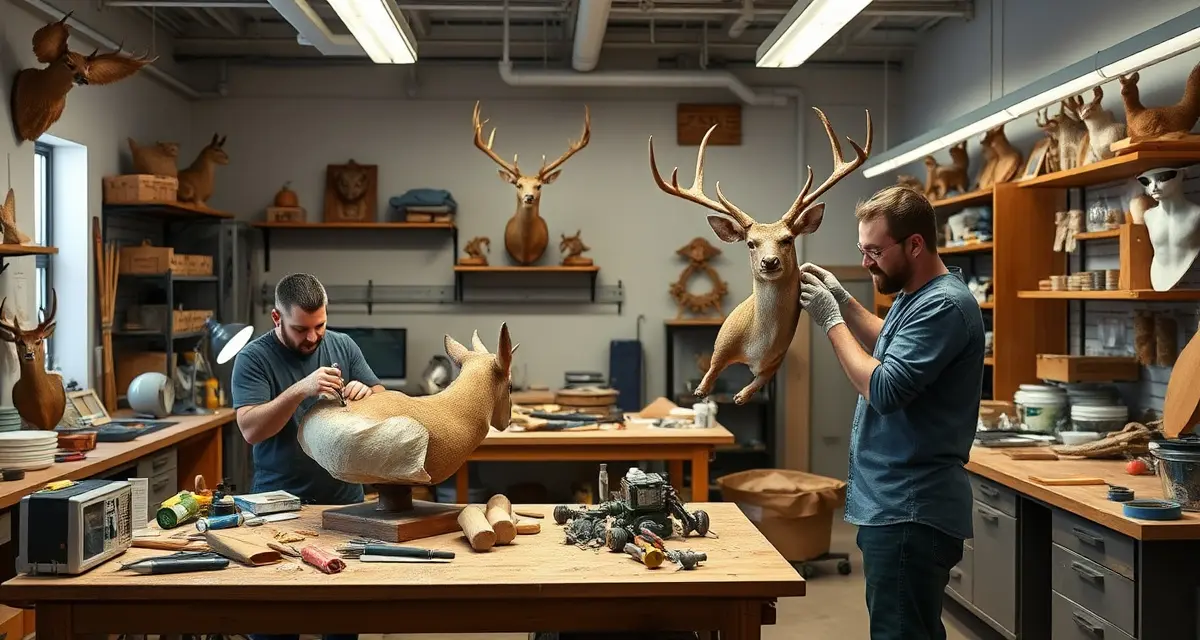
How a Two-Person Taxidermy Shop Uses MountChief Year-Round
Most taxidermy software conversations are about deer season. The rush, the intake volume, the status calls. All real problems worth solving.
But the offseason, February through September, is where a taxidermy shop either builds a sustainable business or falls behind. That's when you're working through the mountain of deer season intakes, managing cash flow, handling waterfowl and spring turkey work, doing African game for hunters back from safari, and trying to find a rhythm before the next October.
Sarah and Jim run a two-person shop in Kansas. They do around 220 mounts per year, primarily whitetail and turkey, with some waterfowl, the occasional elk cape from out-of-state hunters, and a handful of African pieces each year. Both of them are working taxidermists. Sarah handles the bird and fish work; Jim does most of the big game.
Here's how MountChief fits into their year-round operation.
TL;DR
- "The time we save at peak intake alone is worth more than $79 a month.
- check-in reminder message, "Your cape is still at our tannery, on track to return in about 6 weeks", goes out automatically around week 8 for anything still in transit.
- MountChief at $79/month is $948/year.
- They do around 220 mounts per year, primarily whitetail and turkey, with some waterfowl, the occasional elk cape from out-of-state hunters, and a handful of African pieces each year.
- MountChief at $79/month is $948/year. Their previous system: paper, a shared binder, and an Excel spreadsheet they kept irregularly. Cost: essentially zero, but significant time.
- With AI photo intake, they process each deer cape in 3-4 minutes versus the 15-20 it used to take.
The Offseason Problem They Were Trying to Solve
"Our problem wasn't just deer season," Sarah said. "It was that we never had a clear picture of where we were. How many mounts do we have left from last season? What's actually done versus what's in finishing? If someone calls about their mount from October, where is it?"
With a manual system, paper binders organized by season, handwritten job tags, answering those questions required going to the binder, finding the folder, and reading notes that Jim or Sarah had made at various points. If the notes were complete, they could answer. If not, they were guessing.
"We had a situation every spring where a customer called in April, their mount was from the previous November, and neither of us could tell them with confidence exactly where it was in the finishing process. It might be in the staging area. It might be done and we hadn't updated the record. We needed a better system."
How They Use MountChief Through the Full Year
October, November: Peak Intake Season
Intake is the priority. Sarah handles most of the customer-facing intake while Jim keeps production moving.
With AI photo intake, they process each deer cape in 3-4 minutes versus the 15-20 it used to take. During the busiest weekends, that time savings is the difference between staying on schedule and getting buried.
Every customer gets a tracking link via the automated SMS confirmation. By the end of November, most of their active customers are checking the portal rather than calling.
"We explain it at intake: 'We texted you a link, bookmark it, it updates automatically.' The hunters who do this almost never call. The hunters who don't use the link call constantly."
December, January: Tannery Prep and Shipping
The hides that came in November are prepped and salted. They're staged for the tannery shipment. Jim scans every QR tag as hides go into boxes. MountChief generates the packing list. Sarah photographs each box.
They ship two or three tannery loads between December and February, spread out to manage the tannery's schedule. Each load is tracked as a named batch in MountChief.
"In January, Jim can tell me exactly which hides are in which box, which tannery, and when they shipped. Before, that information was on a handwritten list that might be filed in one of three places."
February, April: The Waiting Period and Production Ramp
This is the period when customers start getting anxious. Hides are at the tannery. Nothing visible is happening. Status calls would spike in the old system.
With automated stage updates, most customers already know their hide is at the tannery. The check-in reminder message, "Your cape is still at our tannery, on track to return in about 6 weeks", goes out automatically around week 8 for anything still in transit.
Meanwhile, Jim and Sarah are working through the birds and fish from the previous fall. Turkey fan mounts, duck full-body mounts, fish skin-on work. These go through their own production stages in MountChief.
"The portal is just as useful for bird work as deer work. A guy waiting on his turkey strutter wants to know where it is just as much as the deer guy."
May, July: Tannery Returns and High Volume Production
Tanned hides come back. Each one gets scanned at return, matched to its record, and moved to "Staging" status. Customers receive automated "your cape is back from the tannery" messages.
Sarah and Jim work through their queue systematically. MountChief's queue view shows them everything in each stage, how many are in staging, how many are in active production, how many are in finishing. They use this to plan their weeks.
"Every Monday morning we look at the queue. Here's what's in staging, here's what Jim has actively in production, here's what's in finishing. We can see if we're getting backlogged anywhere."
Progress photos go into MountChief as they work. Customers can see photos of their mount as it develops, forms going in, eyes, habitat positioning. This is especially valued for higher-end pieces where customers have strong opinions about the final look.
"For a $1,200 African piece, the customer wants to see photos. We post them to the job record, they show up in the portal, customer sees them without us having to email anything. Three or four customers this summer specifically mentioned liking that feature."
August, September: Finishing and Pickup Season
This is when Sarah and Jim are completing the bulk of their deer season work from the previous fall. Mounts are finishing, customers are being notified, pickups are being scheduled.
The automated "ready for pickup" message goes out when a job moves to the Pickup stage. Customers can reply to schedule, or they call. Sarah manages pickup scheduling through MountChief's calendar integration.
"Before, we'd have mounts sitting done for weeks because we hadn't gotten around to calling everyone. Now the notification goes automatically when it's ready. Pickups happen faster. That improves cash flow, we collect the balance sooner."
For the handful of mounts that aren't claimed quickly, MountChief's tracking shows exactly how long they've been in the ready stage. No hunt through binders to figure out who hasn't picked up.
Year-Round: African and International Game
About 15-20 pieces per year are African game, mostly whitetail-hunting customers who've been on safari, bringing in leopard, kudu, zebra, warthog, or similar species.
These pieces have longer timelines and more complex documentation requirements. MountChief's compliance documentation fields handle CITES permit photos, import documentation, and country-of-origin records for each job.
"For African work, the documentation requirements are serious. We need to keep CITES paperwork permanently. Having it attached to the digital job record, not in a file folder somewhere, means we can actually find it years later if we need to."
The Cash Flow Angle
One benefit Sarah emphasized that isn't immediately obvious: deposit tracking and accounts receivable.
With a paper system, tracking who still owes a balance required going through every completed job. Some customers pick up without paying, not intentionally, just the chaos of the moment. Following up required finding the record and making a call.
MountChief shows all jobs with outstanding balances in a single report. Sarah runs it every Friday: here are the mounts that are ready with unpaid balances, here are the picked-up mounts with balances still outstanding. She sends a reminder text from within the system.
"We've reduced our uncollected balances significantly. Not because customers are less honest, but because we can actually track it consistently now."
What It Costs Them
MountChief at $79/month is $948/year. Their previous system: paper, a shared binder, and an Excel spreadsheet they kept irregularly. Cost: essentially zero, but significant time.
"The time we save at peak intake alone is worth more than $79 a month. But the year-round organization, the tannery tracking, the compliance documentation, that's all additional value. We're a two-person shop. We can't afford an administrator. The software is kind of our administrator."
Related Articles
- How Much Does a Taxidermy Shop Make Per Year?
- Is Running a Taxidermy Shop Hard?
- What Is a Taxidermy Shop Management Hub?
- What is a QR Tag in Taxidermy Shop Management?
FAQ
Does MountChief help with invoicing and payment collection?
Yes. MountChief includes invoice generation and tracks deposit and balance payments per job. You can see all jobs with outstanding balances, send invoice reminders via SMS or email from within the system, and mark payments received. It doesn't replace accounting software (QuickBooks, etc.) for tax purposes, but it handles the job-level billing tracking.
Can two people use MountChief at the same time?
Yes. MountChief supports multiple users under one shop account. Both Sarah and Jim can be logged in simultaneously from different devices, she might be updating bird jobs from the office while he's scanning a tannery return in the processing area. Changes sync in real time.
How do you handle the offseason volume of non-deer species, does the software adapt?
MountChief works for any species. The intake form adapts based on species selection, birds have different fields than big game, fish have different fields than both. The compliance documentation section prompts for federal duck stamp info on waterfowl, CITES documentation for applicable species. The stage names you use can be configured to match your actual workflow regardless of species.
How does this apply to solo taxidermy shops?
The principles in this guide apply to solo shops just as they do to larger operations, though the scale differs. A single-person shop may have lower absolute volume but faces the same documentation, compliance, and customer communication requirements. The practical advice here scales down to any shop size.
What is the most common mistake taxidermists make with two person shop offseason management?
The most common mistake is treating two person shop offseason management as an afterthought rather than building it into the standard workflow from the start. Shops that encounter problems in this area typically did not establish clear processes before season, which means every situation becomes a one-off decision rather than a standard response.
Try These Free Tools
Put these insights into practice with our free calculators and planners:
Sources
- National Taxidermists Association (NTA)
- US Fish & Wildlife Service
Get Started with MountChief
Pre-season preparation is what separates shops that handle peak volume smoothly from those that fall behind on day one. MountChief's intake, tracking, and communication tools are designed to handle the pace of your busiest weeks. Try MountChief before your next season opener.